Radio is characterized by the 'frequency' and 'modulation' of the transmission. Learn what these are.
Radio is characterized by the “frequency” of the transmission. All radio transmissions are sinusoidal in nature, and the frequency is the number of cycles per second within that waveform. This frequency is measured in “Hertz”. Radio frequencies are normally denoted in Mega-Hertz (MHz) which is a million cycles per second.
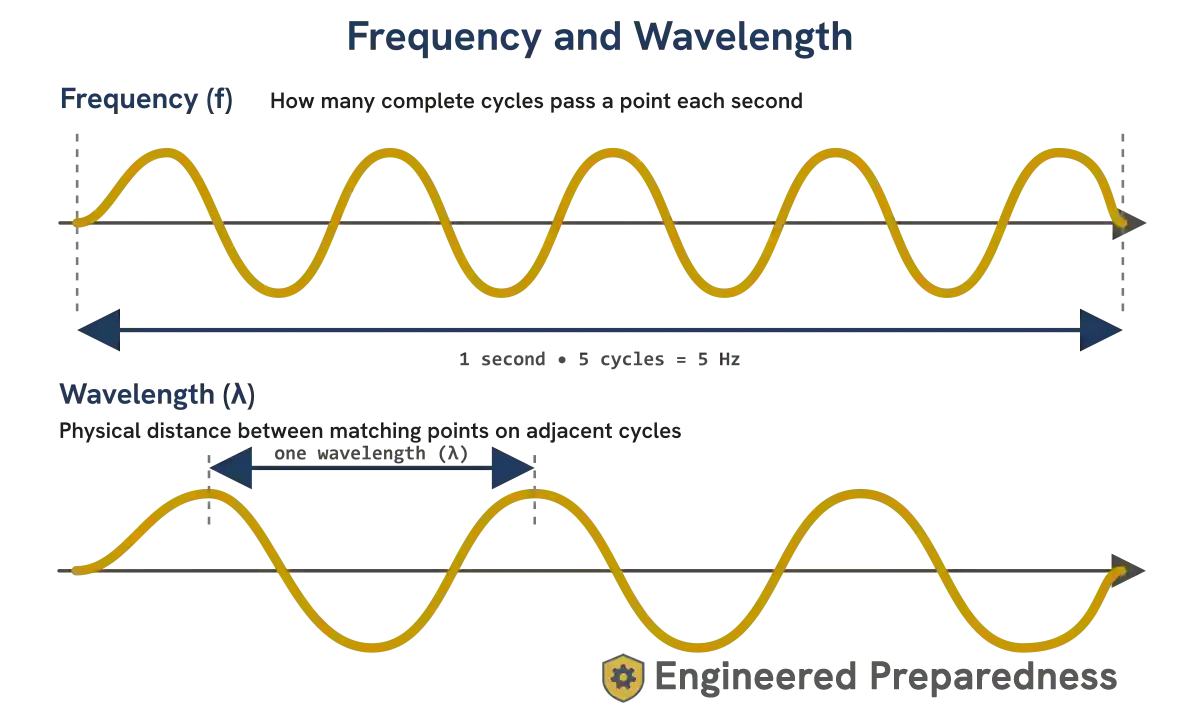
Frequencies are commonly grouped by “family” as transmissions within a family have similar propagation characteristics. These families are:
In order to transmit voice or other data over radio, the transmission must be more than just a single sine wave of a given frequency. To do this, the data is “modulated”. There are three main modulation methods utilized in radio:
| Mode | Description |
|---|---|
| FM | FM stands for Frequency Modulation. In this mode, the various frequencies being transmitted (voice for instance) are encoded as variations in frequency, centered around the frequency you are “using”. By doing this, the “power” of the transmission essentially always stays the same, and as a result, volume is more consistent. But due to this method, it is very sensitive to data being lost, interference, etc. |
| AM | AM Stands for Amplitude Modulation. In this mode, the data being transmitted is added to a carrier signal, varying it’s amplitude as a result. This creates a very simple way of modulating the data, but is inefficient due to the carrier signal. This mode is very resilient to interference, etc. |
| SSB | SSB Stands for Single Sideband. In this mode, it starts just like AM, but then filters out the carrier wave and one “side” of the data. What’s left is a “single” side of the transmission. But interestingly, this one side contains all the data necessary for reconstruction on the other end. And because the carrier and half the data has been stripped out, it is much more efficient to transmit (getting much farther on the same wattage). This modulation has two variants - USB (upper sideband) and LSB (lower sideband), describing which “side” is actually being transmitted. |
Generally, FM is used on UHF and VHF bands and AM & SSB are used on HF Bands.
