Preparedness spends enormous effort on things — beans, bullets, batteries — and almost none on people. That’s backwards. Your supplies behave exactly as expected. People are the single biggest wildcard in any emergency, with the widest range of possible outcomes, and the framework treats them that way: not with a vibe about whether the neighborhood “seems nice,” but with a repeatable process for sorting who’s around you before you ever need to know.
Fair warning — in the book, this is the chapter with the most work in it, and some of it feels frankly creepy. I don’t enjoy digging into people’s lives. But the alternative is meeting the most important variable in your survival for the first time on the worst day of your life. Use only public information, keep whatever you gather confidential, and never do anything illegal to collect it.
The process is five steps
Every person and group you look at runs through the same order of operations:
- Identify — the people and groups near you, or those who could affect your area during an emergency.
- Research — everything you can find, from public sources.
- Record — compile it into a simple dossier so it’s usable later, not a pile of screenshots.
- Categorize — decide which bucket each one falls into (below).
- Map — put every one of them on a map, because a list tells you who and a map tells you where — and where is what matters when you’re deciding whether your zone boundaries are right.
The five categories
This is the distinctive part, and I haven’t seen anyone else lay it out this cleanly:
- Friends & Family — the people you trust to help you, and the ones you expect you’ll need to help. A known quantity, which is exactly why they get their own bucket.
- Help — assets in an emergency: first responders and medical professionals, farmers and gardeners, the people who can build and fix things (carpenters, plumbers, electricians, engineers), former military.
- Hazard — anyone whose likely behavior hinders a response or exploits the situation. The defining trait here is behavior, not group identity: the person whose actual plan is to take from others when the rules go quiet. Judge the conduct you can reasonably expect, not the label.
- Complicate — people with a major effect on how things play out, who might help in one scenario and hinder in another: government officials and emergency-management staff, law enforcement, media influencers, state or federal assets operating locally, HOA leaders.
- Unknown — the honest bucket. Always try for one of the first four, but some people you simply can’t learn enough about, and pretending otherwise is worse than admitting it.
Color-code and map them
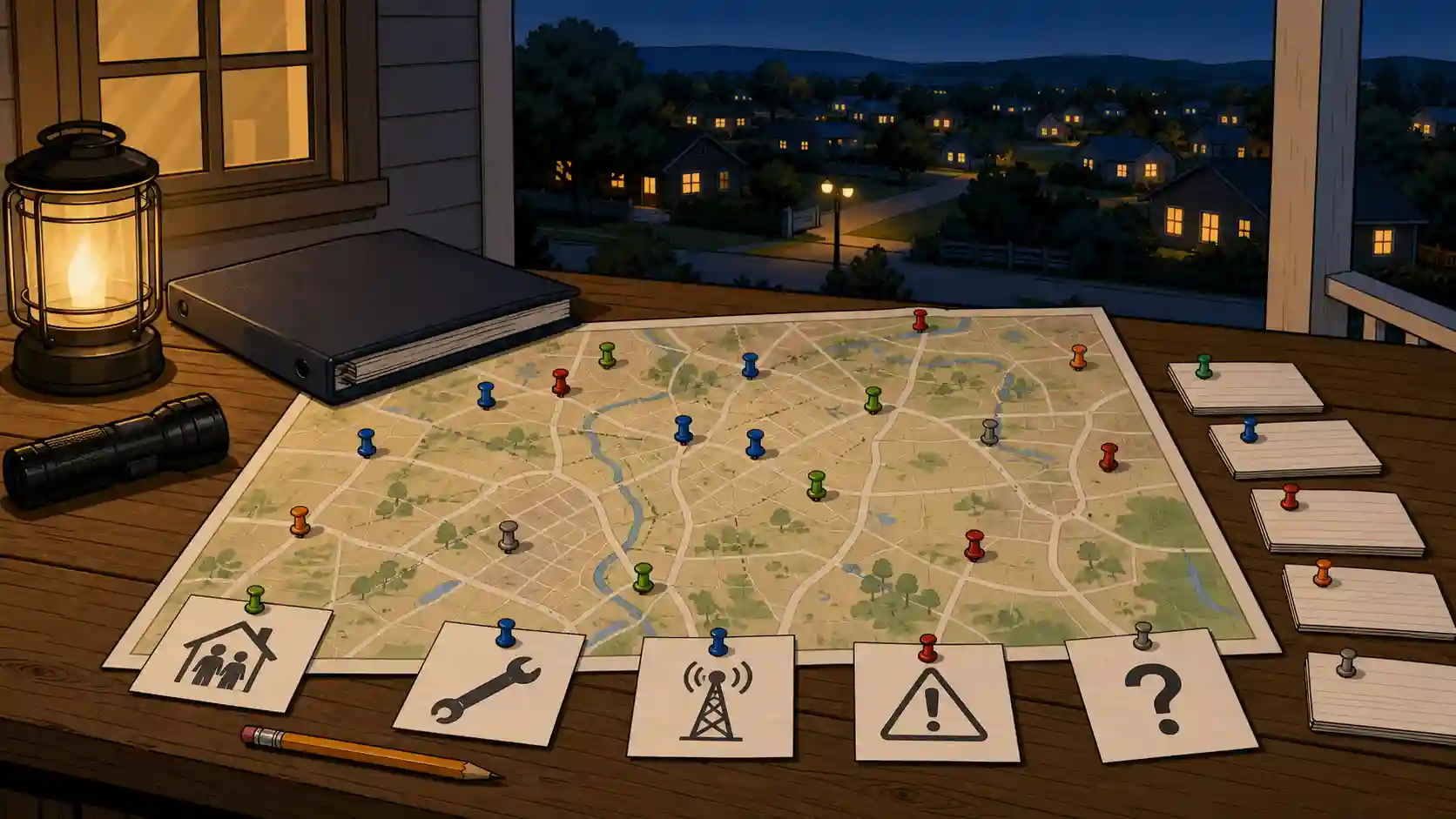
Categories are only half of it. Give each one a color — the book uses green (Friends & Family), blue (Help), red (Hazard), orange (Complicate), gray (Unknown) — and put a colored, numbered marker on every place you identified. Yes, it may be a couple hundred markers, and yes, it takes time. The payoff is that the neighborhood stops being a feeling and becomes a picture you can actually read.
And then read it. The map isn’t a someday-reference — it has immediate analytical value. Look at the clusters and ask two questions: do you need to move any of your zone boundaries, and do any of these places create a threat you have to plan around?
If you map your people and find yourself ringed by red and orange, you’ve just learned something important — and the cleanest fix is to move. If you can’t, plan hard to mitigate the problems those neighbors are likely to create.
Don’t forget groups, leaders, and the mundane relationships
Individuals aren’t the whole picture. Groups — governments, law enforcement, National Guard, churches, media, militias, activist organizations — can act as a single entity and swing a whole situation, so research their location, size, leadership, capabilities, and likely effect. Pay special attention to groups already organized around a cause; people who are already mobilized tend to stay mobilized. For the key players — mayor, council, county commissioner, police chief and sheriff, emergency-management staff — learn enough about how they see the world to predict how they’ll act before the situation arises.
One note the book makes here that’s worth repeating: you be the influence. Those decision-making seats are open to you. If you want a say in how your area handles a crisis, run for one.
Last: search yourself
When you see how much is publicly available about other people, turn the lens around. Search yourself and everyone in your household the same way you searched the neighborhood, and see what’s out there. If it’s more than you’re comfortable with, that’s a gap in your own security worth closing. There are online services that help you close this gap. I’m using one but I’m not ready to endorse them yet - time will tell.
Bottom Line
You will not get to choose your neighbors during an emergency. Knowing which is which beforehand is free, and it’s the highest-leverage research you can do.
- Run the five steps — identify, research, record, categorize, map — on your AO first, then work outward.
- Sort by behavior, not label — especially for the Hazard category. The question is what someone will do.
- Read the map. A wall of red dots is a finding. Act on it — ideally with distance, otherwise with a plan.