Two households buy the same gear according to the same checklist. One is in a river valley two miles downwind of a chemical plant, with a city of 400,000 15 minutes away. The other is thirty miles up a gravel road in a county with nothing worth driving to. Same kit. Completely different odds.
That’s the flaw in every generic preparedness list ever written: it doesn’t know where you live. And where you live is the single largest input to what you should be preparing for.
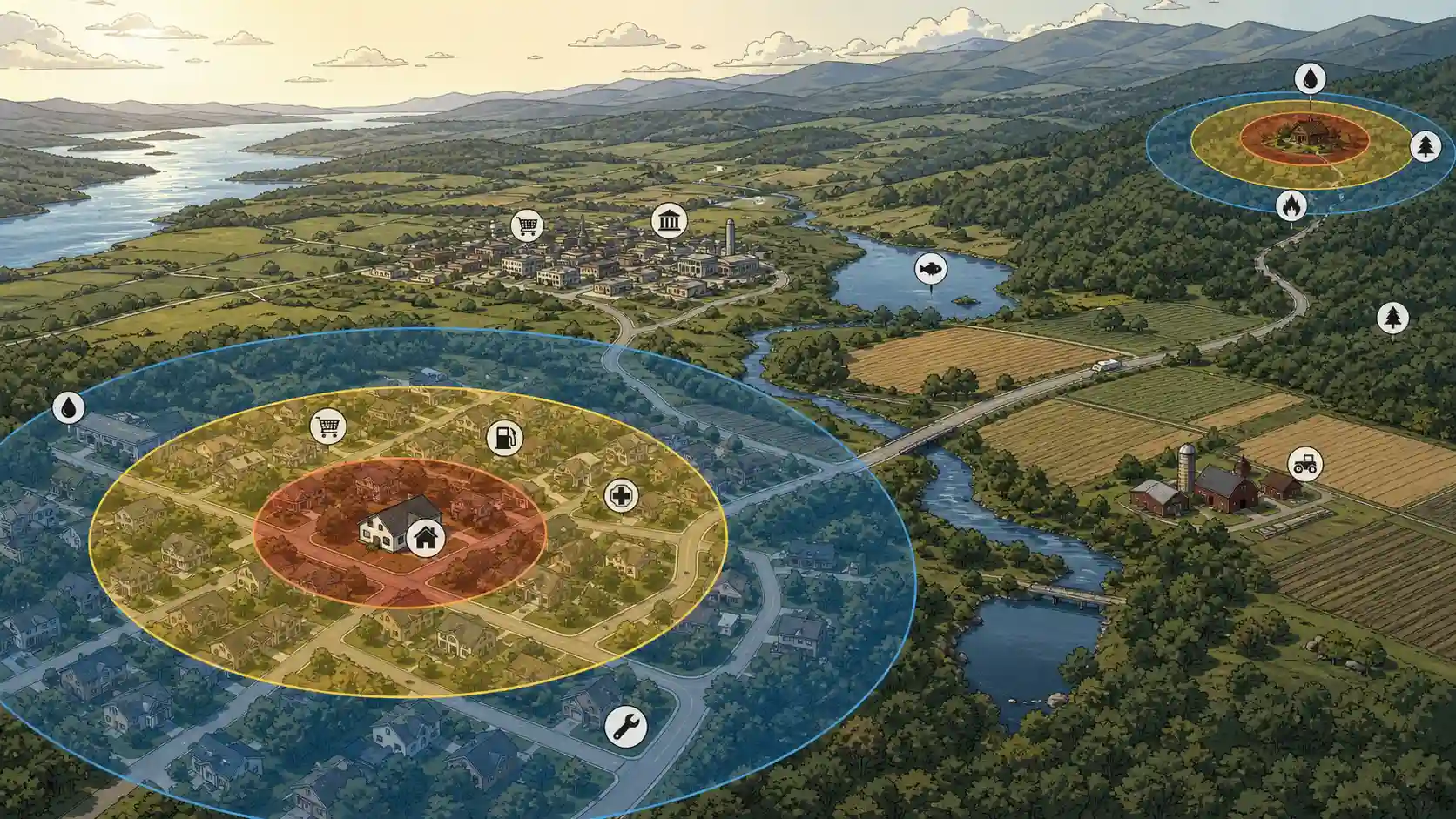
So before you buy anything else, do the first real task of the framework — draw your zones. There are three:
- Area of Operation (AO)
- Area of Interest (AI)
- Area of Awareness (AA)
Mark them on an actual map and put it in your binder. A visual representation of these areas is genuinely helpful, and it becomes essential in later steps.
Area of Operation (AO)
This is the area immediately surrounding your home, retreat, or wherever you intend to ride things out. It gets the most focus because it has the largest direct effect on your preparations.
In military circles, the AO is the ground you’re actively controlling, guarding and patrolling. In a major emergency, it’s the same idea for you: this is the ground you’re responsible for.
When setting the boundary, keep these in mind:
- Ensure the area provides a buffer around you on all sides. Your house shouldn’t be on the edge of it.
- Include the neighbors or other people you expect mutual assistance with. If you’re counting on them, they’re inside.
- Ensure key gardening areas, water, fuel and supplies aren’t along the perimeter. Anything on the boundary is the first thing you lose.
- Ask how you’d restrict or limit people coming in and out of the area.
- Ask how you’d defend it in a worst-case scenario.
That last pair of questions does most of the work. Most people discover their AO has multiple roads into it, no way to see any of them, and the garden sitting on the property line.
Area of Interest (AI)
This is the ring immediately surrounding your AO. The military treats their equivalent as a buffer they monitor for incoming threats. That applies to you too — but for preppers it can’t be only that, because this is also where you go to get groceries and take your kids to soccer.
So the AI has two roles at once:
- Outside the AO, this is where you and the people you care about spend 99% of your time.
- It’s the region containing the threats that most directly impact your AO, or can reach it the quickest.
Setting the boundary:
- Include all the key places you regularly spend time — work, school, family, friends.
- Include others you might use for mutual assistance in an emergency.
- Keep it as small as possible while still containing the above and giving your AO a buffer. Ideally your AO sits in the middle of your AI.
- Ideally, it should have one contiguous border. If your work is far away from everything else, it may make sense to not include all the area between, but you need to plan for this accordingly.
The “as small as possible” rule matters. The AI isn’t a wish list of places you like. It’s the set of ground you’d have to physically cross, defend, or retrieve someone from. Every mile you add is work you’re signing up for.
Area of Awareness (AA)
The last zone is a larger region surrounding your AI. Here we’re using it more like the military uses their AI — as a pure buffer. So set it based on the geography and population centers around you.
For my area, a radius of roughly 250 miles from my AO works well. Your mileage may vary, and it should — the point isn’t the number, it’s the coverage.
The key is to make it big enough to capture any and every threat that could be generated out there and still reach your AO. If there’s a military base close enough to affect you in any way, it belongs inside your AA. Same for the nuclear plant, the refinery, the dam, the fault line, and the metro area whose population becomes everybody’s problem when it empties out.
You’re not defending your AA. You’re watching it — so nothing arrives that you never knew existed.
Do it on a real map
You can do this with a paper map and a marker, and that’s a perfectly good answer — it works when the power’s out, which is more than most tools can say.
If you’d rather do it with technology, Area Recon is built for exactly this task. Set your home, draw the AO, AI and AA, and then turn on the layers that tell you what’s actually inside them — power plants and substations, rail, ports, airports, bridges, hazards, natural resources and community features. Drop pins for the people, resources and threats you find, and map your routes. Then print it for the binder, because a map on a screen is a map you can lose.
The layers are the point. You’d be surprised how much sits inside your AA that you’ve driven past a thousand times without ever putting it on a list.
Baseline, then refine
You need these zones established to do the next steps. But I guarantee that as you do those steps, you’ll realize you missed things and need to tweak the boundaries.
Don’t worry about that. It’s part of the process. Get things as close as you can now, refine as you go, and then do it all again.
Preparedness isn’t a straight line. It’s a loop you tighten.
Something to consider
There’s one more thing you need to think about, and you’re not going to like the answer.
What do you do if you realize there are major problems inside your AO or AI?
Unfortunately: you may need to move.
There’s an old adage in business — location, location, location — meaning location is the most important characteristic of real estate. There are a lot of good reasons to make the same argument about preparedness. If you’re trying to bug in from a crime-ridden neighborhood of a major city that happens to be surrounded by a volcano, a hazardous chemical plant, and a base housing nuclear weapons and you have a meth lab next door, I think you’d agree the location isn’t wise from a preparedness standpoint.
No location is perfect. Mine isn’t. But as you work through these exercises you’ll see how much your location truly drives both your preparedness needs and your survivability in a major event. Your address is a bigger prep than anything you can put in a cart, and it’s the one most people never reconsider.
If you do end up needing to move, the good news is that this same process shows you exactly what to look for in the new place.
Bottom Line
Three zones, drawn honestly, turn preparedness from a generic checklist into your checklist.
- AO — the ground you’re responsible for. Buffer on all sides, mutual-aid neighbors inside, nothing critical on the perimeter.
- AI — where you actually live your life, plus the threats that can reach your AO fastest. Keep it tight.
- AA — everything far enough out to still hurt you. Watch it; don’t try to hold it.
Do it this weekend. Get a map, draw the rings, and list what’s inside each one. You’ll be surprised by what you find when you really look.