


The most common question a new radio owner asks is “how far will this reach?” — and it’s almost always the wrong question, because the honest answer is it depends on things that aren’t the radio. The same handheld can reach two miles or, on a different band at a different hour, two thousand. People who don’t know that go shopping for watts, buy a bigger radio, and are baffled when the range barely changes.
Range is set by physics you don’t purchase: the band you’re on, the time of day, the terrain between you and the other station, and how you hang the antenna. Understand those four and you can predict your reach before you key up. Ignore them and you’re guessing, expensively.
Line of sight
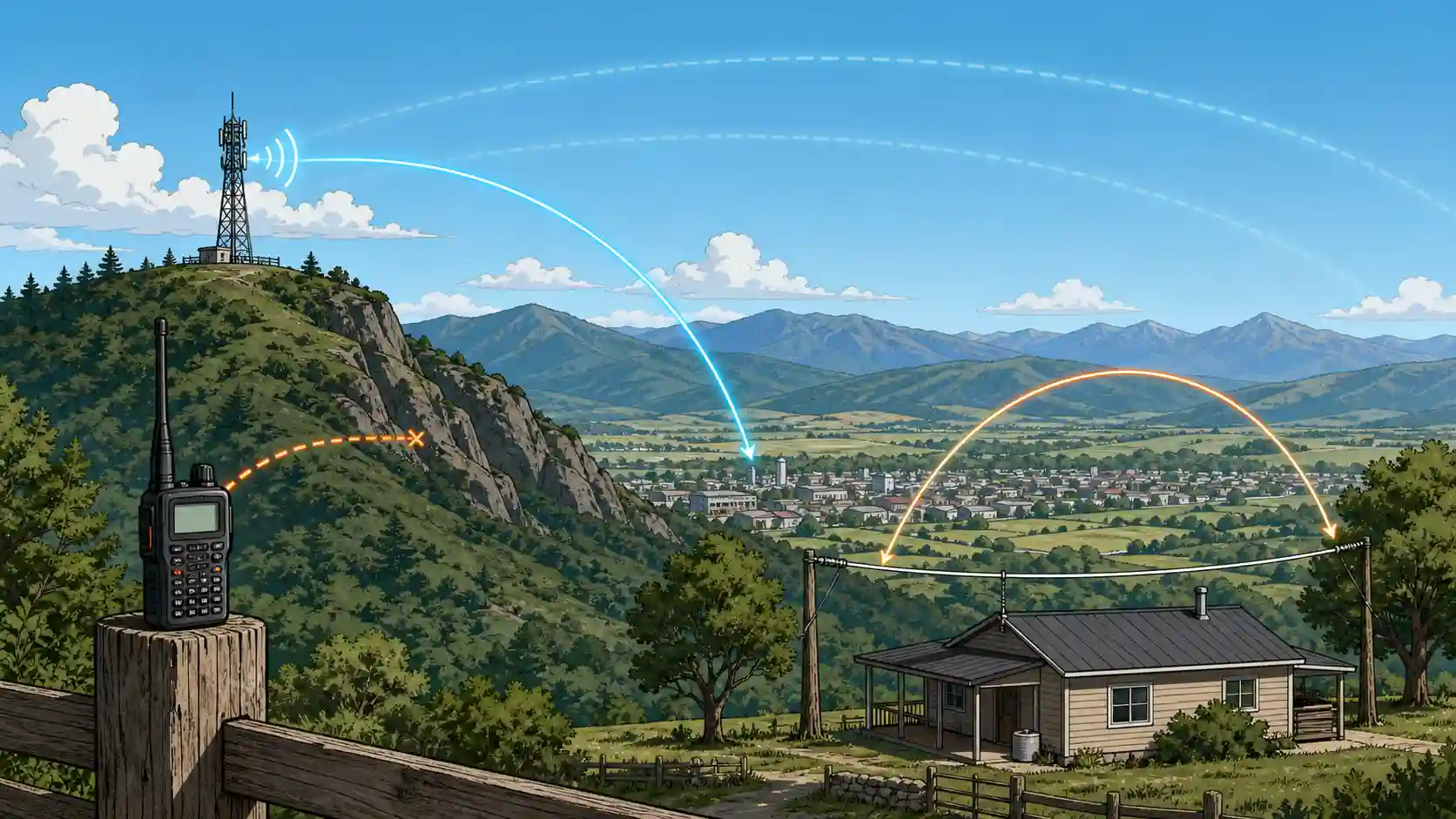
All radio is essentially line-of-sight. Radio waves can be bounced, and we’ll get there in a minute. But it’s critical to always think of radio being line of sight. This means if two people with radios can see one another, then they can talk. You’re probably thinking that if we can see each other, then we don’t need radios. This may be true if we’re talking about two sides of a street. If we’re talking about between two mountain peaks, then it’s a whole different story - line of sight becomes great distances.
Due to the curvature of the earth, a person can only see about 6 miles on “flat” ground. This creates a pretty reliable max range for handheld-to-handheld communication. I know the bubble pack radios you bought at Wal-Mart advertised 35 mile range, but I’m here to tell you that you’re not going to get that unless you’re both on mountain peaks.
Keep in mind that line of sight is affected by any object in between - it doesn’t have to be the earth. If there are buildings or trees, they greatly diminish the effective range as well.
VHF and UHF
We’ll start at the high end of the radio spectrum, with the VHF (very high frequency) and UHF (ultra high frequency) bands. The most common radios fall into these two bands:
- VHF - 30 MHz to 300 MHz. - Multi-Use Radio Service (MURS), 2-meter ham band
- UHF - 300 MHz to 3 GHz - FRS/GMRS family radios, 70-centimeter ham band
Between the two, there’s a useful nuance: UHF (higher frequency) slips through clutter — buildings, woods, urban sprawl — a bit better, while VHF (lower) tends to reach a little farther in the open. Neither bends over a ridge.
That “can’t see over the hill” problem is exactly why repeaters exist. A repeater sits up high, hears you, and re-transmits — getting your signal over the terrain you couldn’t cross on your own. It’s the single biggest range multiplier available on these bands, which is why knowing the repeaters that cover your area is worth more than another watt of power.
Groundwave — HF, close in
Drop down to the HF bands (3 to 30 MHz - also known as shortwave) and a second mode of travel appears: groundwave, where the signal actually hugs the curve of the earth and follows the ground outward. This gives you reliable local-to-regional reach that the line-of-sight bands can’t — very roughly a couple hundred miles on the lower HF bands, tapering as you go up in frequency. It’s how you cover the county and the next county over without a repeater in between.
Skywave and the skip zone — HF, far
HF has a second trick, and it’s the spectacular one: skywave. Aim the signal upward just above the horizon and the ionosphere can reflect it back to earth hundreds or thousands of miles away — coast to coast, or around the planet, at the right hour. This is how a 5 watt HF station talks to the other side of the world.
But skywave creates a problem that trips up every beginner: the skip zone. Groundwave fades out at a couple hundred miles; the first skywave hop might not come back down until several hundred miles out. In between is a dead ring where you can’t be heard at all — too far for groundwave, too close for skip. Which produces the deeply counterintuitive truth of HF: sometimes the station a thousand miles away is easy and the one 250 miles away is impossible. Farther can be easier than medium.
NVIS — filling the gap
That regional dead zone is exactly the distance a prepared family most needs — the next few counties, the region you’d actually coordinate across. There’s a technique built to fill it: NVIS, Near-Vertical Incidence Skywave.
The idea is simple. Lower a horizontal wire antenna close to the ground and it stops firing outward and starts firing nearly straight up. The signal goes up, the ionosphere reflects it, and it rains back down over a circle roughly 30 to 300 miles around you — precisely the gap groundwave and normal skywave both miss. It’s the quiet secret of regional HF, and most people have never heard of it.
Two honest caveats. Lowering the antenna makes it less efficient, so you trade some strength for that coverage. And it only works with horizontal wire antennas (dipoles, end-fed wires) — you can’t NVIS a vertical whip, because of how a vertical interacts with the ground.
Time of day changes everything
One more variable, and it’s a big one: the same frequency behaves completely differently at noon and at midnight. The ionosphere is charged by the sun, so the higher HF bands tend to open for long-haul work in the daylight and close after dark, while the lower bands come alive at night and can carry astonishing distances. A band that’s dead at 2 p.m. can reach across the country at 2 a.m.
The practical upshot: pick the band for the time as well as the distance, and don’t expect consistency. Stop being surprised that last night’s easy contact is gone this afternoon — that’s the ionosphere doing exactly what it does.
Bottom Line
Retire the question “how far does this radio go?” It has no single answer. Ask the four questions that actually determine it:
- What band? Line-of-sight VHF/UHF for local; HF for regional and beyond.
- What time of day? HF long-haul is a day/night decision.
- What antenna, hung how? A repeater or an NVIS wire can beat raw power by a mile — literally.
- What terrain? On the line-of-sight bands, the hill between you decides more than the radio does.
Same radio, four different answers. Once you can predict which answer you’ll get, you can plan around it — choosing the band and technique that covers the distance you actually have to reach, instead of buying watts and hoping.
A one-page band plan with typical reach per band lives on the Field Reference deck, and the PACE builder is where you commit which band covers each distance in your plan.