


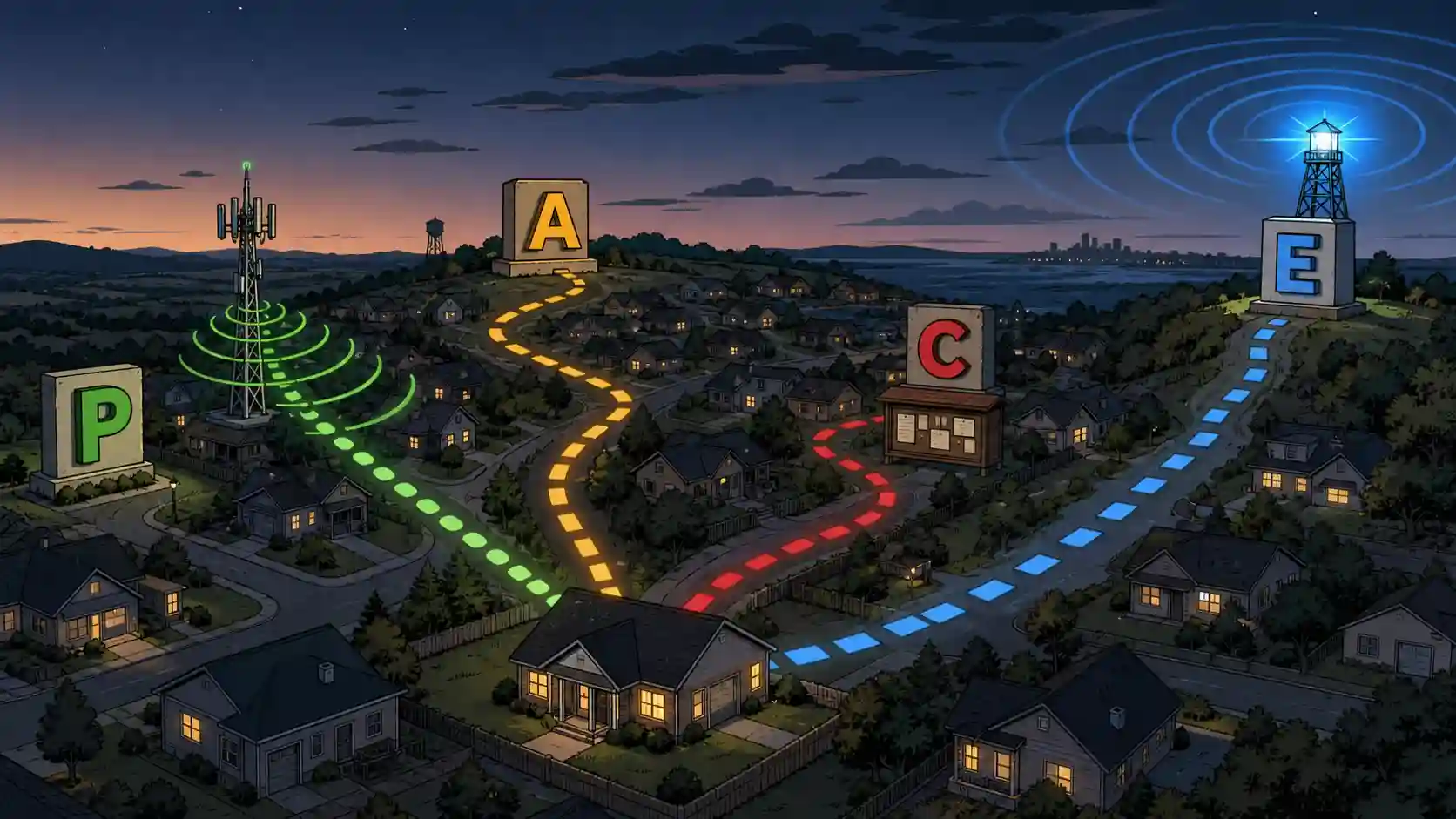
Ask most people how they’d reach their family in an emergency and you’ll get one answer: a cell phone. Ask what happens if that doesn’t work and you’ll usually get a pause, and then a worse answer — “I’d text them.” That’s not a second plan. That’s the same plan, wearing a hat.
The military solved this problem a long time ago, and the solution is simple enough to write on an index card. It’s called PACE: Primary, Alternate, Contingency, Emergency. Four ways to pass a message, ranked, agreed on in advance, so that nobody has to improvise when the first one dies.
The four rungs
The order isn’t a preference. It’s a sequence you fall down as things break.
- Primary — what you use every day. Fast, easy, everyone already knows how. The cell phone, for most families.
- Alternate — a different method that does the same job nearly as well. You switch to it without much loss.
- Contingency — slower, clumsier, and you’d never choose it on a normal day. But it works when the first two don’t.
- Emergency — the last resort. Slow, limited, maybe one-way. It exists to answer one question: are you alive and where are you?
Each rung should be a step down in convenience and a step up in independence. If your Emergency method depends on the same wire your Primary does, you don’t have four plans. You have one.
The rule that makes it work
Here’s where most PACE plans fall apart, and it’s an engineering problem, not a radio problem.
A PACE plan where every rung shares a failure mode is one rung. Cell call, cell text, cell data, and a messaging app are not P-A-C-E — they’re four features of the same tower. Even if you argue that you can use cell towers or WiFi, you’re still relying on the same digital device — and it can be lost, damaged or have a dead battery — showing your plan only has one rung…
The point of the ladder isn’t to have four options. It’s to have four independent options. Before you write one down, ask what each method actually needs to function:
- Cell phone — a working phone, towers, backhaul, and commercial power (most tower batteries last hours, not days).
- Land-line — the old copper kind carries its own power and has survived events that took cell down. The modern “land-line” from your cable company does not; it dies with your internet.
- Internet / messaging apps — your provider, their backbone path, and power at both ends.
- GMRS or ham radio — a licensed operator and batteries. Simplex works with no infrastructure at all; a repeater makes it reach further but is one more thing that can fail.
- A physical rally point or message drop location — needs nothing. It cannot be jammed, congested, or powered down. It’s slow and it’s the most reliable thing on this list.
Score your four rungs against that list. If “commercial power” appears in all four, fix it before you buy anything.
This is the same principle from the framework’s Redundancy discussion — two is one and one is none — applied honestly. Redundancy that shares a single point of failure isn’t redundancy. It’s a second copy of the same risk.
Receiving is half the job
PACE gets discussed as though it’s only about talking to people. It isn’t. Most of what you need in an emergency is information, and receiving it takes no license, no permission, and almost no money.
The book The Ultimate Preparedness Framework™‘s Zone Research chapter builds this out in detail; the short version is that you should know, in advance, what you can hear from where you sit:
- NOAA weather radio — seven FM frequencies, transmitting continuously. Know which station covers you and its frequency, and just as important — where it transmits from.
- AM radio — arguably the best official information source there is. Map the stations within 300 miles, then the 50,000-watt stations within about 1,000 miles. Many of those are part of the federal Emergency Alert System. At night, under the right conditions, the big ones carry for thousands of miles.
- Shortwave — a receiver and some patience gets you information from the other side of the planet after dark.
- A scanner — your local police, fire, and ambulance frequencies are a wealth of information during an emergency.
Write down the pertinent details for each: distance, callsign, band, frequency, mode, power, format. Do it now, while looking things up is easy.
There’s a second use for all of this that’s easy to miss. Suppose you can normally hear a handful of stations from outside your area. Then there’s a disaster, and those stations are gone. The absence of data just told you something — they were affected too, and probably badly. You learned that without hearing a word.
Build yours in ten minutes
Don’t overthink the first draft. A plan that exists beats a better plan you never wrote.
- Establish your PACE plan, and check them against the failure-mode list. Cell → land-line or a second carrier → GMRS on an agreed channel → rally point at a fixed time.
- Agree on the trigger. Everyone needs to know when to drop to the next rung. “If you can’t reach me by two attempts, go to the radio at the top of the hour” is a trigger. “If things get bad” is not.
- Set times, not just methods. Radios can’t be monitored constantly. A five-minute listening window at the top of each hour saves batteries and guarantees the other person is there.
- Write it down and put a copy in every wallet, bag, and vehicle. Your phone holding the only copy of the plan for when your phone doesn’t work is exactly the mistake PACE exists to prevent.
- Test it. An untested plan is a guess. Try the radios from the actual places you’d use them — houses, hills, obstructions and distance all vote.
Keep it short enough that a stressed sixth-grader can follow it, because that’s roughly who’s reading it when it matters.
Bottom Line
PACE isn’t a radio thing or a military thing. It’s a discipline for making sure the message gets through when the easy way stops working.
- Four methods, ranked, agreed in advance. Not four apps.
- Independence is the whole point. Shared failure modes collapse the ladder to a single rung.
- Write it down, carry it, and test it. The plan lives on paper, not on the network it’s meant to survive.
Most people never make it past Primary. Getting to Alternate puts you ahead of nearly everyone; getting to Emergency means your family can find each other with no infrastructure at all. That’s the goal — not a radio collection.
The Communications & Info inventory tracks the gear each rung needs, and Area Recon maps the cell and broadcast towers you’d actually be relying on.