


Here’s a fact that stops a lot of people from ever getting on the air, and it’s true: in a genuine life-safety emergency, US law lets you use any frequency and any mode you need to get help. No license required, no rule broken. So in the one moment that supposedly matters most, the license is irrelevant.
People hear that and conclude they can skip the license entirely — buy a radio, throw it in a drawer, and call it preparedness. That’s exactly the wrong lesson, and it comes from misunderstanding what the license is actually for.
The license buys practice, not permission
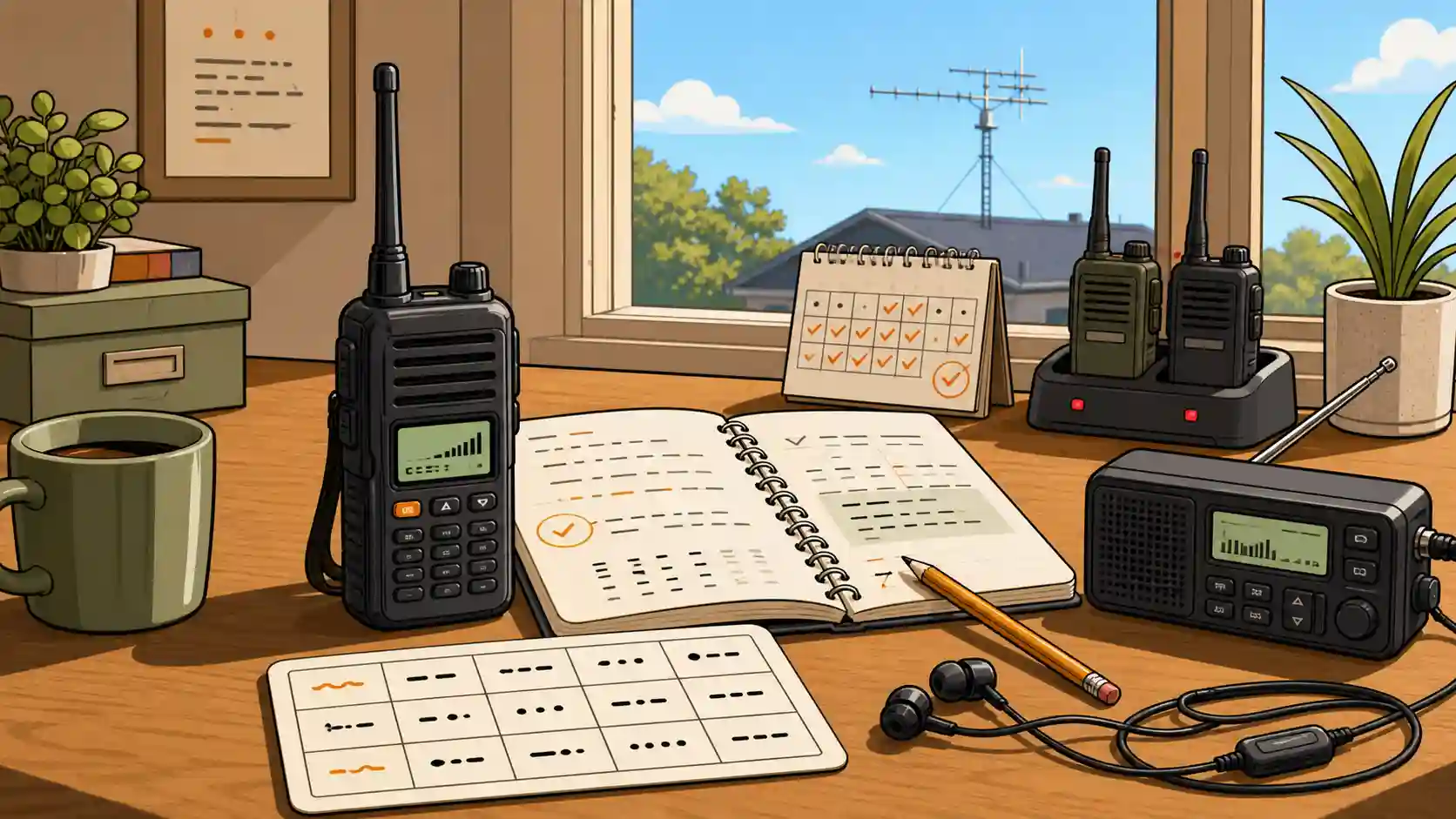
The license was never permission to save your life — the law already grants you that. The license is permission to practice, legally, on every other day. And practice is the whole game, because a radio you have never used is not a communication plan. It’s a paperweight with an antenna.
Knowledge without practice is close to useless in an emergency. Under stress, you don’t rise to the occasion — you fall to your level of training. The person who has actually keyed up, made contacts, fumbled the squelch, learned which repeater reaches their area, and worked out that their handheld is deaf inside the house — that person has a working skill. The person with an identical radio still in the blister pack has a prop. Same hardware, completely different outcome, and the only difference is the hundred boring transmissions in between.
So get the license, and then use it, for the same reason you’d dry-fire a pistol or run a fire drill: so the motions are already in your hands when it counts.
The ladder, cheapest first
You don’t have to leap straight to a hard exam. There’s a ladder, and every rung adds real capability:
- Just buy a radio and listen. You can legally receive almost anything with no license at all — NOAA weather, AM/FM and shortwave broadcasts, a scanner on local public-safety, HF on a receiver. Receiving is fully half of emergency communications, it needs nobody’s permission, and it’s where I’d tell anyone to start. Information you can’t act on beats no information; information is the point.
- GMRS — a single family license covers your entire household for ten years, with no test — you just request it from the FCC and pay the fee. It’s the lowest-friction way to legally transmit for family and neighborhood coordination, and the radios are cheap and simple.
- Amateur (ham) — three license classes, earned by exam: Technician, then General, then Amateur Extra. One modest fee covers the testing session, the license lasts ten years, and it renews with no retest. Technician alone unlocks enormous local and regional capability; General opens the HF bands and with them the regional and cross-country reach that nothing else on this list can touch.
(You may meet older operators holding Advanced or Novice class licenses — those still exist but are no longer issued. Don’t worry about them.)
Which rung is yours?
Match the license to what you actually need to reach:
- You want your family and close neighbors coordinated when the phones are down. GMRS. One license, whole household, no test. Done in an afternoon.
- You want to gather information from your region and beyond, or reach past the horizon. Ham — and aim for at least General so HF is open to you. Start studying for Technician; the material is the on-ramp and the free study apps make it painless.
- You’re not sure yet. Buy a capable receive-capable radio and start listening today, under no license at all. It costs you nothing in permissions, it teaches you the landscape, and it makes the license decision obvious once you see what you’re missing.
The exams are more approachable than their reputation. The question pools are public, free apps drill you against the exact questions, and volunteer clubs run the testing sessions cheaply and welcome beginners. Most people who dread it pass Technician after a weekend of study and wonder what they were worried about.
Bottom Line
Don’t let “the license doesn’t matter in an emergency” talk you out of the thing that actually saves you.
- Start listening now. No license, immediate value, and it teaches you the terrain.
- Get GMRS for the family. No test, ten years, whole household — the best effort-to-payoff ratio in preparedness comms.
- Climb to ham if you need reach. Technician to start, General for HF. The exam is the on-ramp to the practice, and the practice is the point.
The emergency will never ask to see your license. What it will demand is that you already know how to work the radio — and that skill is bought with the ordinary, licensed hours you put in long before the bad day. Get the license for those hours.
Ready to put it to work? The Field Reference deck has the band plan, Q-codes, and phonetics on printable cards, and the PACE builder turns your radios into an actual household plan.