


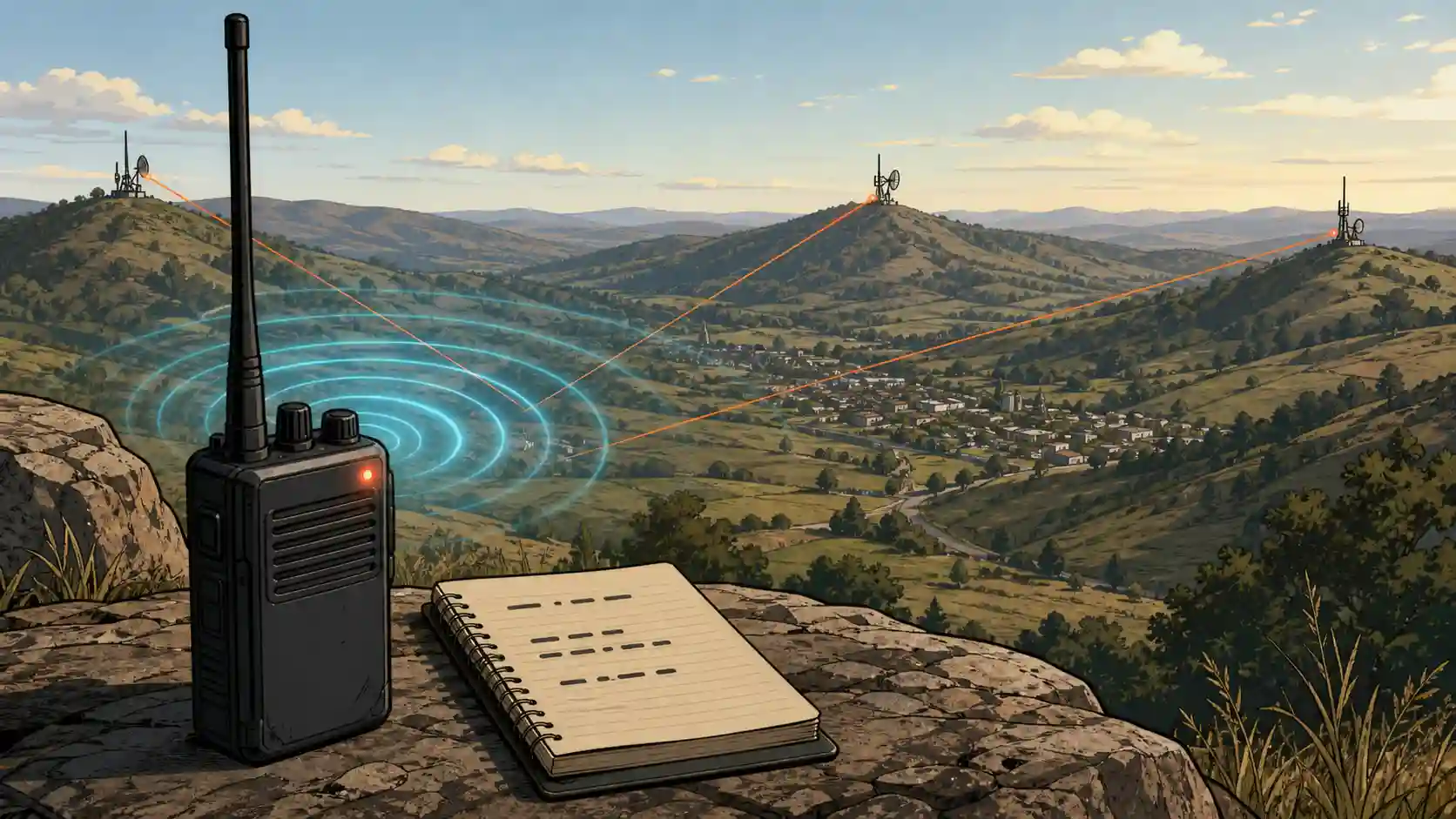
New radio operators reach for privacy almost immediately, and they reach for the wrong thing. They set a “privacy tone,” maybe invent a little code with the family, and feel covered. They are not covered. A privacy tone is not privacy, a homemade code is thin (and usually illegal), and neither addresses the real problem — which isn’t that someone might understand your words. It’s that the transmission itself announces you.
Get this straight up front, because everything else follows from it: radio is not, and cannot be made, private in the way people assume. Once you accept that, you stop trying to hide and start doing the thing that actually works — being disciplined about when and how you transmit at all.
Two assumptions to make about every transmission
Before you key the mic, assume both of these are true, every time:
- Everything you say is being heard by someone you didn’t expect and don’t want.
- Everything you say is being recorded and will be analyzed.
They cost you nothing to assume and they change how you talk — shorter, plainer, less. If those assumptions feel paranoid on a normal day, good; the habit is free now and priceless later, and habits don’t install themselves in the middle of an emergency.
Privacy tones are not encryption
This is the single most common misunderstanding in radio, so let’s be very clear.
A CTCSS or “PL” tone is a sub-audible signal your radio sends along with your voice. Its only job is to keep your radio quiet unless it hears the matching tone come back. It lets several groups share one channel without hearing each other. That’s useful — it’s not protection.
Here’s the proof: anyone listening on that frequency with no tone set at all hears every word you say, from every group, tone or not. The tone filters what your speaker plays. It does nothing to what leaves your antenna. Call them “privacy tones” if you like, but never believe the name.
Obfuscation is typically illegal
There’s an interesting thing about most radio law in the US that many aren’t aware of - you can’t obfuscate what you say. This means using “code words” or other ways to manually “encrypt” your communications is illegal, as is direct encryption of the signal.
Prohibited uses: No person shall use a Personal Radio Service station: (f) To transmit a false or deceptive communication.
- Code of Federal Regulations § 95.333
Prohibited transmissions: (a) No amateur station shall transmit: (4) messages encoded for the purpose of obscuring their meaning or false or deceptive messages, signals or identification.
- Code of Federal Regulations § 97.113
“Personal Radio Services” includes all the free bands (FRS, GMRS, CB and MURS). “Amateur station” is referring to what’s commonly called “Ham Radio”. This means that you can’t encrypt or use code words or other techniques to change the meaning of a transmission on any of these bands — period, no exceptions. It’s also required that Ham radio operators periodically identify themselves via FCC-granted call-sign, which would render encryption or obfuscation pointless.
Some say that the “emergency” exemptions get around these rules. It’s true that during an emergency, licensing, etc. doesn’t apply - you can do what you need to do to get help, etc. in an emergency. This doesn’t apply to encryption or obfuscation as it’s not required to save life or property. It’s just something you want to do.
There are two radio types that do allow encryption:
- Meshtastic (including Meshcore and Reticulum)
- Business band radio
It’s beyond the scope of this article to delve into these two options, but I did want to include them for general awareness.
The part even encryption doesn’t solve
Say you did everything right — you’re on a band and mode where strong encryption is legal, and your message is unreadable to anyone without the key. You’re still not hidden, and this is the point that reframes the whole topic.
When you transmit, you raise a sign that says I am here. Anyone with the knowledge and the equipment — which every government and a great many serious hobbyists have — can take a bearing on your signal, take another from a second spot, and cross them on a map. That’s direction finding, and it’s old, cheap, and reliable. Encryption hides the content of the message. It does nothing about the beacon that carried it.
So the security of radio isn’t a gear problem you can buy your way out of. It’s a behavior problem. The question is never “how do I make this unbreakable?” It’s “how do I keep from lighting myself up in the first place?”
Match your emissions to the threat
The military has a discipline for exactly this — controlling emissions according to the threat level. It scales cleanly to a prepared civilian, and it’s the actionable core of this whole article. Four conditions, each tightening what you’re willing to put on the air:
- 1 — Routine. Any and all transmissions authorized. This is normal use in a permissive environment — most of the time, for most people.
- 2 — Essential. Mission-critical and emergency traffic only; radios off except when actually in use. This is the sensible default once things have gotten serious.
- 3 — Silence. No voice at all — short digital or burst transmissions only, on scheduled windows, using techniques (like low NVIS antennas) that make you harder to locate. This is for when someone is actively listening and it matters.
- 4 — Blackout. Everything off, batteries out. Rare for a civilian — but real under occupation, or when active collection is overhead.
You will spend nearly all your time at Condition 1. The value of the ladder is knowing the other rungs exist before you need them, so that “go quiet” is a plan you already have rather than a panic you improvise.
Bottom Line
You cannot make radio private. You can make yourself boring, brief, and hard to find — and that’s the security that actually holds up.
- Assume you’re heard and recorded. Let that shorten every transmission and only give the minimum information required.
- Don’t trust “privacy” tones or homemade codes to hide you. They don’t.
- Control your emissions, not just your content. Transmitting is the exposure; discipline is the defense.
- Know the legal line. Brevity, and timing. Encrypting the bands or using code words aren’t.
Discipline beats equipment here, every time. The operator who says little and says it fast is far safer than the one with the fanciest radio and a loose thumb on the key.
The EMCON conditions and the report format live on the Field Reference deck for quick recall, and the PACE builder is where you set the timing windows this article keeps mentioning.