


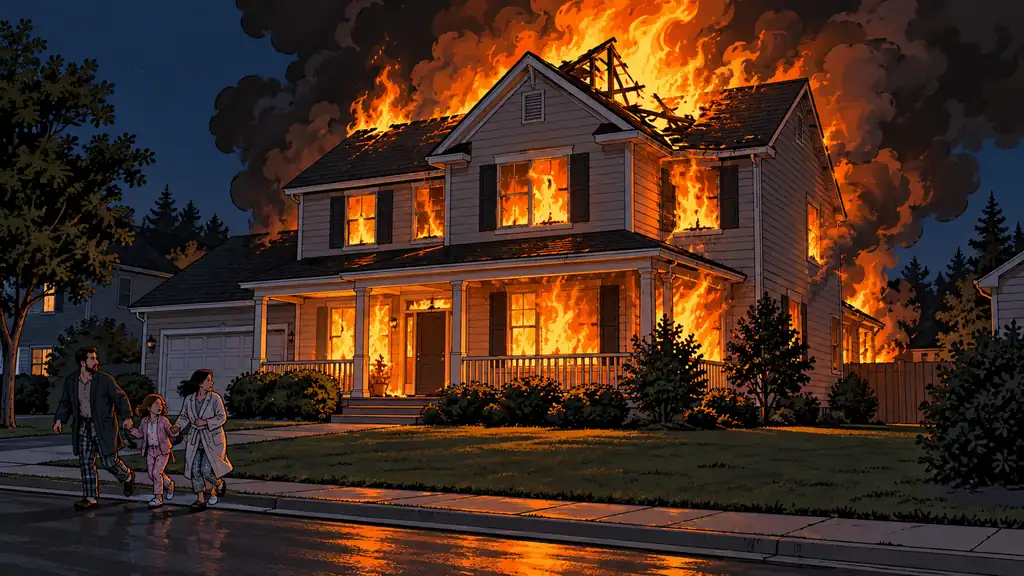
If you already prep, you probably own a fire extinguisher and a smoke alarm or two, and you think this box is checked. It usually isn’t. There’s a big gap between “I own the gear” and “my family gets out,” and the gap is made of three things you can only fix ahead of time: where the alarms are, whether you’ve walked the escape, and whether the bedroom doors are shut. A house fire is fast and it runs on physics. How it ends is mostly decided before the first wisp of smoke.
The number that changes everything
The house you grew up in burned slower than the one you live in now. Old furniture was cotton, wool, and solid wood. New furniture is foam, plastic, and glued-up engineered lumber — which is basically solid petroleum. It lights faster, throws heat faster, and makes thick poison smoke faster.
Here’s the fact that should reset your whole plan. In a side-by-side burn by UL’s Fire Safety Research Institute, a modern synthetic-furnished living room reached flashover — the moment everything in the room ignites at once and the space is no longer survivable — in about 3.5 minutes. The same room furnished the old way, in cotton and solid wood, took about 29 minutes. That’s not a small change. That’s your escape window cut by eight times.
So the escape window isn’t the ten-plus minutes old advice assumed. It’s three minutes, and shrinking. Everything below is about not spending those three minutes on decisions you could have made last year.
Run the clock
Put real numbers on it. The alarm sounds at 2 a.m. You’re asleep, so the first 30 seconds go to waking up and figuring out it’s real. Now you’ve got maybe two and a half minutes of survivable air left in the room where it started, and less if that’s your room.
In that time you have to get yourself up, get to the kids’ rooms, get everyone moving, and get out the door to the meeting spot. Two adults and two kids, two of them half-asleep — that’s tight even when you’ve practiced it. It’s impossible if you’re also deciding which window, hunting for the ladder you’ve never touched, or going back for the dog.
That’s the whole case for rehearsal. A drill doesn’t make you faster on the night. It just moves the thinking to a boring afternoon, so the night is only movement.
What the fatal fires have in common
Look at home fires that kill people and the same picture shows up again and again. The deaths cluster at night, when everyone’s asleep and nobody catches it early. They cluster in homes with no working alarm — none installed, or one with a dead or pulled battery. And they cluster where nobody had practiced getting out, so the few seconds that mattered went to confusion instead of the door.
The NFPA finds that roughly three of every five home fire deaths happen in homes with no smoke alarms or none that worked — and that a working alarm cuts your chance of dying in a house fire by about half. That’s the highest-leverage thing in this entire article, and it costs about ten dollars a room.
The causes are just as boring. Unattended cooking starts the most fires — the NFPA puts about 44% of home fires there. Heating equipment is next and drives a spike every winter. Electrical faults and smoking materials fill out the top. But here’s the twist: cooking starts the most fires, while smoking materials start the most deadly ones — because they smolder into bedding and upholstery while people sleep. The lethal fires don’t start differently from the harmless ones. They end differently, and detection and escape are the difference.
Low odds this year, real odds over a life
Be honest about the number. For your specific house this year, a serious fire is genuinely unlikely, and it sits below the midpoint on our likelihood scale for exactly that reason. Under-hyping a rare-per-year event is the honest move.
But run it the way a prepper should. The NFPA counts about 350,000 home structure fires a year, killing on the order of 2,600 people. Spread that across the decades you’ll live in homes, and everyone you’re responsible for, and the odds that some serious fire touches your family stop being tiny. Pair that with the fact that this is one of the very few everyday emergencies that routinely kills — and the prep pays for itself, because the prep is nearly free.
What it does, in order
The hazards arrive in a specific order, and the order tells you where to spend.
- Smoke and toxic gas come first and kill most. Carbon monoxide and hydrogen cyanide from burning plastics knock you out before flames get near you. This is why “I’ll wake up and think it through” isn’t a plan — the gas takes your judgment first.
- Heat and flashover come second. A room can be lethally hot at head height while the floor is still survivable. That’s why “stay low” is real advice, not a slogan.
- Losing the house comes third. Even a clean escape often ends with the structure and everything in it gone — including your documents, drives, and photos.
The second wave is where families get hurt after surviving: nowhere to sleep tonight and for the months of rebuilding, proving who you are and what you’re owed with your papers burned, and a coverage gap if the insurance never kept up with what it costs to rebuild.
What preparedness actually looks like
Move past “I own an extinguisher” to a system with four layers.
1. Detection — the best money you’ll ever spend.
- Alarms on every level and inside every bedroom, interconnected if you can, so one going off sounds them all. That matters most when the fire starts far from where you sleep.
- Prefer photoelectric or dual-sensor units. Photoelectric reacts faster to the slow, smoldering smoke that dominates the nighttime fires that kill.
- Add CO alarms near the bedrooms.
- Test monthly, swap batteries yearly (or run ten-year sealed units), and replace the alarms themselves at their rated end of life. The sensors wear out.
2. Escape — walked, not imagined.
- Two ways out of every room. Upstairs, that means an escape ladder in the room it serves, and somebody who has actually deployed it once.
- One meeting spot outside, and the habit of going straight there so you can count heads in seconds.
- Practice at night, in the dark. Kids, pets, and anyone slow to move all change the plan. Find that out in a drill, not a fire.
3. Suppression — small and early only.
- ABC extinguishers in the kitchen and garage. Know PASS — Pull, Aim, Squeeze, Sweep — and the rule that you only fight a contained fire with your exit behind you. A kitchen fire that’s left the pan isn’t a fire to fight; that’s a fire to run from.
- Keep a lid handy for a grease fire, and never put water on one.
4. Hardening and recovery.
- Sleep with bedroom doors closed. A closed door holds back heat and smoke long enough to matter, and it costs nothing.
- Keep vital documents in a grab-and-go folder or a fire-rated box, and — better — scanned and backed up off-site, so a total loss doesn’t also erase your paperwork.
- Check that your insurance reflects what it costs to rebuild today, not the price you paid years ago.
Measured honestly, the whole system is an afternoon of setup, a few dollars of hardware, and a five-minute test once a month. What it buys is the only minutes that will ever matter.
The fire won’t give you time to think. Everything that saves you is a decision you make now, while it’s boring.
Bottom Line
- Your escape window is about three minutes, not ten — modern furniture flashes over fast, so prep to the short number.
- Interconnected alarms on every level and in every bedroom are the single highest-leverage thing you own — they cut the death rate roughly in half.
- Walk the escape at night — two ways out of every room, one meeting spot, ladders where you need them.
- Closed doors and staying low turn the physics in your favor for free.
- Off-site documents and current-cost insurance decide whether survival is followed by recovery or a second disaster.
Store scanned IDs, insurance, and deeds in the Digital Binder so a total loss can’t erase your recovery paperwork.