


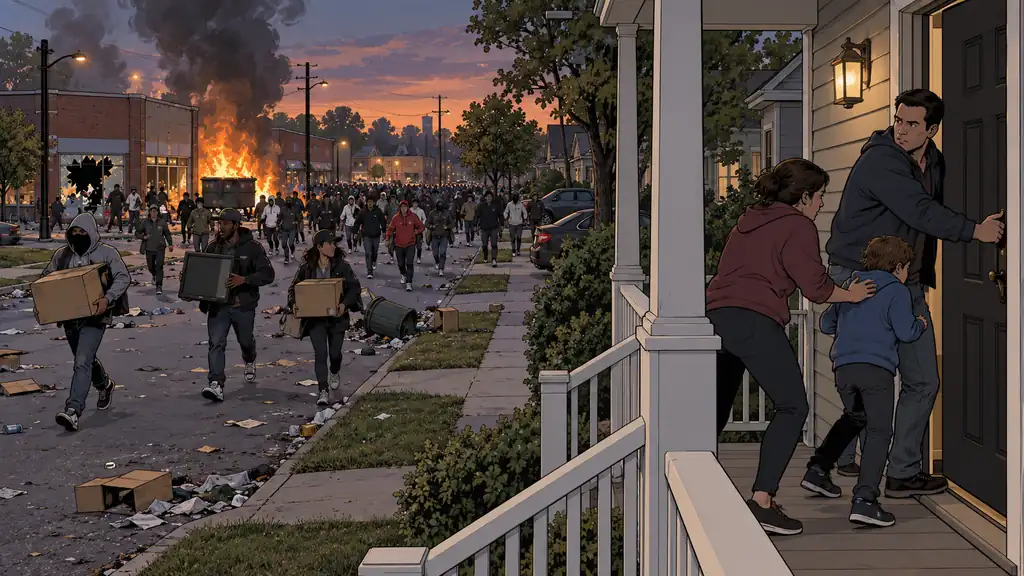
Most preppers file widespread unrest under “avoid the protest and buy a rifle.” Both of those have their place, and both are already covered elsewhere on this site — the downtown riot is a danger you dodge by keeping your distance, and a local crime wave is hard times raising the crime rate in your immediate area. Widespread social unrest is a bigger, slower, heavier thing than either. It’s what happens when the systems people lean on stop working across a whole region at once — and the thin layer of rule of law that keeps everyone civil starts to give way with them.
There’s a rule that runs through society, and it’s basic physics: without outside influence — order, maintenance, the rule of law — things drift toward chaos. That’s true of a machine, and it’s true of a society. When it happens at scale, the danger isn’t really the crowd downtown. It’s quieter and far more personal than that. Sooner or later, the people who didn’t prepare come looking for the people who did — and the hardest decision of the whole event happens at your own front door.
What “widespread” actually means
A single city’s riot is a local event with a boundary you can stay outside of. Widespread unrest is the version with no clean edge: stores closed for days instead of a night, deliveries stopped, services degraded, police and fire stretched past the point of responding, and all of it over a wide area at the same time. It can go national fast — the unrest after the 1968 assassination of Martin Luther King Jr. touched more than 100 cities in a single week, and the 2020 unrest produced events in thousands of towns at once. That’s the shape to plan for: not one bad night nearby, but a broad stretch where normal simply isn’t available.
And it doesn’t always stay in the cities. People move — but this movement is typically along the predictable corridors. For a worst-case scenario, I walk through this in this article about the Golden Horde. That article can pertain here, but things don’t have to be a worst-case scenario for people to end up on your doorstep.
Most of them pass most people by. But “most” isn’t “all,” and the ones who reach you are, by definition, out of options. A few things about desperate people are worth saying plainly, because they’re the hinge of everything that follows:
- People will arrive with one of two motives: help or hurt. Some will be escaping something and in need of help, and others will be looking to spread the chaos.
- People fleeing something are usually desperate.
- Desperate people are dangerous — and not only the bad ones. A good person trying to keep their kid alive becomes a threat when they’re desperate enough.
And don’t discount this as something that can’t happen to you - it can. The McCloskeys never expected this and they made national news when a crowd of protestors arrived at their St. Louis home in the summer of 2020. They’re in a posh neighborhood and this crowd found their home while trying to find the mayor’s. Never assume it can’t happen to you.
The part nobody wants to plan: the knock at the door
Here’s the scenario the plate carrier doesn’t solve. It’s day nine of a regional breakdown. Someone is standing at the end of your driveway. Play it out with two different options:
- A single mother with a toddler. They have nothing but the clothes they’re wearing. If you turn them away, they may not make it. This is a real human being in real need, and saying no has a real cost you’ll carry.
- A man who’s working an angle — asking for a little food while his eyes catalog your generator, your fuel, your buildings, counting what he and his friends will come back for tonight.
Now the trap: standing at your door, in the moment, you often cannot tell which one you’re looking at. The mother might be exactly what she seems, or the cover story. The man might be a genuine father who’s scared and rough around the edges, or a scout. And you’ll be making the call tired, frightened, and flooded with adrenaline — the single worst state a human being can be in for a decision this heavy. If you wait until that moment to decide, you will almost certainly decide badly, in one direction or the other: you’ll turn away someone you could have saved, or you’ll open up to someone who marks you as the soft house on the block.
There are no easy answers here. That’s not a failure of planning; it’s the actual nature of the thing. The only real move is to have already decided who you are before the knock comes.
Decide now — Yes, Maybe, or No
So decide, on a calm day, in writing, as part of your plan. It’s really one hard question with three honest branches. None of them are comfortable, and that’s the point.
Will you help those in need who reach you?
If yes:
- What will you give? Food, water, hygiene items — what, exactly, and how much per person?
- Will you ask for anything in return — work, information, moving on by nightfall?
- Have you set aside specific supplies for this, separate from your family’s survival stock? (This is the one people skip, and it’s the one that matters most — more below.)
- What do you do when the giving runs out? Because it will.
- What do you do if they don’t leave — if help turns into a camp at the edge of your property?
If maybe — you’ll help some and not others:
- What’s the criteria, decided in advance and not on a face you feel sorry for?
- Can you actually stick to it when the next person doesn’t meet it?
If no — you won’t help:
- How will you turn them away in a way that’s firm, safe, and final, without inviting exactly the confrontation you’re trying to avoid?
Whatever you choose, write it down and talk it through with your household before you need it. The goal isn’t a clever answer — there isn’t one. The goal is that the decision was made by you, calm and clear-eyed, and not by a frightened stranger and your own adrenaline.
Work the number: the charity you can afford
If your answer is “yes” or “maybe,” here’s the discipline that keeps it from destroying you. Charity comes out of a set-aside, never out of your family’s survival stock.
Say you decide you’ll help. Buy a separate buffer for it — a couple of buckets of rice and beans marked “give away,” some water, basic hygiene. That’s your charity fund. When someone reaches you, they eat from that bucket. And when the bucket is empty, the answer becomes no, cleanly, because you decided that in advance too.
Without the set-aside, every act of kindness comes straight out of what’s keeping your own kids fed — and you end up making the impossible choice of feeding a stranger’s hungry child by taking from yours, in the moment, with no plan. A $40 bucket bought now is what lets you be generous without being suicidal, and lets you say “I’m out” without lying. Decide the size of your generosity while your stomach is full.
The Christian version of charity
Above is the practical answer. If you’re a Christian, this topic gets much harder as we’re commanded by Jesus to “love our neighbors as ourselves”. In this situation, I would take that to mean giving sacrificially. I’m not going to give direct guidance for what to do here as I don’t feel it’s appropriate. I just want to bring this up so that you’re considering it. One day, you’ll be held to account for your actions on earth and that may include a situation like we’re outlining here.
While I won’t tell you what to do, I will tell you how to figure it out:
- Pray.
- Just like the practical answer, your plan needs to be made now, and not in the moment. Figure out what you’ll do and write it down.
- Pray some more.
It’s a household decision — and a neighborhood one
A lone door is a weak position no matter how you answer. A street that has talked this through together is a far stronger one. That’s why I recommend you build two sets of plans — one for your family, one for your community.
The math is blunt: your neighbors’ preparedness is part of your security. A block of prepared households that have agreed on how they’ll handle newcomers — who’s in, where the informal edge of the neighborhood is, how they’ll share the load — is a place desperate people move past. A block of isolated, unprepared homes is a place they move into, one soft door at a time. You don’t have to run a checkpoint to benefit from your street simply knowing each other and having thought about the same knock at the same time.
The common mistakes
- Assuming it won’t reach you. Run the corridor math for your actual address before you bet your plan on distance.
- Preparing only for defense. The rifle answers the man with bad intent. It does nothing for the mother with the toddler — and that decision is the harder one, and the more common one.
- Deciding in the moment. Adrenaline and pity are both terrible planners. Choose cold.
- No charity set-aside, so every generous impulse robs your own family and there’s no clean point to stop.
- Going it alone when a coordinated street would have carried the same weight far more safely.
What preparedness looks like
- Depth to not need to go out. A rotating two-plus weeks of everything you’d otherwise leave home for. Every trip skipped is exposure avoided — the foundation the rest sits on.
- Know your corridors. Map the population centers and routes that actually bear on you, so you know whether “people reaching me” is a likely branch of your plan or a remote one.
- Make the door decision now. Write the Yes / Maybe / No — with the sub-answers — into your household plan. This is the piece almost no one has, and it’s the one you’ll wish you had.
- Fund your charity separately if you’ll give, so kindness never comes out of survival.
- Do it with your neighbors. A street that has decided together is stronger than any single hardened house.
- Keep security as the floor, not the plan. It’s the last layer for the person who came to take — not a substitute for having thought the whole thing through.
Bottom Line
- Widespread unrest is a broad, sustained breakdown, not one bad night downtown — plan for days or weeks of “normal isn’t available,” over a wide area.
- The defining danger is personal: the desperate eventually come to where the prepared are, and you can’t always tell need from threat at the door.
- Decide before the knock. Write your Yes / Maybe / No, with every sub-question answered, on a calm day.
- Charity ideally comes from a set-aside, not your survival stock — decide the size of your generosity while your stomach is full.
- This is a neighborhood problem. Your neighbors’ readiness is your security; a street that decided together is a street the horde flows past.
The riot you can avoid by staying home. The knock at your door you can only answer well if you’d already decided who you were going to be before it came.
Write your household’s door decision and your two-plus-week depth into your Threat Plans, and map the population centers and corridors that actually reach you in Area Recon.