


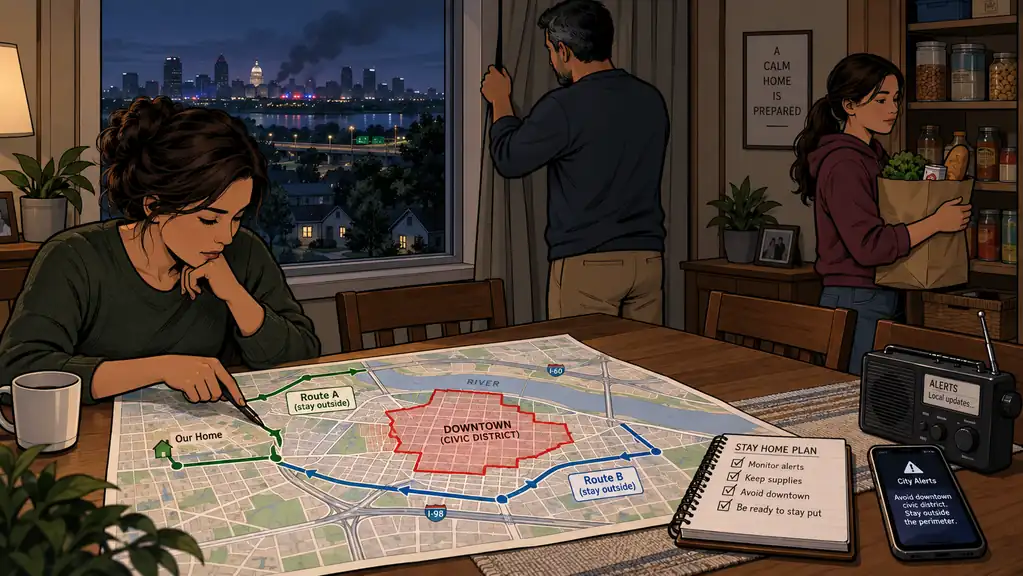
Civil unrest is the threat most people prepare for in exactly the wrong direction. The gear-forward fantasy — hardening the house into a fortress, planning to face down a mob — inverts the actual risk. Unrest scores moderate impact (6 of 9) and lower likelihood (4 of 9), and its danger depends on how close you are to a degree almost no other hazard shares. So don’t picture a battle. Picture a fire with an edge. It has a place it starts, warning signs before it does, a spread shaped by streets and crowds, a lifespan, and a boundary. Your job isn’t to fight it. Your job is to be on the outside of that boundary and stay self-sufficient until it burns itself out.
The four things every unrest event has
Treat any unrest event as having four dimensions you can actually measure and plan against:
- A starting point. Unrest kicks off around specific triggers — verdicts, elections, high-profile incidents, contested events — at specific places: government and courthouse districts, downtown business cores, university corridors, and big gathering venues. These are stable, mappable flashpoints in any given metro. Detailed event-level tracking of American demonstrations since 2020 shows serious violence starting at a small subset of these sites rather than spreading evenly across the map.
- An edge. Unrest has a boundary that grows and shrinks. It’s bounded by physical geography — rivers, highways, terrain — by police containment lines, and by the plain fact that crowds don’t travel far from where they formed. Residential areas, most of the time, sit well outside any realistic edge.
- A lifespan. Events run a duration — usually hours to a few days, and they often follow a day-night rhythm: calmer in daylight, escalating after dark. That’s what your supplies have to outlast, and it’s short.
- A warning. Unlike a flash flood, unrest telegraphs. Scheduled demonstrations, rising tension in the local news, official advisories, police pre-positioning — all of it gives you lead time, usually enough to make getting clear a planned act, not a panicked one.
Plan against those four and a 6-impact event turns into background noise.
The patterns that hold well enough to plan around
Across the modern record of US unrest, several patterns repeat reliably enough to build a plan on:
- It clusters tight. Damage and violence concentrate in commercial corridors and near flashpoints; the residential neighborhoods next door are frequently untouched. In the summer of 2020 — the largest protest wave in modern US history — researchers logged more than 10,600 demonstrations, yet over 93% involved no violence and the destructive events were confined to fewer than 220 locations. Run the numbers and it’s roughly 2% of events, in a handful of known spots. Distance of even a mile or two is often the whole decision.
- It escalates after dark. Daytime protest commonly turns into nighttime disorder. The clock is a planning variable: if you must move or run an errand, do it in daylight and away from event times.
- Cars become traps. A recurring way people get hurt is the occupied vehicle stuck in gridlock next to a crowd — immobilized, exposed, and a potential flashpoint itself. On foot at the edge with an exit is often safer than boxed in a car in the middle. Cars aren’t always a shelter; they can also be a cage.
- Information falls apart. Real-time information quality collapses during events. Rumor, staged or miscaptioned footage, and deliberate disinformation move faster than verified reporting. Decisions made off social-media inputs are frequently just wrong.
- Local supply ripples out. Pharmacies, fuel, and groceries near the zone shutter for the duration and sometimes days after. For a household that stayed clear, that’s the main way unrest touches you at all.
Where the cascade stops
The direct hazards — entrapment, violence, crowd-control exposure, property loss — only exist inside the edge. The second-order effects that can reach a prepared household are logistical: local stores shut, roads and transit closed, information degraded. Here’s the structural point worth sitting with: every one of those second-order effects is defeated by self-sufficiency. If you don’t need the closed stores, don’t need to cross the closed roads, and picked your information sources ahead of time, the cascade has nothing left to act on. That’s why the impact is capped at moderate for a prepared household — the preparation cuts the chain at the first link.
To put a number on the property side: the 2020 unrest produced an estimated $1 to $2 billion in insured losses (the Insurance Information Institute, via Property Claim Services), the costliest civil disorder in US insurance history — more than the 1992 Los Angeles riots. But notice where that damage landed: overwhelmingly in the flashpoint corridors, not spread across the metros it touched. Even the record-setting case was geographically concentrated. That’s the whole thesis in one statistic — huge total, tiny footprint.
There are third-order effects worth knowing as a serious planner. Prolonged or repeated unrest in a corridor can drive business flight and push insurers to pull back or reprice, and it can strain mutual-aid and emergency services across a region. Those are community-scale and long-term more than household-scale — but they’re real, and over years they inform where you choose to live and travel, which is a slower and more powerful lever than any go-bag.
The preparedness system
1. Flashpoint and edge mapping. Build a working map of your metro’s flashpoints and the natural edges around them — the barriers, chokepoints, and terrain that tend to contain a crowd. From that, derive redundant bypass routes between home, work, and school that avoid every flashpoint. Keep at least two independent ways out of your area that don’t both funnel into a downtown core. This is standard recon work, and it pays off for a dozen threats, not just this one.
2. Set a self-sufficiency threshold. Define the stock level at which a multi-day “stay put” advisory is a non-event: food, water, medications, sanitation, and essentials for one to two weeks. For unrest specifically the target is modest, because events are short — but running your general deep pantry covers it with room to spare. Measure your readiness in days you can not-leave, not dollars of gear.
3. Preserve mobility for the case avoidance fails. If the edge reaches you, the move is early, calm relocation — not defense. That needs four things staged in advance: a vehicle kept above half a tank (local fuel may be shut), a ready go-bag, a destination picked ahead of time outside the metro or across a natural barrier, and — most important — a departure trigger you decided beforehand. Something like: “if disorder reaches within N blocks, we leave now, in daylight if we can.” Pre-deciding the trigger is what prevents the fatal mistake, which is leaving too late, into the gridlock. Deciding to go while you’re still watching it on a screen is easy; deciding once it’s on your street is not.
4. Set up your information sources. Pre-pick and bookmark the authoritative ones: official municipal and emergency alerts, established local newsrooms, a reliable road-closure feed. Make it a rule to treat unverified viral content as noise until confirmed. Consider a scanner feed or an official incident map if your area has one. The single question you’re trying to answer is “where is the edge right now” — and you want to answer it from signal, not rumor.
5. Know what to do if you’re caught. If you’re inadvertently near a crowd that turns: no engagement, no filming, no debate — all three mark you as a participant or a target. Move to the edges, toward open space, away from choke points, storefronts, and police lines — because both the crowd and the response to it carry risk. Get back to your vehicle only if it’s outside the congestion; otherwise go on foot to a safe indoor space. Hands visible, movements unhurried, face neutral. The whole skill is de-escalation plus getting out.
6. Decide what you’ll do if it comes to your house. The McCloskeys never expected this and they made national news when a crowd of protestors arrived at their St. Louis home in the summer of 2020. Never assume it can’t happen to you and have a plan in place in case trouble does find you.
The failure modes to design against
- Fortress mentality. Spending on confrontation capability instead of avoidance pours effort into the least likely, most dangerous scenario. Distance beats hardening, every time.
- Leaving too late. The most common way avoidance fails is deciding to go after the roads clog. Pre-set the trigger so the decision is already made.
- Trusting the car. Treating the vehicle as safe when it’s actually a gridlock trap next to a crowd. Know in advance when to abandon it and walk.
- Rumor-driven moves. Acting on unverified social media can walk you straight into danger. Curate sources beforehand.
- A single missing essential. One item you’re out of that forces a run toward the zone. Keep enough margin that you never have to go get anything mid-event.
How you know you’re ready
- A flashpoint map with at least two independent egress routes that don’t converge downtown.
- A self-sufficiency stock that turns a multi-day advisory into a non-event, measured in days you can stay put.
- A staged vehicle, go-bag, out-of-area destination, and a written departure trigger everyone in the household knows.
- A short list of trusted sources bookmarked, and a household rule that viral footage is noise until confirmed.
- Everyone briefed on the disengage-and-exit conduct, so nobody freezes or films if it ever comes close.
Bottom Line
- A riot has a boundary — a start, an edge, a lifespan, and readable warning signs. Plan to stay outside it.
- Map your flashpoints and keep redundant bypass and egress routes; distance of even a mile or two is often decisive.
- Self-sufficiency severs the cascade — a one-to-two-week general stock turns a multi-day advisory into a non-event.
- Preserve mobility with a pre-set departure trigger for the rare case the edge reaches you; leave early, calm, and in daylight.
- Set up your information sources and drill disengagement — no engagement, move to the edge, exit to open space.
Unrest has an edge, and almost all of your safety comes from one decision made in advance: be on the outside of it, with no reason to cross.
Build your flashpoint map, edges, and redundant egress routes in Area Recon, and set your self-sufficiency threshold with the Food & Water Storage tool.