


If you haven’t already read the previous articles about a potential conflict with China, I recommend you read them now as they lay a groundwork that’s not covered here. You can find them here: Introduction and The 100-year Marathon
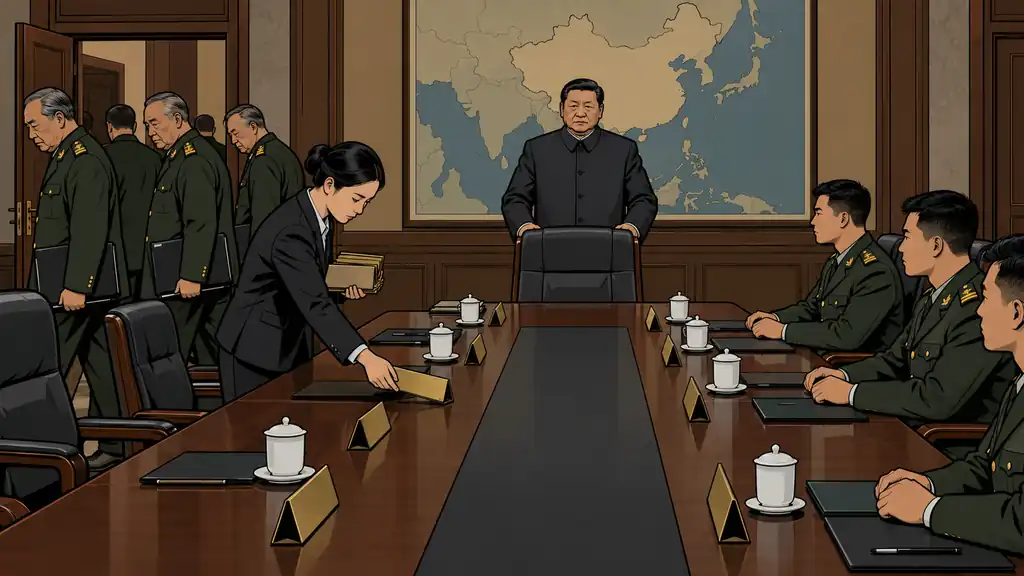
Since Xi Jinping took power in 2012, he has led a major effort that has involved the replacement of hundreds of military officers within all sections of the Chinese military. Since Trump’s second term began in 2025, the US military has begun a similar process.
While these events may not be related and may be part of general restructuring or other improvements, it’s worth examining closely as there is a historical precedent for similar actions and if history is repeating they could mean both countries are preparing for war.
The historical example
In the late 1930’s, Joseph Stalin started what would become known as “The Great Purge”. During this effort, tens of thousands of Soviet officers were removed, imprisoned, or executed. Stalin feared that powerful military officers could become his future political rivals or participate in a coup, so he targeted any he felt were a threat. Additionally, he saw a future conflict looming and wanted military leaders in place that were aligned with his vision and ready and willing to follow his orders to carry out that vision.
Around the same time in Germany, Hitler began a similar effort. In early 1939, Hitler removed his two most senior commanders — Blomberg, his war minister, and Fritz, his army commander. Hitler had come to believe both were too cautious and too ideologically opposed to his future war plans. Blomberg was pushed out over his wife’s past and Fritz was accused of homosexuality. These were just the two highest profile changes, but similar changes were quickly made throughout the military organization to prepare for war.
As war began in 1939, the United States started a similar process, beginning with a new appointment. General Malin Craig had served as the Chief of Staff of the U.S. Army since 1935 and retired in August of 1939. President Franklin Roosevelt, at the recommendation of Craig, appointed General George C. Marshall to the position with a specific mandate — to turn the U.S. military into one ready to fight a modern war. General Marshall was sworn in on September 1, 1939 — the day Germany invaded Poland, so he couldn’t delay in this effort. Marshall rapidly pushed out old leaders that still believed in the need for horse cavalry and replaced them with a younger command structure built around armored divisions and mechanized infantry. In all, Marshall got the U.S. ready to fight wars on two fronts in a timeframe no one thought was possible.
China’s Purge
When Xi assumed power in 2012, he inherited a military where corruption had become deeply embedded in the promotion system. Officers were literally buying their way into higher ranks. He recognized how this undermined the capabilities of the military and set out to change it.
He started with junior officers, which seems backwards, but was actually very smart from a strategic standpoint. Xi wanted to ensure that as higher positions were opened, only worthy candidates would be promoted into them — those that were loyal to him and his vision for the nation. Soon, entire networks inside the People’s Liberation Army (PLA) were under investigation and the purge was moving upward rapidly.
In March of 2014, General Gu Junshan was charged with corruption, bribery, embezzlement and abuse of power.
By the end of 2014, the investigations had let to the very top of the military structure. In October of 2014, Xu Caihou, the Central Military Commission Vice Chairman (reporting directly to President Xi) was charged with taking bribes for promotions. He died of bladder cancer before his court-martial could conclude. Xi pursued him even though he was dying as an example to all — no one was exempt.
In 2016, Xi abolished old command regions and replaced them with new theater commands. This helped to centralize power and the command structure beneath himself. At this point, the purges slowed dramatically. The purge escalated again in 2022 when 120 of the mid-level officers were suddenly arrested and/or fired. This included the defense minister, who disappeared from public view for months. Once he reappeared almost a year later, he was charged with corruption and ultimately given a suspended death sentence.
By this point, nearly all of the 30 top generals and admirals had been replaced under Xi. Between 50% and 70% of all generals were replaced during the purge.
It was during these later years that rumors came out of China more frequently that these purges weren’t about corruption any longer — it was because they disagreed with war plans over Taiwan.
The purge reached a very interesting mark in January of 2026 when the new Central Military Commission Vice Chairman General Zhang Youxia (second to Xi himself), was arrested and accused of leaking nuclear secrets to the United States. This marked the second time the top military position in China was replaced because of corruption in a 12 year period.
There is also evidence that Zhang was involved in an attempted coup on Xi. On January 18th, 2026, Xi Jinping was due to check into a luxury hotel in Beijing. Supposedly, General Zhang had planned to capture Xi Jinping and to overthrow his rule. Instead, Xi was tipped off ahead of time by someone within the operation. Zhang’s men were ambushed by security forces and there was a fierce gunfight at the hotel, but the coup plot was foiled and Zhang was arrested.
I’ve also heard things that makes me believe that this may not be a simple power grab. It’s likely that Zhang may have done this because of disagreement about a future invasion of Taiwan. If the rumors are correct, Zhang was trying to delay this invasion, so it may mean the timetable isn’t long at this point.
The United States military changes
Because of our leadership structure, the U.S. has a long history of presidents firing top generals. President Truman famously fired General Douglas MacArthur during the Korean War after the two clashed over strategy and MacArthur publicly challenged the administration policy. More recently, President Obama fired General Stanley McChrystal, a legendary US special forces commander who was in charge of operations in Afghanistan, because the two had personal and strategic disagreements. While these events aren’t uncommon, they are still an unusual event, which makes the recent actions by the Trump administration all the more relevant.
On February 21, 2025 President Trump fired the Chairman of the Joint Chiefs of Staff, General Charles Brown Jr. In May of 2025 the Pentagon ordered a reduction of 20% of the four-star generals and a 10% cut to all generals and admirals.
On September 5, 2025 President Trump signed and executive order to change the name of the Department of Defense to the Department of War, resuming the name it had used prior to the 1940’s. Some also wondered if it marked a switch in the “mission” or “focus” of the United States military.
On September 30th, 2025, U.S. War Secretary Pete Hegseth and President Trump held an unprecedented gathering of American military leadership. In all, 800 of our top generals, admirals and senior enlisted leaders were gathered in one place. During this event, Secretary Hegseth compared himself to the World War 2 Secretary of War and compared the new Chairman of the Joint Chiefs, General Dan Caine, to General George Marshall. I mentioned Marshall above — these two men were responsible for reshaping the US military prior to World War 2. This parallel being mentioned directly in the context of World War 2 shouldn’t be glossed over as it could have serious consequences for the near future of our nation.
After the gathering, dozens of senior officers, generals, admirals, and military judges stepped down and announced early retirements. The US Army’s Chief of Staff, Randy George, took an early retirement. Secretary of the Navy John Phelan was fired on April 22, 2026 by Secretary Hegseth.
In all, five of the eight members of the Joint Chiefs of Staff, have been fired, forced out or pressured into early retirement since January of 2025. If we expand to include civilian secretaries and other top-tier military officials, the total number exceeds two dozen leadership roles that have changed in the last eighteen months.
The paralells from then and today
Maybe I’m imagining things, but I see clear parallels to what is currently happening in China and the U.S. vs what occurred in Russia, Germany and the U.S. leading into World War 2. I also see a clear parallel between the mandate that President Roosevelt gave General George C. Marshall, and the apparant mandate President Trump has given Secretary Hegseth.
Clearly, something is going on within both China and the United States that warrants closer examination. Hopefully it’s nothing, but if it is something, it will become extremely significant to every citizen of both countries in the coming years.
Bottom Line
- Historically leadership purges preceded war — prior to World War 2, the Soviet Union, Germany and the U.S. conducted high-level military purges.
- China is 14 years into their purge — China continues to purge, including the top military positions in the country.
- The U.S. is making the biggest military changes since World War 2 — and the parallels cannot be discounted.
While you can’t prevent a war with China, you can be watching for the signs that one may be coming and prepare accordingly.
Size the deeper reserves this kind of shock demands with the Food & Water Storage tool, which measures your household stockpile in weeks and months rather than guesses.