


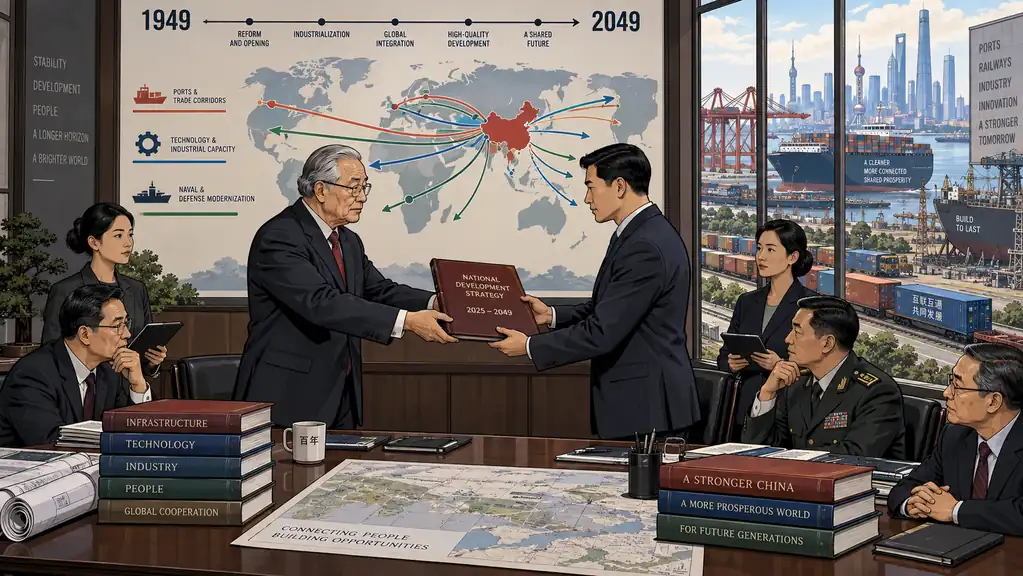
A key to understanding any potential adversary is simply understanding their goals. China’s goals have been an open secret for almost 80 years, and over this period we’ve seen continued work toward reaching those goals. It’s time that the West recognized that the goal is real and will be likely achieved unless something drastic changes.
The goal
Shortly after the People’s Republic of China (PRC) was established in 1949, the Chinese Communist Party (CCP) put together a plan called the Hundred-year marathon. The goal of this plan was China becoming the sole global superpower within 100 years (global leader economically, politically and militarily). Since this time, China has worked diligently toward this goal.
Political leader
China was a founding member of the United Nations in 1945, receiving a permanent Security Council seat. However, this wasn’t the China we think of today. This seat went to The Republic of China (ROC), led by the Nationalist government of the time. During the Chinese Civil War, the ROC retreated to Taiwan as the Communist Party formed the People’s Republic of China (PRC) on the mainland. As a result, the leadership in Taiwan held the UN Security Council seat.
This was maintained until the People’s Republic of China (PRC) took over the seat from the Republic of China (ROC) on October 25, 1971. This was the first major step in China becoming relevant on the modern world political stage.
China’s political relevance was further elevated when President Richard Nixon made a visit to China in February of 1972. This was the first time a U.S. president had visited China and it gave further legitimacy of the People’s Republic of China (PRC) government in the eyes of all other nations.
In the time since, China has continued to exercise increased political clout, growing into one of the dominant political forces on the planet. Recent proof of their progress is the war in Ukraine. Before Russia began the invasion in 2022, Putin visited with China’s President Xi, and they made a joint statement about their cooperation before the invasion began. Since then, China has assisted Russia considerably with weapons, and even soldiers. The fact that a former superpower needed the approval and/or help of China is very telling about the political power that China now wields.
Economic leader
China’s path toward economic dominance lagged their political changes, but has a similar meteoric rise. The first major milestone in this path came in 1978 when under Deng Xiaoping, China shifted from a rigid command economy to what they called a “socialist market economy”. In this system, it decentralized economic control and invited foreign investment.
The next major milestone was the 2001 entry into the World Trade Organization (WTO). After this point, China became the “world’s factory”. I can attest to the dramatic increase in capabilities over the following 20 years as I’ve intermittently been doing business with Chinese companies since 2000. In 2001, China had only basic industrial manufacturing capacity and essentially no modern semiconductor capabilities. In the following years, they greatly expanded into nearly every sector of industry, becoming leaders in many of them.
If you’re not familiar with how this process has typically happened, here is what I’ve observed time and time again (and I know many others that have seen the same):
- A Western company invests into China by building a factory, etc. The Chinese government typically gives them the land, building, etc. along with tax incentives to come to China.
- Western engineers, scientists, etc. go to China for ~2 years to get the new processes off the ground.
- Around 5 years after the start of the project, a new business opens nearby. It coincidentally makes exactly the same products using the exact same processes, but under a new name. This new business typically implements further improvements into the process so that they’re actually better/cheaper than the original.
- The original factory loses significant orders to the new business.
Many, many Western companies followed this pattern and it’s what has allowed China to go from limited and sub-par industrial capabilities in the year 2000 to being the “world’s factory” today. In 2010 China surpassed Japan in GDP, making it the 2nd biggest economy in the world (behind the United States).
Until Covid-19 occurred, it was projected that China would surpass the U.S. as the world’s largest economy by 2035. While Covid did slow their progress, but I expect this to be remedied quickly as failure is not tolerated by the Chinese government. I’ve seen multiple estimates that predict that China will surpass the USA to become the world’s largest economy in the next 20 years.
Military leader
Once China became an economic powerhouse, they turned this resource toward becoming a military superpower. Currently, China is the world’s second-largest military spender (the USA is first). From 2013 to 2024, China’s public defense budget has nearly doubled. For perspective, China spends about 2.5x what Russia does and about 7x what Japan does per year.
One of their biggest single steps in China’s military leadership was called the “Belt and Road Initiative.” This was a massive global infrastructure and diplomacy project. While technically an economic program, it has major military and political ramifications, allowing China to better project power across Asia, Africa and Europe. This effort was similar to the Interstate highway network and other projects the US undertook from the 1930’s through the 1960’s, which greatly helped our industrial base during that period. These same efforts had major military reasons as well as they allow for the rapid transit of men and materials during a time of war.
According to the Pentagon’s 2024 report on Military and Security Developments Involving the People’s Republic of China, China is fully on track to “become a world-class military by 2049.” Realize what this means. World-class means the best in the world – ahead of the United States. I recommend that you read the report as it outlines China’s military strategy, plans and capabilities.
The Pentagon’s 2025 report shows no signs of China’s military progress slowing. If anything, it appears to be increasing further.
Army and Navy
China currently fields one of the largest armies in the world (over 1 million men), and the largest navy in the world with over 370 ships and submarines. Each year, China brings new ships and submarines online, only further increasing this lead. Most of the media attention has been on their new aircraft carriers (they now have 3 in service). However, to me the more important metric is their submarines, which are at near parity with the USA:
| Type | China | United States |
|---|---|---|
| Diesel-Powered Attack Submarines | 48 | 0 |
| Nuclear-Powered Attack Submarines | 6 | 49 |
| Nuclear-Powered Ballistic Missile Submarines | 6 | 14 |
I also suspect that the number of Chinese submarines may be greatly underestimated. It’s known that China employs underground submarine bases. We know about the Yulin / Longpo Naval base, located on the southern coast of Hainan Island and the Jianggezhuang Naval Base (also called Submarine Base No. 1), located near Qingdao along the Yellow Sea. It’s likely that China has other hidden bases that we are unaware of, and by using underground / underwater bases, it makes it extremely difficult for aerial or satellite reconnaissance to accurately track their assets coming in/out of the bases we do know about.
Air Force
China still lags in terms of fighter jets, bombers, etc. with approximately half that of the USA. This is an area with continued efforts and development. In June of 2026, China publicly announced testing of their Chengdu J-36 6th generation stealth fighter jet, which is designed to match the US’s new F-47. China is also developing a stealth bomber designated the Xi’an H-20, which is designed to function as an equivalent of US B-21 Raider.
China is ahead of the United States in some key military areas, namely hypersonic missiles. In the summer of 2021 China conducted two tests where they launched a missile in China, it went around the world, released a hypersonic glide vehicle that then struck a target inside China. According to an article by Financial Times, US government scientists were stunned and said the achievement appeared “to defy the laws of physics.” China first fielded a hypersonic missile in 2019, the DF-17. As of September 2026 the U.S. has some hypersonic missile capabilities in development and testing, but they are still not fielded. So, it appears that we are at least 5 years behind China in this technology and possible even 10 years or more behind.
Hypersonic missiles are a major threat as they have no known defense at this time. Due to their extreme speed, they cannot be stopped by current methods. The result is that all our naval vessels and other key military assets would be nearly defenseless against these weapons.
General Hyten, a senior U.S. officer, was asked about the hypersonic test that went around the world during an interview with CNN. He said that “They look like a first-use weapon. That’s what those weapons look like to me.” A first-use weapon is what would be used in a preemptive or decapitation strike – not used in defense as a response to attack or in a larger conflict. The fact that China is developing such a weapon may give major clues to its future plans.
Nuclear Capabilities
China has been rapidly expanding it’s nuclear weapon arsenal, increasing by about 100 warheads per year. It’s estimated that they possess approximately 620 warheads as of early 2026, making them the third-largest stockpile globally. Projections estimate China will reach 1,000 warheads by 2030 and up to 1,500 by 2035.
In the early 1980’s China first deployed around 20 liquid-fueled ICBM silos. In 2020 it was discovered by researchers that China had begun constructing three large silo fields for ICBMs. These new silo fields can hold 775 ICBMs. For comparison, the US has 400 and Russia has between 324 and 330 operational ICBMs, which would mean China aims to have more than the US and Russia combined. As of the end of 2025 it’s believed that only 100 of these silos are “loaded”, but an exact number is unknown.
In September 2024, China launched an unarmed intercontinental ballistic missile (ICBM) into the Pacific Ocean for the first time since 1980. The missile flew approximately 11,000km before impacting the ocean. This test most likely served as a not-so-subtle nuclear deterrence reminder but also allowed them to validate their ability to deliver a nuclear weapon to full range with their current systems.
In addition to silos, China also has an estimated 230 road-mobile nuclear missile launchers. Most of these are kept in underground bases, so it’s possible they could have much more and by keeping them in underground bases and moving them often, they will always have retaliatory strike capability. For comparison, the US has no road-mobile launchers and only relies on it’s naval assets for mobile launch capability.
The largest concern for me regarding China’s nuclear arsenal isn’t their ICBMs, it’s their submarines. Like the United States, they have the ability to launch nuclear missiles from submarines. But unlike the US, China has the ability of launching hypersonic nuclear-tipped missiles from their submarines. This would allow them to launch directly off the US coast, giving the US no time for a response, especially if hypersonic missiles were used.
War is likely the ultimate outcome
Clearly, for China to become the global leader economically, politically and militarily, they must either surpass or eliminate the current leader in these categories – the United States. Quotes by leadership and influential voices within China echo this sentiment.
“History shows that no global power remains dominant forever,” — President Xi Jinping at the U.S.-China Summit (May 14, 2026).
It’s worth noting that Xi’s remark is explicitly invoking what is known as the “Thucydides Trap” — the historical theory that war is highly likely when a rising power challenges and established one. I also want to note that this was said directly to President Donald Trump.
“Facing the ‘Thucydides Trap’ and border disturbances, the military must step up its capacity… War with the United States is inevitable, and we must thoroughly prepare.” — General Xu Qiliang (Former Vice Chairman of the Central Military Commission — the highest-ranking uniformed officer in the Chinese military) at the National People’s Congress (March 5, 2021)
“We are resolved to fight the bloody battle against our enemies… with a strong determination to take our place in the world.” - President Xi Jinping at the 13th National People’s Congress (March 20, 2018)
“The so-called ‘competition’ by the U.S. is all-round containment and suppression, a zero-sum game of life and death… If the United States does not hit the brakes but continues to speed down the wrong path, no amount of guardrails can prevent derailing, and there will surely be conflict and confrontation.” — Former Foreign Minister Qin Gang at the National People’s Congress (March 7, 2023)
“We must not hesitate to use any means, even if it means the destruction of half the world… Only by using non-destructive weapons that can kill many people can we reserve America for ourselves… It is either the United States or us; there is no room for both.” — General Chi Haotian (Former Minister of National Defense) at a defense strategy session (2003)
“We are ahead of schedule in terms of overtaking the United States. There will be no problem reaching this goal in 2027. The U.S. will not survive. As long as we go to work every day, we will drive the U.S. to its death.” — Prominent Chinese sociologist Li Yi at the Shenzhen IT Leaders Summit (October 16, 2020)
Current status
On the eve of 2027, China has not reached their goals of surpassing the United States politically, economically or militarily. They are, however, well on pace to surpass the USA in these areas long before 2049, which is their ultimate goal.
While China is expected to surpass the USA economically in the next decade, China is still behind the US significantly militarily and politically. Only time will tell if/when this changes and what this change will bring to the United States and the world at large.
Bottom Line
- China established a plan in 1949 to be the world-leader politically, economically and militarily by 2049.
- China has proven they are a key political player on the world stage.
- China is set to surpass the US economically in the next decade.
- China lags the US militarily overall, but have surpassed us in select areas such as hypersonic missiles.
- It’s clear that Chinese leadership expect a war with the US eventually due to the “Thucydides Trap”.