


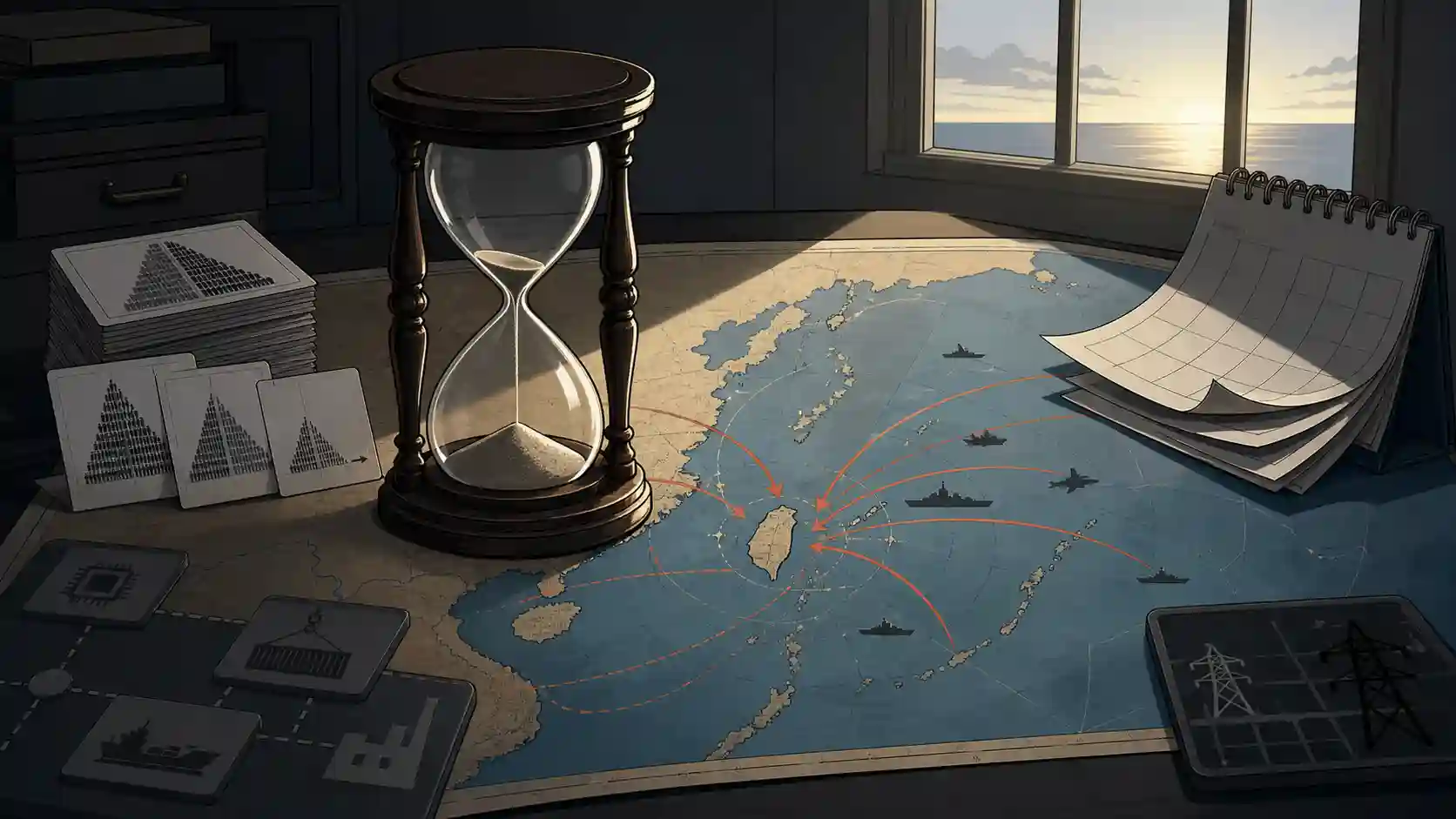
The standard story about China is a story about growth. An economy that was going to pass ours, a navy that keeps launching ships, a plan to be the world’s dominant power. It’s a story about a country on the way up, and it makes the threat feel like something that arrives gradually, later, with plenty of warning.
I think the story is wrong in a way that matters. China’s serious problem isn’t that it’s rising. It’s that its window is closing — and a rival running out of time behaves very differently from one that has all the time in the world.
What’s actually on the record
Start with the parts nobody has to speculate about.
The Chinese Communist Party has pursued something often described as a hundred-year marathon — the goal of becoming the sole global superpower, economically, politically, and militarily, within a century of the Party’s 1949 founding. Seventy-five-plus years in, they’ve worked at it consistently.
The Pentagon’s 2024 report on Military and Security Developments Involving the PRC assesses China as on track to become a “world-class military” by 2049. Read that phrase carefully. World-class doesn’t mean respectable. It means best in the world — ahead of the United States. That’s the stated destination in an official U.S. assessment, not a talking point. And while 2049 may seem far off, it’s not - it’s a year your kids will definitely face.
Regarding Taiwan, the intent isn’t hidden either. Xi Jinping has said reunification is “a historic mission and an unshakable commitment of the Communist Party of China” (July 2021) and called it “a historical inevitability” (2023 year-end address). Multiple sources report Xi has directed the PLA to be ready for a forced reunification by 2027. Asked directly at a House Armed Services Committee hearing in March 2024 whether the PLA would meet that 2027 mark, Admiral John Aquilino — then head of Indo-Pacific Command — answered in the affirmative.
“Ready by 2027” is not the same as “invading in 2027.” Readiness is a capability date. But it’s a real date, from real testimony, and it’s the anchor for everything that follows.
The clock they built themselves
Here’s the part that reframes the whole thing, and it’s a problem entirely of China’s own making.
Over the second half of the 20th century China’s population went from roughly 400 million to over 1.4 billion. To slow it, the government enforced a one-child policy from 1979 until 2015. It worked — and then it kept working, long after they wanted it to stop, because birth rates are a trend that takes decades to reverse and they waited too long to try.
The results are arithmetic, not opinion:
- Population crash. As per the World Bank, fewer than half as many children are being born as ten years prior, and only about a quarter as many as forty years ago. Every year from here on, dramatically more people leave the workforce than enter it.
- Age imbalance. The pre-1979 cohort is large and aging; the cohort meant to support it is small. A rough American rule of thumb is that it takes about ten taxpayers to support one person on Social Security. Apply anything like that ratio to China’s pyramid and there’s clearly a major gap.
- Gender imbalance. With one child permitted and a son culturally near-essential to carrying a family name, sex-selective abortion ran for decades. The result is roughly 20 million men who cannot have the family they expected — a number that grows annually, and a class of frustrated young men no government is comfortable having.
Stack those and you get four trends pointing the same way: the economy slides, the dependency burden becomes unpayable, the social pressure builds, and the military shrinks — because a military is made of young men and China is running out of them.
Every one of those problems is worse next year than this year. That’s the whole point. The gap between what China wants and what China can afford to attempt is widening, permanently, starting now.
Why “weakening” is the scary word
Now put the two halves together, because this is where the intuition breaks.
If China were simply rising, time would be on their side and there’d be no reason to gamble. Waiting would be free. The rational move for a rising power is patience.
But a power whose capability peaks and then declines has the opposite incentive. If you’re going to move, you move while you still can. Everything that makes China weaker in 2035 is an argument for acting before 2035.
The window closes from both ends. It shuts when the demographic cliffs bite hard enough to break the plans. It also shuts if the United States and its allies get fully ready in the Pacific — shifting military focus out of Europe and the Middle East, closing capability gaps. Either of those tilts the balance back, and China’s planners can read a calendar as well as anyone.
So when does it happen? I don’t think it’s 2027. My best guess is they wait for the 2028 U.S. presidential election, because who wins tells them what a response would look like. They view Trump as unstable and I suspect they can’t predict his response with the certainty they would want. If they expect someone they perceive as soft on China to win, they’d likely wait until after the 2029 inauguration. If not, it could come sooner. I don’t think they wait much past 2030 — the demographics get worse by the day. And they may well wait for domestic turmoil or a natural disaster to distract the U.S., or arrange one.
That’s a guess. It’s labeled a guess. But notice that it’s a guess bounded on both sides by things that are measurable — an election calendar and a population pyramid — rather than by vibes.
The war that doesn’t announce itself
One more thing worth understanding, because it changes what you’d even be watching for.
In 1999 two PLA colonels, Qiao Liang and Wang Xiangsui, published Unrestricted Warfare — laying out a doctrine where conflict isn’t confined to the military domain. War is prosecuted by every available means, simultaneously: economic, societal, political, legal, medical, terrorism — there are no limits. The doctrine almost certainly predates the book; the book just made it visible to the West. I will note that there’s a lot of debate and speculation about why the book was published. Were these rogue officers acting as whistle-blowers, or something else. I don’t have an answer, but it’s something to consider as motivations matter.
The implication is genuinely uncomfortable: under that framing, a great deal of what looks like competition or friction or bad luck is, doctrinally, the war. It doesn’t start with a declaration. It starts, and you find out later.
I’d encourage you to read the primary sources rather than take my summary for it — the Pentagon’s annual China report is public, and Unrestricted Warfare is in print.
What this means for you
The temptation with a threat this size is to file it under “nothing I can do” and move on. That’s the wrong read, and it’s also lazy — this threat rates like any other, with Impact × Vulnerability × Likelihood, and it decomposes into things you can actually prepare for.
Because here’s the thing: you don’t prepare for “war with China.” You prepare for its effects, and you’ve seen them all before on this site:
- Grid failure, if infrastructure is targeted — which is exactly what a multi-day outage or EMP plan already covers.
- Supply chain breakdown, which is the same preparation as a national supply-chain event.
- Economic disruption, which is the same runway math as job loss — buffer divided by burn rate.
- Fuel and food scarcity, which your category plans already have numbers for.
That’s the useful property of a good framework: a threat this large mostly doesn’t generate new work. It re-prioritizes existing work, and raises the Likelihood score on preparations you’d already justified for other reasons.
Bottom Line
The clock is the story. Everything else is detail.
- Take the demographics seriously. They’re the most predictable thing in geopolitics — the people who’d be twenty in 2040 are already born.
- Understand that closing windows create urgency, not patience. Declining power is the dangerous kind.
- Watch the bounded dates, not the headlines. Readiness by 2027, a U.S. election in 2028, demographics that don’t wait.
- Prepare for effects, not for the event. Grid, supply chain, economy, fuel. You already know what to do about all four.
None of this requires you to believe a war is coming. It requires you to notice that the country in question has a stated goal, a published doctrine, an official readiness date, and a population pyramid that punishes every year they wait. Rate it honestly and prepare in the order the math gives you.
See where you sit relative to the infrastructure and military targets that would matter in a large-scale conflict, and run the threat-rating math on it yourself rather than taking my word for the ranking.