


I’ve purposefully waited a few days to write this article as I didn’t want the article to be reactionary — I wanted to take time to think through what the results could mean for the near-term future of America. Unlike many pundits, I’m not going to claim I can see the future, or that this is the end of the Republic. To be clear, I do feel it was a very negative result, and the next few years will be a step backwards in almost every way. But I also believe that as a Christian, I can’t be black-pilled — I’m not allowed to lose hope.
What happened?
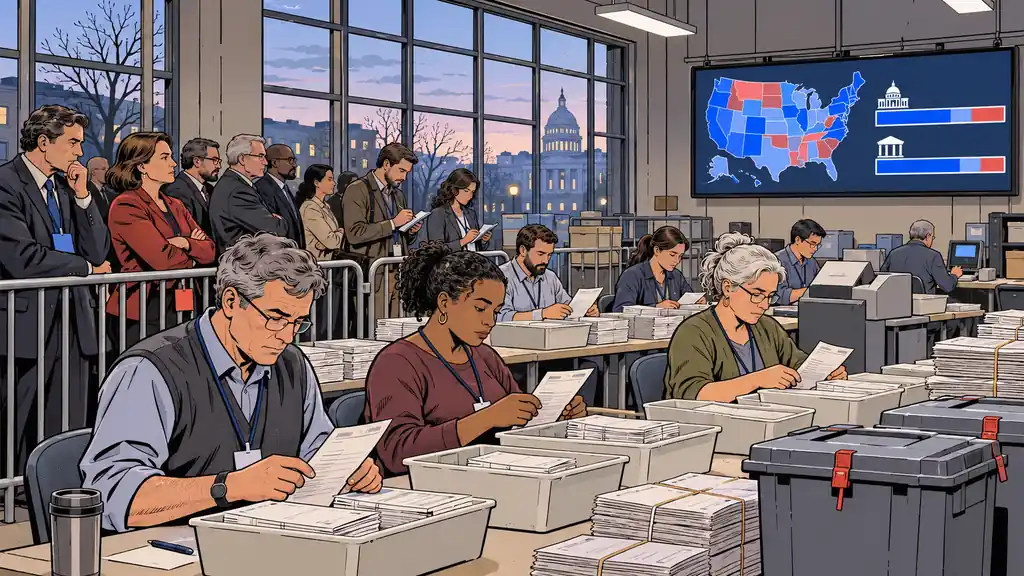
In case you’re been living under a rock for the last week, the Democrats secured major victories in the 2026 mid-term elections. I’ve heard many calling it a “blue wave”, and I feel that undersells what the Democrats accomplished. It wasn’t just a wave, it was a tsunami. Here are a few highlights of the Democratic wins:
Gained ~30 House seats (some aren’t called as I write this), securing the majority
- Indiana, unseating the incumbent
- Iowa, unseating the incumbent and is a Lutheran “pastor” that once participated in a wedding ceremony for Satanists
- North Carolina, unseating the incumbent
- Pennsylvania, unseating the incumbent
- Texas, unseating the incumbent
Gained ~7 Senate seats (some aren’t called as I write this), securing the majority
- Iowa, unseating the incumbent
- Kansas, unseating the incumbent
- Maine, unseating the incumbent
- Michigan, the first Muslim senator in US history
- New Hampshire, the first openly gay man elected to the Senate
- Texas, the first elected there since 1988
Gained 5 more governorships, winning 24 of 36 elections
- Georgia, the first Black female governor in US history
- Texas, unseating the incumbent and first to hold office since 1995
The only major Republican win was for Governor of Florida.
The best historical comparison of the results I’ve found comes from conservative commentator Steve Deace, where he said, “Watergate midterm 1974 in its depth, but 1994 in its message from the voters.” We will examine each of these parallels so see what it really means.
Exploring the “message”
In 1994, Republicans gained 8 Senate seats an 54 House seats, winning the majority in both chambers for the first time since 1952. While significant in the swing that occurred (reversing the trend established in 1974, which we’ll look at below), this “Republican Revolution” was largely voter backlash against President Bill Clinton’s early policies:
- Failed attempt at comprehensive federal healthcare reform, led by First Lady Hillary Clinton
- 1993 tax increases
- 1994 federal assault weapons ban
I can definitely see a parallel with 1994, where a “message” was being sent by the electorate, and and Vice President J.D. Vance said so himself:
“The reason we lost is the war. The president himself said so last night.” — Vice President J.D. Vance
It doesn’t get much clearer of an explanation than what Vice President J.D. Vance gave on X. While J.D. acknowledged that the war with Iran was a central driver, it wasn’t technically the only reason. A pollster he had talked with gave him four answers for “what it would take for voters to come back” to the Republicans:
- End the war
- Focus on cost of living/inflation
- Put America First
- Change our relationship to Israel
What J.D. revealed confirmed what many (including I) had feared going into the election — that President Trump had alienated his base with statements that made it seem that he didn’t care about the economic pain of average Americans:
Reporter: “How much longer will Americans continue to see these high gas prices? Do you have any concerns about the economic strain on families?” Trump: “If they rise, they rise. I don’t have any concerns about it. They’ll drop very rapidly when this is over, and if they rise, they rise. But this is far more important than having gasoline prices go up a little bit.” (an interview with Reuters at the White House on March 5, 2026)
“You have a little higher. It’s a very inexpensive price to pay for what we’ve done,” and “It’s a little more. Frankly, even if it was a lot more.” — Trump during a rally on September 16, 2026
“The United States oil and gas business is making hundreds of billions of dollars,” and “I don’t give a damn, I’m going to say it - we’re making a freaking fortune.” — Trump during a rally in Perry Georgia on October 24, 2026, only 10 days before the election
The national average gas price on election day was $4.15, up 59% since February 28 when the US attacked Iran. With data like this and statements like those above, Trump shouldn’t be surprised by the backlash. As a “populist” to apparently not care about the people will only end one way — with the people turning away from him.
Note: Some will see my critique of Trump and believe it to be partisan-driven, and that’s not the case. I voted for Trump all 3 times, and stand by every one of those votes. But, I also have to be intellectually honest enough to recognize when Trump makes bad policy and messaging decisions and he’s done both this year. And instead of changing course when challenged, he just double-downed, so he fully owns the result.
Exploring the “depth”
Following the Watergate scandal and Richard Nixon’s resignation, the Republican party suffered massive and historic losses in congress in 1974. Since 1954, the Democrats had held majorities in both the House and Senate, but it had always been a “steady” map with minimal major changes within that period. This changed in 1974, when the Democrats picked up 4 additional Senate seats and 48 additional House seats, giving them a commanding majority in both chambers. Basically, the American people had become so disenfranchised with the Republican party over Watergate that they turned their back on them. This shift was slow to reverse — it took a long time for the Republicans to regain the public’s trust. The Republicans took the Senate back in 6 years, but it took 20 years to win back the House of Representatives.
Again, I think Steve nailed it with strong parallels. As I said above, I believe that those that wanted a populist felt betrayed, similarly to the way they felt betrayed after Watergate. If the mechanism tracks, there’s a good chance that the “depth” of the impact may parallel as well. If this is true, then this could be a generational change in the electorate, potentially taking decades (yes, plural) to reverse.
If you look at the 1994 reversal that we covered above that ended the hole dug in 1974, it really wasn’t caused by “improvements” made by Republicans — it was because the Democrats screwed up. This means the problem may not be one the Republicans can solve, it’s just one the Democrats have to not lose. If this part of the depth holds true, we could be looking at a situation like the on that began in 1954, where the Democrats maintain control for 40 years.
Now, do I think Democrats are going to hold control for the next 40 years? Definitely not — the political world today is much different than it was in the 1950’s through the 1990’s. Is it possible though? Unfortunately, yes — the Republicans have dug a big hole. The better the Democrats do at tempering their craziness, the longer their hold will last. The good news is that the Democratic party is crazier than a cat in a carwash, and it seems to get crazier by the minute. Unfortunately, the electorate seems to be more and more accepting of “crazy”, so it becomes a race to the bottom.
I’ll end this section with Florida Governor Ron DeSantis’ analysis on X where he said, “it is very unlikely Republicans will recapture the Congress in 2028. Might not have a shot at Senate control until 2032.” Regarding setting date, I’ll defer to his political expertise as it’s far superior to mine.
What’s next?
The Representatives and Senators will all begin their term at noon on January 3, 2027. This means that the Trump administration has until that date to accomplish anything they want done before 2029. If I was Trump, I’d push the House and Senate to accomplish the following:
- Full-year Fiscal Year 2027 appropriations before the December 11, 2026 stopgap funding deadline.
- Budget reconciliation bill — to raise or suspend the federal debt limit well into 2029, so the Democrats have no fiscal leverage until after the next election and secure funding for defense, border wall, immigration enforcement, etc.
- The SAVE Act — enact voter protections
- Energy Permitting — Enacting the bipartisan energy permitting reform deal to fast-track domestic oil, gas, and grid projects.
- Run the Senate floor 24/7 to confirm every pending conservative nominee. None will be confirmed after the Democrats have control.
Unfortunately, I don’t believe that any of these will actually be accomplished. One reason is that most of our elected officials are feckless, but the bigger issue is likely to be attendance. Many of those that lost just won’t come to work through the rest of the year. As a result, it’s likely that we’re facing these events starting next year:
- Investigations & Subpoenas — high profile hearings will be created to examine the Iran War, DOGE, federal contract awards, etc.
- Impeachments, impeachments, and more impeachments — Secretary Hegseth will be first, with Rubio, Trump, RFK Jr. and others to follow.
- Debt ceiling crisis — in the spring of 2027, likely with a government shutdown.
- Total freeze of judicial confirmations
- Veto Food — The Left will pass lots of “messaging” bills, knowing Trump will veto them.
I’ll close with one last thought. The “message” that was sent likely means that anyone associated with the administration is tainted by it at this point. If true, it means that J.D. Vance and Marco Rubio are not as sure of a choice for the presidential nominee as they were a week ago. It’s likely that Ron DeSantis and others will throw their hat into the ring, and it will likely make for an interesting 2028 Republican primary.
Bottom Line
- The 2026 midterms marks a generational shift in the country, sending a clear message.
- The Democrats’ advantage is likely theirs to lose.
- While it’s impossible to know the long-term effects, it’s likely that the short term will be politically tumultuous.
- The 2028 Republican primary will likely be very interesting.
Actually create the plans to deal with these changes in the threat planning tool.