


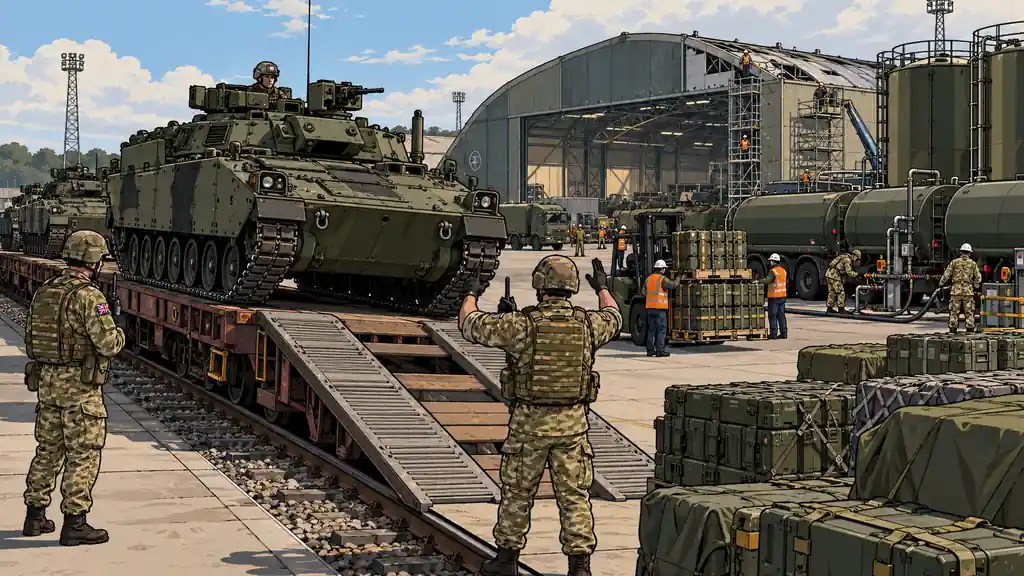
“Our adversaries’ willingness to harm us is not new. What has changed is their capacity. By 2030, their force strength and war economy could put them in a position to attack. That gives us a little over 1,000 days to complete our mission: to be ready with our allies to fight and win.” — British Defense Secretary Wes Streeting
That’s a striking thing for a sitting defense minister to say out loud, and the natural first reaction is to wonder whether it’s theater — a budget pitch dressed up as a warning. So let me do what I try to do with every one of these: separate the sensational framing from the substance underneath, and then ask the only question that matters for an American reader — does this change anything for me?
The “1,000 days” is a device — but the date isn’t invented
The “little over 1,000 days” line is a rhetorical device; it’s just the count to 2030. But 2030 isn’t a number Streeting pulled from the air. It’s the year that keeps recurring across NATO and European defense planning as the point at which Russia could reconstitute its land forces and run a war economy capable of threatening a NATO member — the assessment behind the alliance’s recent spending pledges and Germany’s conscription groundwork. When a British defense secretary says “ready by 2030,” he’s not forecasting a war in 2030; he’s saying the window to deter one closes around then, so the rebuilding has to happen now.
So is it sensationalized? The phrasing is built for headlines. The substance — a Western government telling its public, on the record, to expect that it may have to “fight and win” within the decade — is real, and it is of a piece with everything else coming out of Europe this fall: Britain’s resilience campaign, Germany’s conscription screening, and the broader convergence of war warnings I’ve written about already.
Why an American should care
Three reasons, none of which require believing a war is imminent.
First, alliance math. If the UK is in a shooting war with Russia, the United States is not a spectator — NATO’s Article 5 and a century of habit make American involvement the default, not the exception. A British timeline is, indirectly, an American timeline.
Second, the reversal is the signal. I keep coming back to this because it’s the most reliable tell: governments spent forty years telling citizens not to worry. When they reverse that — when a defense secretary starts counting down days — they’re responding to threat assessments, not polls. The specific date matters less than the direction of the change.
Third, it’s one more data point in a cluster. One minister’s speech is easy to dismiss. But the UK’s 2030 line lands in the same month that multiple countries told their citizens to stock supplies and the Pentagon ordered its bases to be able to fight for 90 days without the civilian grid. Any one of these is noise. Together they’re a pattern, and the pattern keeps pointing to the same uncomfortable conclusion — that war is coming.
Bottom Line
- The framing is punchy; the date is real. “1,000 days” is a countdown to 2030 — the year Western planners keep citing as when Russia could be positioned to threaten NATO. It’s a deterrence deadline, not a war forecast.
- A British timeline is an American timeline. If the UK ends up at war with Russia, the U.S. is almost certainly in it too. Allied clocks are your clock.
- Read it as part of the cluster, not alone. Taken with Europe’s civil-resilience push and the Pentagon’s FORTRESS directive, this is one more government reversing a long “don’t worry.”
- The response is boring and portable. You don’t need a 2030 plan. Deep, steady reserves cover a war scare the same way they cover a storm — build them calmly, now.
Rate how much a Russia/NATO conflict should weigh on your plan with the Conflict with Russia threat brief, and turn “be ready” into a number with the Threat Planning Tool.