


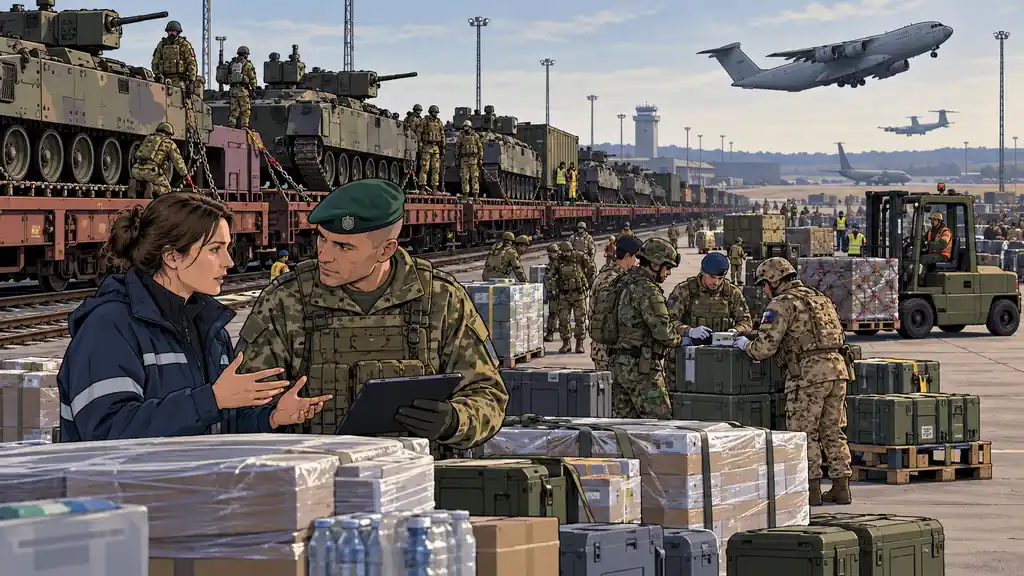
Something happened this autumn that’s easy to miss if you only read one headline at a time. Inside the space of a few weeks, a US Army general, NATO’s secretary general, NATO’s top commander in Europe, and the government of the United Kingdom all said, in their own words, some version of the same sentence: get ready for a major war. Not one voice. A cluster.
When signals cluster like that, a serious person pays attention. But paying attention is not the same as panicking, and it is definitely not the same as believing whatever lands in your feed with the loudest font. The useful question isn’t “is war coming?” It’s “which of these warnings is credible, which is noise, and what does the honest version actually ask me to do?” That’s the engineer’s move — separate signal from spin before you spend a dollar or a night’s sleep on it.
So let me do that here.
What’s actually on the record
Start with the parts that are sourced, named, and dated — the signal.
The US Army. At the Association of the United States Army’s annual conference in October 2026, Gen. Christopher LaNeve — the Army’s acting chief of staff, and its Senate-confirmed vice chief of staff — warned that a future war with a near-peer adversary won’t stay overseas. “If we’re going against a pacing threat, power projection will be contested,” he said — meaning the drones, cyberattacks, and long-range weapons that would hit US bases and critical infrastructure before American forces ever deploy. His point was that the Global War on Terror assumption — secure bases, safe supply lines at home — is dead. That’s a sitting four-star saying the continental United States is now part of the battlefield map.
NATO’s secretary general. In a December 2025 speech in Berlin, Mark Rutte told Europe it is “Russia’s next target” and that the alliance must “be prepared for the scale of war our grandparents and great-grandparents endured.” His timeframe: Russia could be ready to take on NATO in roughly five years — an estimate several Western officials have echoed since 2022.
NATO’s top soldier. At the Warsaw Security Forum in October 2026, Supreme Allied Commander Europe Gen. Alexus Grynkewich said the alliance is “ready to fight tonight” if attacked, and laid out a “block, blunt, break” plan for stopping a Russian assault. Read his whole statement, though, because the nuance is the point: he explicitly said he does not believe conflict is imminent or inevitable, and that the best way to keep the peace is to prepare for war while keeping lines of communication open.
The UK government. Through 2026 the Cabinet Office, under what it calls its Home Defence Programme, has been telling households to keep a few days of bottled water, tinned (canned) food, a torch (flashlight), batteries, and a wind-up or battery radio on hand. Officials were careful to frame it as readiness for any major disruption — cyberattack, extreme weather, or war — and stressed it is not a prediction that an attack is imminent. A government telling fifty million people to stock a pantry is, nonetheless, a government that has thought hard about the lights going out.
Four separate institutions, four different countries’ worth of bureaucracy, no shared press office. That convergence is real, and it is the signal.
Now the noise
Here’s where it gets interesting, because the same week those sourced statements landed, the internet produced a much more exciting version.
You’ll see it phrased as a flat countdown: “A NATO official says we have about one year left.” It gets stripped to a number, slapped on a graphic, and passed around as alliance policy. I went looking for the primary source. What I found is an unverified post on an obscure site, quoting an unnamed “deputy assistant secretary general” at the Warsaw Security Forum saying the alliance has “a year, something like that, to be fully ready.” No credible outlet — Reuters, AP, BBC, or NATO’s own channels — corroborates that quote, and I could not confirm it against any named official.
Two things are wrong with the way it travels. First, even taken at face value, “a year to be ready” is a readiness deadline, not a war date — the same kind of capability target as Rutte’s five-year estimate, not a prophecy. Second, the named four-star at that very forum, Grynkewich, said the opposite of imminent. So the honest read is: an anonymous, uncorroborated quote got amplified into a specific doomsday clock, while the on-the-record commander standing at the same podium said “not imminent.”
That’s not intelligence; that’s a game of telephone with a sales incentive. Use them the way you’d use a tip from a stranger — as a pointer to go check a primary source, never as the source itself.
When a warning comes with a specific date and no name attached to it, that’s the tell. Real institutions publish readiness windows and capability targets. They do not sell you a countdown. The countdown is almost always someone else’s product.
Why the cluster still matters
Here’s the part that trips people up. If the named officials keep saying “not imminent,” why care at all?
Because you don’t weigh each statement in isolation — you weigh the pattern. One general warning about home-soil threats is a data point. A secretary general, a theater commander, and an allied government independently revising their plans in the same season is a trend, and trends are what a threat looks like before it arrives, not after. Finland and Poland didn’t wait for a declaration to pour concrete; they read the same calendar everyone else can read.
And notice what the credible voices actually converge on. Not a date — a shape. Contested power projection. Infrastructure as a front line. Cyber and drones reaching the homeland. Five-year readiness windows, not next-Tuesday invasions. The institutions aren’t predicting when. They’re describing what, and the “what” is remarkably consistent across all four.
What this means for you
The temptation with something this size is to file it under “nothing I can do” — or to go the other way and buy a bunker on the strength of an anonymous tweet. Both are errors. Here’s the move instead: you don’t prepare for “World War 3.” You prepare for its effects, and you’ve hopefully seen every one of them on this site before.
- Grid and infrastructure attacks — exactly what LaNeve described — are the same plan as a multi-day grid failure or EMP.
- Supply-chain shock is the same preparation as a national supply-chain breakdown.
- Economic disruption is the same runway math as any income loss — buffer divided by burn rate.
- A few days of self-sufficiency — water, food, light, information — is precisely what the UK just told its entire population to go buy. You can do it this weekend for the price of a nice dinner.
That’s the quiet advantage of a real framework: a threat this large mostly doesn’t create new work. It re-prioritizes work you’d already justified for a dozen likelier reasons.
Bottom Line
- The convergence is real; the countdown is not. Four named institutions warning in one season is signal. “One year, says an unnamed official” is noise dressed as signal — trace every date to a name before you believe it.
- Prepare for the shape, not the schedule. The credible voices agree on what (contested homeland, infrastructure, cyber, drones) and hedge on when. Build for the what.
- Readiness windows aren’t war dates. “Ready in five years” and “ready to fight tonight” are capability statements. Treat them as planning horizons, not prophecies.
- Rate it honestly and get back to work. Run it through Impact × Vulnerability × Likelihood like any other threat. For most American households it won’t top the list — but the effects it shares with likelier events mean the preparation is never wasted.
None of this requires you to believe a war is coming next year. It requires you to notice that an unusual number of people whose job is to be right about this started saying the same careful thing at once — and to do the boring, scheduled version of getting ready, instead of the loud one someone’s trying to sell you.
See the full picture on the world war threat page.