


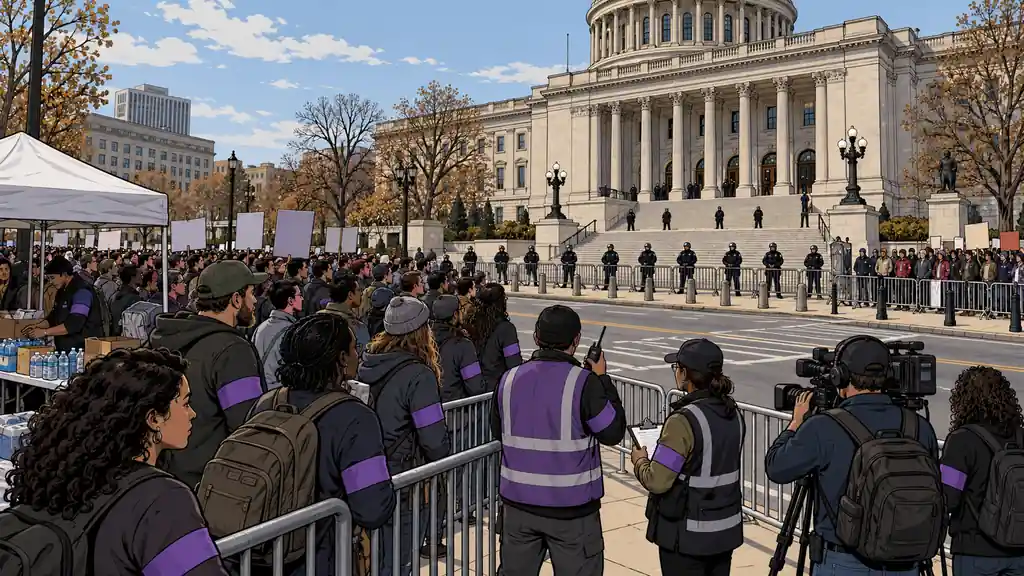
If you’re not familiar with the concept of a color revolution, I recommend you first read this article so you understand the overall concepts and strategies.
In that article I laid out the playbook: a color revolution topples a government in weeks, not years, by hitting its legitimacy, authority, and capacity at the same time, organizing toward a tipping point of roughly 3.5% sustained participation. I also made the point that most of what looks like a color revolution is just ordinary political noise — and that the value of knowing the playbook is being able to tell the signal from the noise.
So let me be careful with this one, because it’s easy to get wrong in either direction. A pile of leaked recordings and anonymous documents can be made to sound like a grand conspiracy, and a pile of ordinary activism can be made to sound like one too. What I’ll do here is walk through what’s actually being claimed, by whom, and with what evidence — then map it onto the three pillars so you can judge for yourself how much of the method is visibly in motion. Much of what follows comes from partisan sources and unverified recordings; I’ll flag that as I go. Treat this as a situational-awareness briefing, not a verdict.
The “savior of democracy” frame
Start with the mindset, because the mindset is the engine. A color revolution needs its participants to believe the current government is illegitimate — that resisting it isn’t lawlessness but rescue. On the American left, that frame is now explicit and mainstream: the argument that President Trump is a dictator, that democracy itself is in danger, and that stopping him is a civic duty. The economist Paul Krugman, writing after the fall 2026 “No Kings” demonstrations, framed the Minnesota protests as the beginning of exactly this kind of pro-democracy movement — people who see themselves as restoring a democracy they believe has been stolen.
That’s the legitimacy pillar in plain sight, and I want to be fair about it: millions of people hold that belief sincerely, and holding it is not a plot. The “No Kings” marches in the summer of 2025 drew perhaps three million people — real, large, and mostly peaceful. But three million is also about a quarter of the ~12 million the 3.5% rule says it takes to make a government fall, which is closer to the threshold than I’m comfortable seeing. The question this article is really asking is whether, underneath that sincere mass sentiment, a smaller set of organizers is running the method — and there’s now a body of claims that says they are.
The recordings: a planned “legitimacy crisis”
The sharpest of those claims comes from a series called The Democracy Files, recordings published by the account Data Republican and written up by YourNews. I can’t independently verify the recordings, and the outlet reporting them is openly partisan, so hold all of this loosely. But the content of what’s described is worth understanding because it reads like the planning phase of the playbook rather than the street phase.
According to that reporting, participants in political-organizing discussions in early and mid-2026 discussed the possibility of a federal “legitimacy crisis” around the November 2026 midterms — and, crucially, discussed it as an opportunity. The idea, as described, is that widespread questions about an election’s legitimacy could open a window for fundamental constitutional change: a speaker reportedly floated a gathering resembling a “third Continental Congress,” a declaration of political “red lines,” a national dialogue, and eventually a new constitutional convention — explicitly contemplating a process outside the existing amendment framework.
One participant is described as a member of the Democratic Socialists of America and its Marxist Unity Group caucus, pushing for a program calling for a new constitution with a single-chamber legislature. Another described working with a Democracy Renewal Group said to include roughly 300 former USAID personnel experienced in — and read this in light of the intro article — international democracy-promotion and responses to authoritarian governments. The same tradecraft the United States has spent decades exporting to topple foreign governments is the tradecraft being described here, pointed inward.
I’ll repeat the caveat the honest version requires: discussing constitutional reform, even radical reform, is legal and common, and nothing in these descriptions establishes that anyone intends to seize power unlawfully. The distinction that matters is between advocating change and exercising authority outside the law — and the recordings, as reported, sit in the uncomfortable gray zone between the two.
Red lines, a situation room, and a memo to governors
The same reporting describes an August 2026 discussion involving a group called Renew American Democracy (RAD) and a broad coalition styled the United Democracy Alliance — a coalition said to combine litigation, civil resistance, and noncooperation. According to the account, the coalition has been building “political red lines,” indicators, and a “situation room” meant to feed real-time guidance to member organizations during the 2026 and 2028 cycles. In the language of the playbook, that is the authority pillar being staffed: an apparatus to coordinate mass disobedience and tell allied groups when a trigger has been hit.
The most striking claim is a reported options memorandum prepared for state governors, exploring how states might respond if they came to regard the federal government as illegitimate after certain lines were crossed — including possible coordination among governors and even communication with foreign governments. The reporting names Massachusetts, California, Illinois, Wisconsin, Utah, and Washington as states where outreach was attempted, says Massachusetts declined, and says the concept was explicitly not framed as secession.
Nothing here establishes that any governor agreed to anything, and state officials talking through contingencies is not the same as a plan to assume federal power. But a worked-out proposal for state governments to treat Washington as illegitimate and pick up federal functions is, if real, a direct assault on the first pillar — legitimacy — at the level of institutions rather than crowds.
The “Metro Alignment Playbook”: the capacity pillar
If the recordings describe the legitimacy and authority pillars, the document described in this thread describes the capacity pillar in operational detail. The author claims to have found an April 2026 draft called the “Metro Alignment Playbook” — a city-by-city plan to create economic disruption during an election crisis. Again: unverified, single-source, and I’m relaying it as a claim.
The described logic is pure capacity-attack: identify the corporations that carry the most economic weight in each city, find where they’re vulnerable, and build the labor, faith, community, and small-business infrastructure to pressure them on cue. The named targets reportedly include Wall Street, Silicon Valley, the Los Angeles ports, Delta’s airline hubs in Atlanta, Dallas–Fort Worth, Minneapolis and Detroit, and major employers like Target in Minnesota.
The “activation” language is the part that turns a protest into a blockade — “NYC unleashes on Wall Street,” “LA calls strikes at the port,” “California starts a caravan to Silicon Valley and clogs it up” — with the instruction that every city already knows its role and that “nobody is waiting for orders.” If certification is delayed or winners aren’t seated, the plan reportedly escalates to general strikes, coordinated business closures, boycotts, walkouts, and occupations of corporate headquarters, with smaller events used as rehearsals to test the system first.
That last detail — rehearsals — is what makes a document like this worth taking seriously even while doubting it. Choking ports, rail, and major employers to deny the government and economy their capacity is step three of the playbook almost verbatim, and testing the machinery before the real event is exactly how a serious operation would work.
Mapping the claims onto the three pillars
Set the sourcing debate aside for a moment and just sort the claims by which pillar of government each one attacks. The fit is uncomfortably clean:
| Pillar | What’s reportedly in motion |
|---|---|
| Legitimacy | The “save democracy / Trump is a dictator” frame; recordings describing a planned election “legitimacy crisis”; a memo urging governors to treat the federal government as illegitimate. |
| Authority | A “blocking movement” of coordinated litigation, civil resistance, and noncooperation; a “situation room” built to tell allied groups when a trigger has been hit. |
| Capacity | The “Metro Alignment Playbook” — strikes, blockades, and occupations aimed at ports, airline hubs, and major employers to choke the economy during a certification crisis. |
That table is why I didn’t simply file this under ordinary election-season noise. Any single row is normal politics — protests, lawsuits, and strikes are legal and American to the core. But all three rows, built in advance and pointed at the same two-month window, is the shape of the method rather than the shape of a mood. It’s also worth remembering from the companion article that this is precisely how the cleanest color revolutions began: a disputed or distrusted election used as the fulcrum, with the machinery to exploit it already assembled. The Orange Revolution and Euromaidan both turned on exactly that fulcrum.
The other side appears to be preparing too
Here’s the part that moves this from “activists have plans” to “the next two months could be genuinely rough”: the government seems to be bracing for it. MS NOW reported that FBI agents are worried about being directed to polling places. And while a top general said in August there were no plans to put troops at polling sites, more recent reporting suggests National Guard units could be called up around the election — a notable shift from the military’s earlier flat denial. When both the resistance and the state are visibly staging for the same date, the odds of friction at that date go up regardless of anyone’s intentions.
Is the plan already in motion? The suspicious packages
Then there’s the signal that pushed me to write this now. In mid-October, Oklahoma’s State Election Board and Alabama’s Secretary of State’s office — among election offices in multiple states — reported receiving suspicious packages containing white powder. I don’t know who sent them or why, and it may turn out to be unrelated. But coordinated intimidation aimed at the officials who certify elections is precisely the kind of “rehearsal” and pressure a capacity-and-legitimacy campaign would use to test response and seed doubt about whether the vote can even be safely counted. It is, at minimum, a reason to pay attention.
What could be coming — and what to do
Put the pieces together and you get a coherent (if unproven) picture: a mass movement that sincerely believes it is saving democracy, a smaller organizing layer reportedly building the legitimacy-crisis narrative, the coordination apparatus, and the city-by-city economic-disruption plan, and a government staging to respond — all pointed at the November–December 2026 certification window. Even if only part of that is real, the realistic near-term risk isn’t “civil war.” It’s concentrated disruption in major metros: large protests that can tip, blockades at ports and transit and airline hubs, strikes and shutdowns at named corporate targets, and the friction that comes when federal agents or Guard units are standing at the same intersections.
So the guidance is ordinary and calm. Be aware of your surroundings, especially if you live in or routinely pass through the kinds of places a capacity campaign names as targets — downtown financial districts, major ports, big-airline hub airports, large corporate headquarters, state capitols, and election offices. If you don’t need to be in the middle of a mass demonstration, don’t be; crowds are safe right up until the instant they aren’t.
Beyond that, it’s the same boring baseline that covers any disruption. Keep your vehicle fueled, keep some cash on hand for the days when card networks or a closed store make plastic useless, and keep two weeks of the basics at home so a few disrupted days are a non-event rather than an emergency. Have a simple plan for getting home on foot or by an alternate route if a transit line or a highway is blocked, and agree on a place and a way for your household to regroup if phones are jammed. None of that requires believing any particular theory about who’s organizing what. It just requires taking the calendar seriously.
Bottom Line
- The method, not just the mood, may be visible. Sincere “save democracy” sentiment is the legitimacy pillar; the reported recordings, coordination “situation room,” and city-by-city economic-disruption plan map onto authority and capacity. That’s the color-revolution playbook — if the sourcing holds.
- Hold the sourcing loosely. Much of this is partisan outlets and unverified recordings and documents. Treat it as situational awareness, not established fact, and watch for confirmation from harder sources.
- Both sides are staging for the same dates. Activist plans aimed at the certification window, plus FBI and possible National Guard mobilization, raise the odds of friction in November–December no matter whose intentions are pure.
- Prepare for disruption, not apocalypse. The realistic risk is concentrated chaos in major metros, not nationwide collapse. Stay out of flashpoints, keep fuel, cash, and two weeks of basics, and have a get-home plan.
Understand the mechanics first in how color revolutions work, then rate how much this should weigh on your own plan with the Civil War or Revolution threat brief.