


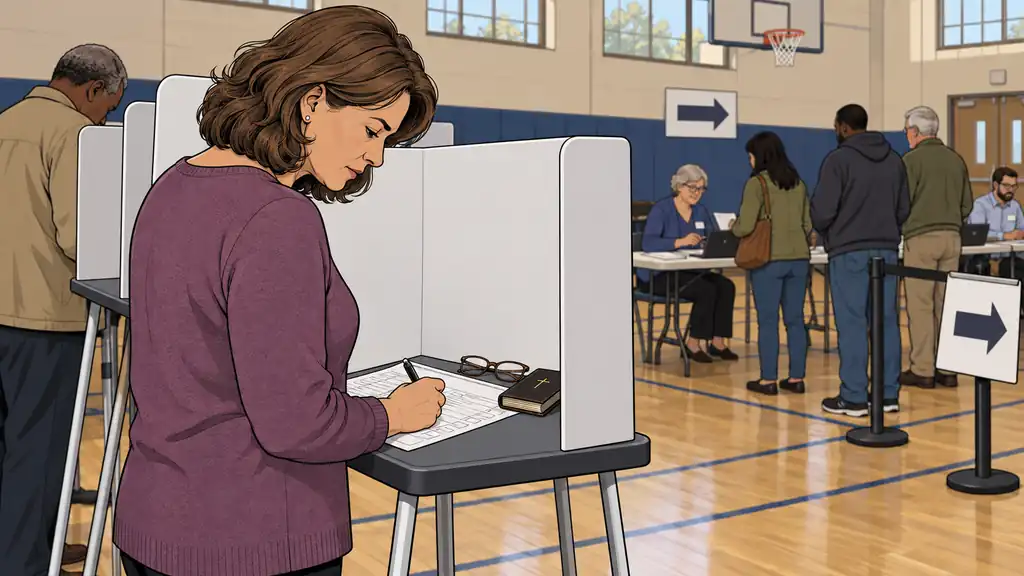
Every election cycle I hear some version of the same thing from fellow Christians: “What does voting have to do with the Bible?” Politics is treated as the dirty, secular corner of life — something faith is supposed to stay out of. I understand the instinct. But I’ve come to believe it’s exactly backwards. How you vote isn’t a break from your faith; it’s one of the clearest places your faith either shows up or doesn’t. And it’s a responsibility you’ll answer for.
God created government on purpose
Start with something most of us skip right over. Scripture describes three institutions that God Himself established — in this order: family, government, and church. As Christians, we pour ourselves into the first and the third. We’ll organize the family and show up for the church. Government? We treat it as somebody else’s business, or as too grubby to touch.
But God didn’t create anything by accident. If He established government, then government matters to Him — which means it should matter to us. Standing at arm’s length from it isn’t holiness; it’s neglecting one of the three institutions He built.
I’ve written before that the church spent the last few generations retreating from public life, hiding behind a misread of “separation of church and state” and deciding that only “church matters” were its concern. The result is a country where believers who could have been salt and light simply weren’t at the table. Being engaged in your community — and yes, that includes politics and voting — is part of being the light you’re called to be. If Christians won’t vote for candidates who reflect a biblical view of right and wrong, who exactly is going to?
A vote is a tool — powerful, but not a savior
Let me be clear-eyed about what voting can and can’t do. History shows we can never simply vote our way out of a problem. Electing a new person is never an instant fix, no matter what the candidates or the parties promise you on election night.
What voting can do is slow a bad trend, and sometimes roll it back a little. That’s not nothing — but it’s a tool with limits, not a rescue. So I use it where I can, and I don’t put my hope in it. My hope is in God, not in an outcome at the polls.
Why I take my ballot so seriously
When you strip it down, you’re voting on one of two things. Sometimes it’s an issue directly — a law, a tax, a constitutional amendment. But usually you’re voting for a person. And what is that person for? They exist to serve as your representative in government. They’re supposed to vote the way you would vote, to act on your behalf.
That word — on your behalf — is why I don’t treat this lightly. I believe I’ll give an account for what I did with my life, and by voting I’m authorizing another person to act in my name.
“And I saw the dead, great and small, standing before the throne, and books were opened. Another book was opened, which is the book of life. The dead were judged according to what they had done as recorded in the books.” — Revelation 20:12
If I hand my proxy to someone, I bear some responsibility for what they do with it. That should make all of us more careful, not less.
And before anyone decides the safe move is to opt out: not voting is a vote too — a vote for whatever happens. If you never even try to affect the direction of things, I think you still own the result. Silence doesn’t absolve you from responsibility.
Research first — actually do the work
So if I want a representative who truly represents me, I’d better find out who actually does. How? You research them. Yes — you’re going to have to do something.
It’s not hard when a candidate has already held office: look at how they’ve voted. Past performance is the best gauge of future behavior I know of. There are ratings services that track voting records for federal and state officeholders, which give you a fast starting point.
When a candidate has no record, the work gets harder but no less important: look at their stated beliefs, past statements, and past affiliations. And don’t ever take a TV ad at face value — those are almost never telling you the whole story.
A few more habits I’d urge on you:
- Don’t vote on a single issue in isolation. You should have hard lines — there should be issues you simply won’t cross. But weigh each candidate across the range that matters: life, the economy and taxes, education, free speech, defense, privacy, self-defense, the size and reach of government.
- Don’t vote by party. A letter after a name — R, D, G, C, L — is at most an early hint, never the answer. I’ve seen races where the candidate I judged best wasn’t from the party I usually side with. Research all of them.
- Don’t vote on name recognition. Most people do exactly that, especially in primaries — pulling the lever for whichever name they’ve heard before. Don’t be that guy.
A lesser of two evils isn’t what many think it is
I need to address a common objection that exists within this subject, and it typically goes something like this: “A vote for the lesser of two evils is still a vote for evil.” I agree with the statement, but not with the sentiment.
As I establish in the nature of man, man’s base nature is sinful. As a result, any choice between two people is a lesser of two evils decision. It doesn’t matter if it’s between the Apostles John and Paul — it’s still a lesser of two evils decision. Furthermore, because nearly everything in this world has been corrupted by man in some way, nearly all decisions are “lesser of two evils” decisions.
This means the “lesser of two evils” argument is really a false argument — and leads to Christians being apathetic about politics which is never a good situation.
Then pray, and vote in obedience
Here’s the step that turns this from civics into discipleship: after you’ve become as informed as you can, you pray about it. You ask God to direct you on who and what to vote for. And then you go and do it — even if you’re convinced your choice can’t win. Winning isn’t your job. Obedience is. Leave the outcome to God; He’s more than up to the challenge.
This is also where I’d warn you off the trap that drives so much voting: fear. Don’t make this decision — or any decision — out of fear. We may feel afraid in a moment, but fear is not a foundation Scripture ever tells us to build on, because God is with us. You may end up voting for the flawed-but-better candidate, or for someone you know will lose, or leaving that race blank. What matters is that you got there by seeking God rather than reacting to dread.
And one more thing: this applies to every race, not just the headline ones. Whether it’s for president or for the county dog-catcher, do the same homework. If anything, the more local the office, the more directly it touches your family — so it may deserve more of your attention, not less. If you truly didn’t research or pray over a particular item, the honest move is to leave it blank, and then ask God’s forgiveness for not being ready.
Bottom Line
- Government is God’s institution, not a no-go zone for faith. He established family, government, and church — and pretending the middle one is too worldly to touch just cedes it to people who don’t share your convictions.
- Your vote is a proxy you’ll answer for. You’re authorizing someone to act in your name, so treat it with the weight of something you’ll give an account for — and remember that not voting is still a choice you own.
- Do the work: research, then decide. Past voting record first, then stated beliefs across many issues — never party label alone, never a familiar name, never a campaign ad.
- Pray, then obey — without fear. Ask God to direct you, vote the way He leads even when it can’t win, and refuse to let fear make the call. Faithfulness is your responsibility; the outcome is His.
Voting is one way we push a biblical worldview out into the world — but it was never meant to be the only one. The deeper work is preparing for eternity, which is the preparation that outlasts every election.