


Ask most people what human beings are really like and you’ll get one of two confident answers. One camp is sure that people are basically good — that given the right conditions, we all lean toward kindness. The other camp, usually after watching the news, decides humanity is just rotten to the core. When I actually work through what Scripture teaches, neither answer survives. The Bible holds two things together that sound like a contradiction: we are made in the image of God, and we are fallen. Miss either half and you’ll misread yourself, your neighbor, and your whole country.
Two truths, held at once
Start with the part the “basically good” crowd is half-right about. Mankind is not pure evil. We carry the image of God, and with it a real capacity for good.
“So God created mankind in his own image, in the image of God he created them; male and female he created them.” — Genesis 1:27
That image is why every person you meet has worth, why we’re capable of love and mercy and courage, and why no human is beyond God’s reach. Paul makes the same point from the other direction — even people who’ve never opened a Bible know God is there:
“18 The wrath of God is being revealed from heaven against all the godlessness and wickedness of people, who suppress the truth by their wickedness, 19 since what may be known about God is plain to them, because God has made it plain to them. 20 For since the creation of the world God’s invisible qualities—his eternal power and divine nature—have been clearly seen, being understood from what has been made, so that people are without excuse.” — Romans 1:18-20
Read that carefully. Everyone knows, at some level, that God exists — creation itself makes it plain. That’s the image of God at work in us. So we’re not blank, and we’re not pure evil.
But we are fallen
Here’s where the “basically good” idea falls apart. The same passage that says everyone knows God then describes what humanity does with that knowledge:
“21 For although they knew God, they neither glorified him as God nor gave thanks to him, but their thinking became futile and their foolish hearts were darkened. 22 Although they claimed to be wise, they became fools 23 and exchanged the glory of the immortal God for images made to look like a mortal human being and birds and animals and reptiles.” — Romans 1:21-23
We knew God and turned from Him anyway — trading Him for idols, for created things, for ourselves. And God’s response is chilling in its restraint:
“24 Therefore God gave them over in the sinful desires of their hearts to sexual impurity for the degrading of their bodies with one another. 25 They exchanged the truth about God for a lie, and worshiped and served created things rather than the Creator—who is forever praised. Amen.” — Romans 1:24-25
God “gave them over.” He allowed their desires to consume them. Sit with what that implies: God is the only thing holding those same desires back from consuming everyone. Left to run, our nature doesn’t drift upward toward goodness — it collapses. Paul names the base condition plainly a few verses later:
“28 Furthermore, just as they did not think it worthwhile to retain the knowledge of God, so God gave them over to a depraved mind, so that they do what ought not to be done.” — Romans 1:28
To me, that’s the core verse of the whole passage. The natural state of the human mind, apart from God, is depraved. Look honestly at the world and the word fits.
Even Paul couldn’t beat it
If you think that’s overstated, consider who wrote it. This is the same Paul who describes his own inner war:
“18 For I know that good itself does not dwell in me, that is, in my sinful nature. For I have the desire to do what is good, but I cannot carry it out. 19 For I do not do the good I want to do, but the evil I do not want to do—this I keep on doing.” — Romans 7:18-19
Think about that. It’s Paul — and when I’m looking for a model of a good Christian, I have a hard time finding a better one. Yet he says his base nature is to sin, and even he can’t carry out the good he wants. That drives a stake through the idea that humans are naturally good. We’re not. The wanting-to-do-good is the image of God in us; the can’t-carry-it-out is the fall. Both, at once.
The cycle — and where it starts
Romans 1 isn’t just a list of sins; it’s a pattern that feeds on itself. Pull the passage together and you get a cycle:
- Pride — people’s pride leads them away from God to worship things or themselves.
- God’s wrath — God gives them over to their own desires.
- Sin explodes — the sin multiplies, inventing new forms.
- Sin is celebrated — they don’t just do it, they applaud everyone else who does.
That last step is the accelerant. It’s one thing to sin; it’s another to cheer it. And this cycle scales. Run it against a nation and it describes exactly the arc I see in the United States since World War II. Run it against a church and it describes what’s happened to several major denominations. Run it against a family and you’ll recognize people you know.
But here’s the part that matters most: a nation can’t sin. Neither can a church. They’re just groups of individuals, and only individuals actually act. The cycle always begins with one person — one person who not only sins but celebrates it, and in doing so pulls others in. The next person does the same, and it grows exponentially. Which means the fix starts in the same place: with you and me, individually, refusing to be that first person, or the ten thousandth, and learning to recognize the cycle so we can stop it.
Why the dual truth matters
If you believe people are basically good, you’ll be blindsided — by others and by yourself — every time the depraved nature shows up, and you’ll build no guardrails against it. If you believe people are pure evil, you’ll write off souls God still calls precious, and you’ll despair of change. Holding both truths is what keeps you honest and hopeful at the same time: honest enough to expect sin (including your own), hopeful enough to know the image of God is never fully erased and grace can reach anyone.
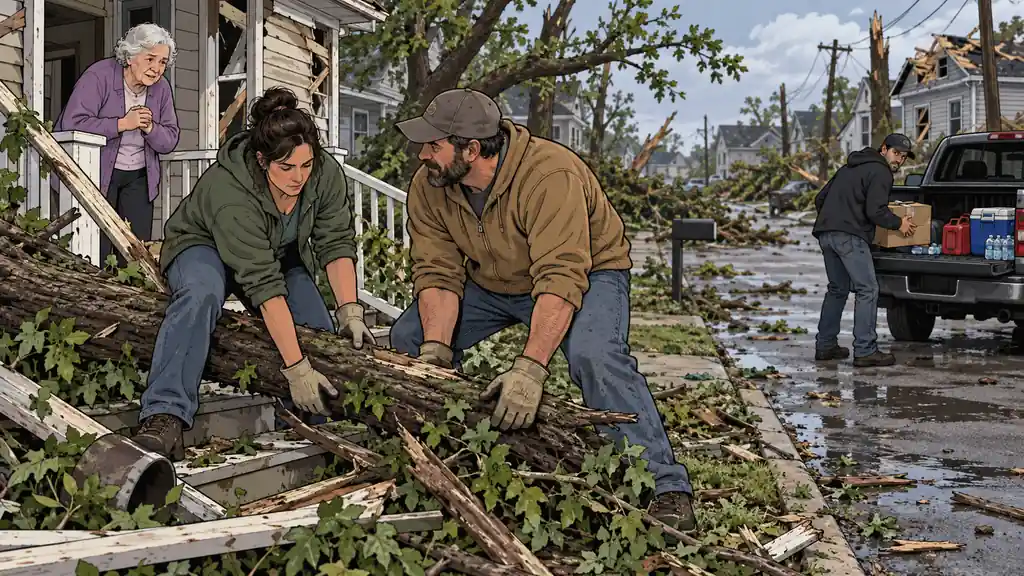
This balance is critical to preparedness because during an emergency people generally aren’t at their best. When people are hurt, scared or angry, this depraved nature commonly overwhelms the good and the result is what you typically expect during the worst of times. Understanding this nature helps us by allowing us to anticipate what depraved people may do during an emergency. But knowing the value of humanity is also valuable in these situations as it helps us avoid making the same mistakes others are making.
Bottom Line
- The Bible refuses both easy answers. We’re not “basically good,” and we’re not pure evil. We’re image-bearers of God who are also genuinely fallen — both at once.
- The fallen nature is real and universal. Romans 1 calls the natural mind “depraved,” and Romans 7 shows even Paul couldn’t overcome his sin nature on his own. Only God restrains what would otherwise consume us.
- Sin runs in a cycle — pride, God’s wrath, sin exploding, sin celebrated — and it scales from the individual up to families, churches, and nations.
- It starts and stops with the individual. Nations and churches don’t act; people do. Guarding against the cycle is personal work before it’s ever anything else.
The most important response to a fallen nature is the remedy for it — see why preparing for eternity is the ultimate preparation.
Scripture quotations taken from The Holy Bible, New International Version®, NIV® Copyright © 1973, 1978, 1984, 2011 by Biblica, Inc. Used by permission. All rights reserved worldwide.