


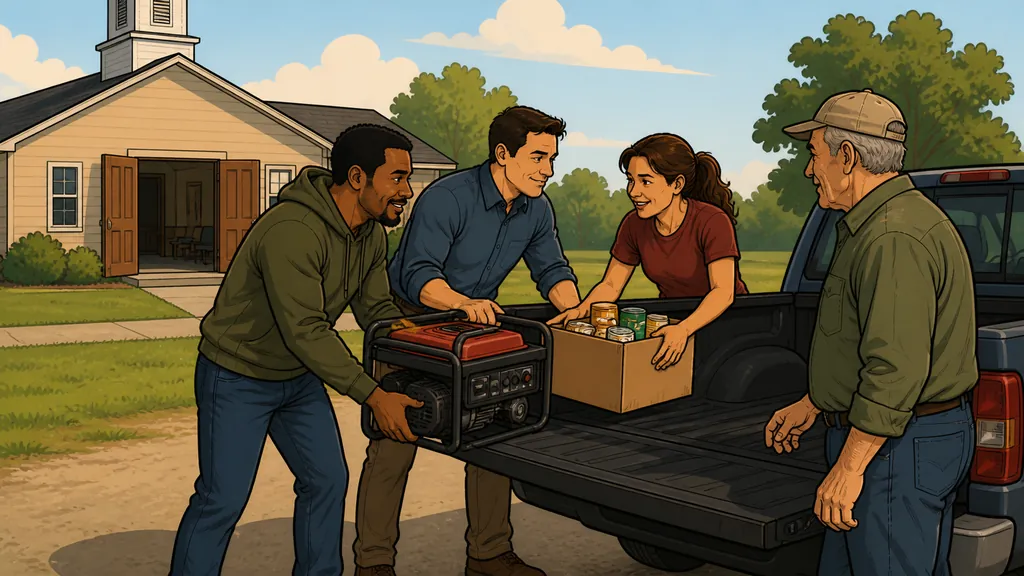
Preparedness gets sold as a solo sport — one prepared man, one stocked bunker, standing alone against the collapse. It’s a compelling image and it’s mostly wrong. A short emergency, sure, you can ride out by yourself. A long one, you can’t. And the most valuable preparedness asset a lot of people already own is one they never list on any spreadsheet: a congregation.
To be blunt, you need a community to survive a real emergency, and building one is not optional. Most people read that and think they have to go build a mutual-aid group from scratch. Many of them are already sitting in one every Sunday.
A congregation is a mutual-aid network with the trust already built
Look at what a functioning faith community actually is, stripped of the stained glass: a standing group of people who know each other’s names, families, and situations; who already have a habit of showing up for each other in a crisis; and who cover a wide spread of skills, ages, tools, and resources. That is the exact thing preppers spend years trying to assemble — and the hardest part, the trust, is already there.
Trust is the whole game, and it’s the one thing you cannot acquire during the emergency. You need someone whose loyalty runs deep enough that you’d both show up for each other no questions asked. You don’t build that kind of relationship in a parking lot the day the grid goes down. You build it over years of showing up and going through the hard parts of life together. A congregation is years of showing up and doing exactly that.
You can’t stockpile trust. It’s the one supply that has to be built before the emergency, and a faith community is often decades ahead on it.
What the body actually brings
Think in terms of redundancy, the way you’d think about backups for anything else:
- Skills. Somewhere in most congregations: a nurse, a farmer, a mechanic, an electrician, a veteran, a grandmother who cans. Capabilities no single household holds.
- Physical assets. Trucks, generators, wells, freezers, land, a building with a kitchen and space to gather.
- Care capacity. People to check on the elderly and the sick — the exact folks who fare worst in a crisis and can’t be helped by a lone prepper across town.
- Continuity. A group that already meets on a schedule has a built-in way to communicate, organize, and make decisions under stress.
None of that is theoretical. It’s the same resilience you’d pay dearly to engineer into a group from nothing.
The honest caveat
Not every congregation thinks this way, and it’s worth being clear-eyed. Plenty are entirely unprepared, or would treat the whole subject as paranoia. If that’s yours, you may be the person who starts the conversation — quietly, without turning it into a doomsday pitch. And a community is a two-way obligation: you’re not just drawing on it, you’re expected to be one of the people who shows up. That’s the point.
Bottom Line
- Long emergencies aren’t solo. You can ride out a weekend alone; you can’t ride out a season.
- You may already belong to a mutual-aid group. A congregation is a standing network with the trust pre-built.
- Trust can’t be stockpiled. It’s built over years of showing up — start now, not during the crisis.
- Belonging is two-way. Be the person others can count on, and you’ll have people to count on.
Open Area Recon and start mapping your people — who’s near you, what they bring, and who you’d count on — the same way you’d map your water.