


Say the word “prepper” and a lot of people picture a hoarder — a garage stacked to the ceiling, a person grabbing the last of everything while the shelves go bare. It’s a fair thing to be wary of. But it’s a caricature of the wrong thing. Hoarding and stewardship look similar from across the room and are opposites up close.
A hoarder accumulates for himself. There’s no plan behind the pile, no accounting, no thought of anyone outside his own walls — just the anxious grab. A steward manages something he’s been entrusted with: he knows what he has, keeps it in good order, uses it wisely, and provides from it. One is fear turned inward. The other is responsibility turned outward.
The difference is the plan and the margin
You can tell them apart by two things: whether there’s a plan, and whether there’s margin.
The hoarder’s pile has neither. It’s volume without a number — no idea how many days it actually covers, no rotation, no priority. The steward’s supply is sized to what he’s responsible for: this many people, this many days, these specific needs. He knows his number because he’s been trusted with specific people, and provision you can’t measure isn’t provision — it’s clutter you feel good about.
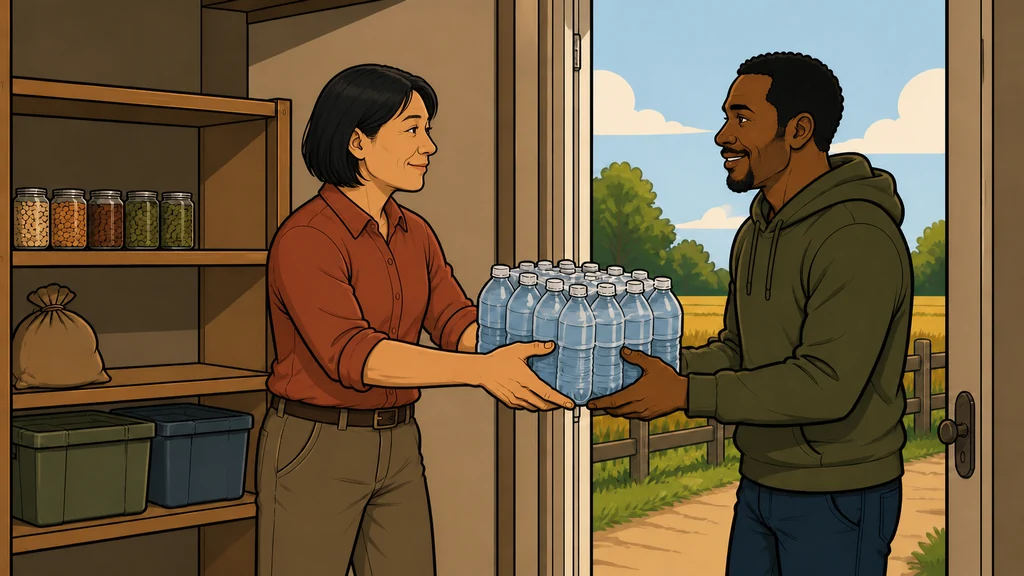
And the steward keeps margin on purpose. Not because he’s greedy, but because the well-stocked household is the only one with anything left to give. The person who can hand a neighbor a case of water, a week of food, a working plan — that person prepared as a steward. You can’t be generous from an empty shelf.
Hoarding grabs so no one else can have it. Stewardship stocks so that when someone needs it, you’re the one who can help.
It’s not just stuff
Stewardship stretches past the pantry. The land you have, the skills you’ve built, the relationships you’ve cultivated, the money you manage — all of it is entrusted, and all of it can be tended well or squandered. The prepper who learns to grow food, fix what breaks, and lead calmly under pressure is stewarding capacity, not just cans. That kind of margin can’t be panic-bought when the crisis hits.
The biblical pattern
This is old ground in scripture, and it’s worth stating plainly for readers who prepare from faith. Providing for your own household isn’t presented as optional or selfish — it’s presented as a basic duty, and neglecting it is treated as a serious failure.
“Anyone who does not provide for their relatives, and especially for their own household, has denied the faith and is worse than an unbeliever.” — 1 Timothy 5:8
“Go to the ant, you sluggard; consider its ways and be wise! It has no commander, no overseer or ruler, yet it stores its provisions in summer and gathers its food at harvest.” — Proverbs 6:6-8
Joseph is a great example of biblical preparedness (Genesis 41). Warned that seven years of famine were coming, he spent seven years of plenty storing grain — and that stored surplus didn’t just feed his own family, it kept a whole region alive when the famine came. That’s stewardship at scale: provision built in the good years, held in reserve, and turned into rescue for others when it mattered.
Now, will you or I be able to save an entire country or region? Probably not. But it’s very possible that your preparations may save a neighbor or someone else close to you.
Bottom Line
- Hoarding grabs; stewardship manages. One is fear turned inward, the other is responsibility turned outward.
- Size your supply to what you’re responsible for. A number you can measure is provision; a pile you can’t is clutter.
- Keep margin on purpose. The well-stocked household is the only one with anything left to give.
- Steward more than stuff. Skills, land, and relationships are entrusted too — and they can’t be bought in a panic.
Open the Food & Water planner to turn “enough” into an actual number for your household — the first step from a pile into a plan.
Scripture quotations taken from The Holy Bible, New International Version®, NIV® Copyright © 1973, 1978, 1984, 2011 by Biblica, Inc. Used by permission. All rights reserved worldwide.