


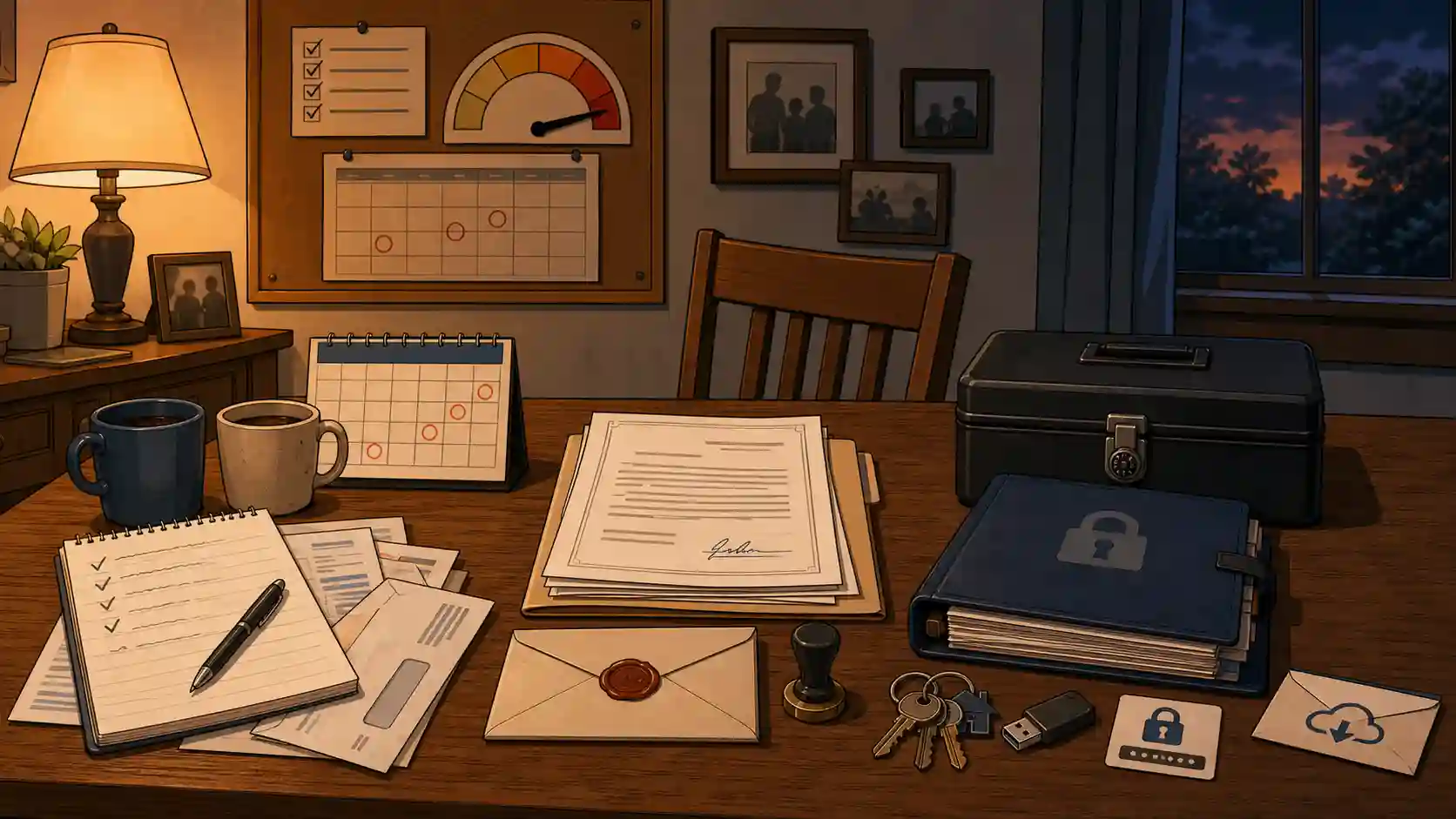
Everyone dies. It’s the one certainty in this life. Because it’s a certainty, it means that we as preppers should actually prepare for it. I know it’s morbid to talk about, but it’s true. What happens after you die is something you need to decide. Who gets all your cool stuff? Is your spouse set up to be able to survive without you? Do you want a funeral service?
This topic came into focus for me when a man I know passed away unexpectedly. The problem was his wife didn’t pay the bills. She didn’t even know what bills got paid, when or how. She knew they were down by more than half their income without him, but she didn’t have a clear plan for what to do next — and it made an already difficult situation much worse.
Run the threat-rating math on this one and it breaks the calculator. Likelihood: 100%. Not “likely.” Not “eventually.” Certain. There is no other item on this website that scores that way, and yet it’s the one people skip to go buy another case of ammunition.
The three parts
Preparing for your death has three pieces, and they have to happen in this order:
- Discussions — the knowledge in your head that nobody else has.
- Legal — the paperwork that makes your decisions binding.
- Wishes — what you want, so your family isn’t guessing while grieving.
Most people who do anything at all do step two and stop. A will in a drawer doesn’t tell your spouse which account the mortgage comes out of.
Discussions
This is the free part and the part everyone avoids.
Here’s the test: if you didn’t come home tonight, could your household operate tomorrow? Not emotionally — mechanically. Would they know what to pay, from where, and when? Would they know what money exists and what it’s for?
The man I described was a good husband by every measure except this one. He handled the bills so his wife wouldn’t have to. That kindness became her second disaster.
Sit down with your spouse — or whoever would be picking up the pieces — and walk through it out loud, then write down the answers:
- The money in. Every income source. What stops at your death, what continues, what changes. Pensions, benefits and insurance all have rules; find out what yours are while you can still ask.
- The money out. Every recurring bill: what it is, who it’s paid to, from which account, on what date, automatic or manual. This list alone is worth an afternoon.
- The accounts. Where they are, what’s in them, and — critically — who can legally touch them. An account only in your name can be frozen at exactly the moment your family needs groceries. Ask your bank what happens to each account, and ask before you need to know.
- The debts. What’s owed, to whom, and what happens to it. Some die with you. Some don’t. Don’t guess.
- The professionals. Attorney, accountant, insurance agent, financial advisor. Names and numbers, written down. Your family should not be meeting these people for the first time via a search engine.
- The dependents. If you have kids, who raises them? If you have aging parents you help, who helps them? If you have animals, who takes them?
- The passwords. Your entire life is behind a login now. If your password manager dies with you, so does access to nearly everything else on this list.
Do it on a calm weekend. It is not a fun conversation and it takes about two hours. Then run the drill in reverse: if your spouse didn’t come home, could you operate? In most households, both directions have holes.
Legal
Depending on your situation, you may want to consider trusts, wills and other legal options. Based on my personal experience, I recommend that everyone has a will — it just makes things go smoother. Even if you think it’s overkill for your situation, I would consult with an attorney.
I’m an engineer, not a lawyer, so I’ll stay in my lane and give you the engineering version: this is a system with a single point of failure, and the failure mode is that a court decides for you. If you die without a will, your state has already written one for you, and you didn’t get a vote on it. Whether that outcome resembles what you’d want is pure luck.
A few things worth understanding well enough to ask good questions:
- A will directs who gets what and, if you have children, who raises them. That second part is the one that should get you off the couch.
- Beneficiary designations on retirement accounts and life insurance generally pass outside of a will — which means a form you filled out fifteen years ago may quietly overrule the document you paid an attorney to draft. Go look at yours. People find ex-spouses on those forms.
- Powers of attorney and medical directives cover the gap most people forget: you’re not dead, you’re incapacitated, and someone has to make decisions today. Statistically this is likelier than the clean version.
- Trusts solve real problems for some households and are unnecessary complexity for others. That’s a conversation with an attorney in your state, not a decision to make from an article.
The rules genuinely vary by state, and the cost of getting this wrong is borne entirely by people you love. Pay the attorney. It is one of the highest-value dollars in all of preparedness, and it’s a one-time cost for a certain event.
Once the documents exist, they’re only useful if they can be found. That’s the documents and records problem, and the same 3-2-1 rule applies: three copies, two media, one off-site. A will nobody can locate is functionally a will that doesn’t exist. Our Digital Binder is a good place for the copies and the account list, and it prints — because the day this matters, your family should be able to hold paper.
Wishes
The paperwork covers what happens to your assets. It says nothing about what happens to you, and that’s the part your family will be deciding within about 48 hours, in the worst emotional state of their lives, with no idea what you wanted.
They will guess. Then some of them will spend years wondering if they guessed right, and a few families never recover from the argument.
Spare them. Write it down — plainly, in a page:
- Burial or cremation. Where. Whether you care.
- A service or not. What kind. Who speaks. What music. Whether you’d rather they skip the whole thing and have a cookout.
- Organ and tissue donation. Decide, register, and tell them, so nobody’s guessing in a hospital hallway.
- The stuff with stories. Not the valuable things — the meaningful ones. The rifle from your grandfather, the tools, the workbench. Say who gets them and, better, say why. This is where families fracture, and it’s almost never about money.
- Your digital life. Photos, accounts, the archive of your family that lives on a hard drive only you know about.
- Letters. If there’s something you’d want said, write it now. Nobody has ever regretted finding one.
None of this requires a lawyer. It requires an hour and a willingness to be uncomfortable.
Eternity
I’m a Christian, so I want to be sure to mention the other half of this topic - what happens to your soul when you die. I’ve written an article about this that I recommend you read if it’s something you have uncertainty about. This is truly the most important preparation that any person can make, so don’t skip it.
Bottom Line
Out of every event mentioned on this website, this is the one that will occur with 100% certainty. As a result, there’s no excuse not to prepare for it. Before you buy more bullets, beans or bandages, have the necessary conversations and then put it into writing.
Three steps, in order:
- Talk. One calm afternoon, both directions, and write down the answers.
- Sign. A will at minimum, plus beneficiary designations you’ve actually re-read. Consult an attorney in your state.
- Store it where they’ll find it. Three copies, two media, one off-site — same as everything else that matters.
This is the only prep on this site with a guaranteed return. Do it before the fun ones.