


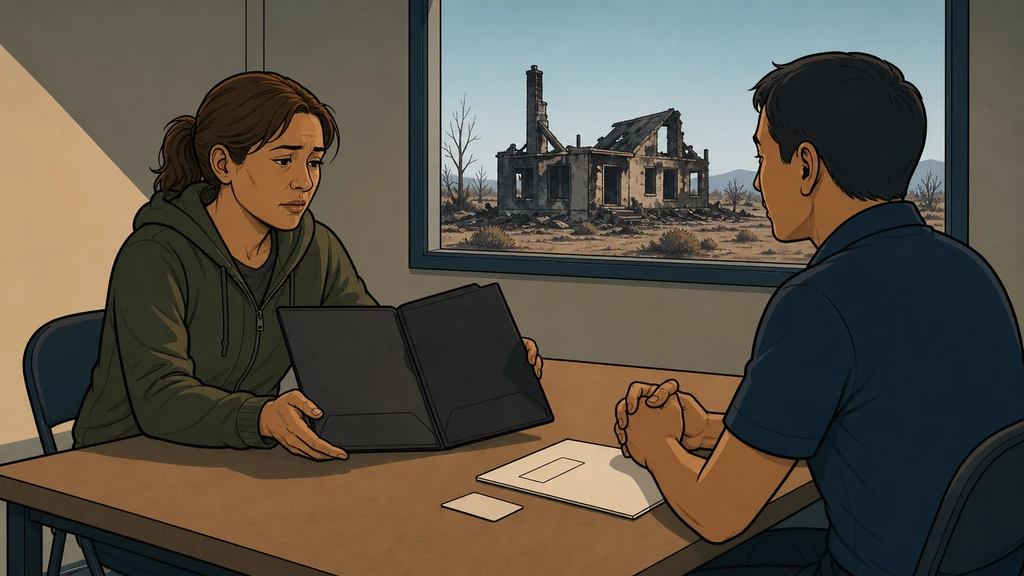
Most people picture disaster recovery as a matter of stuff — the house, the car, the possessions. So they insure the stuff and feel covered. That’s the belief, and it’s half the story. The other half is that before anyone hands you aid, a check, or a replacement anything, they will first make you prove you are who you say you are — and the disaster you’re recovering from is very often the exact event that destroyed your proof.
This is the quiet second disaster. Not the loss of things, but the loss of your ability to demonstrate your own existence to the systems that run your life.
Recovery runs on proof, and disasters burn proof
Walk the chain of a total loss and count how many doors demand a document. Disaster assistance generally asks you to prove identity, occupancy, and ownership — that you are you, that you lived there, and that the thing you’re claiming was yours. Insurance wants the policy and a proof of loss. The bank may freeze an account until it can verify you. The pharmacy needs to confirm the prescription. Every one of those is a checkpoint, and every checkpoint wants paper.
Now notice the trap. The fire, the flood, the tornado — it took the house. The house is where the birth certificate, the Social Security card, the deed, the policies, and the passport all lived. The event and the proof share an address.
A disaster doesn’t just take what you own. It takes your ability to prove you owned it — and, at the DMV, your ability to prove you’re even you.
The chicken-and-egg you don’t want to discover live
Here’s the part that turns a bad week into a bad quarter: the documents that prove identity are used to replace each other. Replacing a driver’s license typically wants another form of identity. Replacing a birth certificate or a Social Security card often wants a photo ID. When all of it burned at once, you can land in a loop where each replacement demands the document you’re trying to replace.
People do climb out of that loop — case workers and agencies have processes for exactly this — but it costs weeks you’ll want for rebuilding, at the moment you have the least patience for a government line. The fix is upstream: make sure at least one clean copy of the proof was never in the building.
The three proofs to pre-stage
You’re defending against a specific demand: identity, residence, and ownership. Stage a copy of each somewhere the local disaster can’t reach — a relative’s house two states away, a safe deposit box in another town, or an encrypted copy off-site.
- Who you are. Certified birth certificates, Social Security cards, passports, driver’s licenses — copies for every person in the household. A certified copy is worth more than a photocopy at most counters; know which you have.
- Where you lived. Deed or lease, a recent utility bill, mortgage statement — the paper trail that proves occupancy for aid and insurance.
- What you owned. The deed, titles, policies, and inventory with values. This is the difference between a claim that pays and a claim that argues.
The 3-2-1 rule already covers the mechanics — three copies, two media, one off-site. Identity recovery is simply the reason the off-site leg is non-negotiable. An on-site backup and the originals burn in the same fire.
While you can still ask
Two moves cost nothing today and are miserable to attempt after a loss:
- Order the certified copies now. A certified birth certificate takes a form and a small fee on a calm day, and a phone call you don’t want to make on a bad one. Get spares; put one in the off-site set.
- Write down the reissue path. For each critical document, note the issuing agency and what it takes to replace it, and keep that note with the off-site copies. When you’re standing in the rubble, “who do I even call?” is its own delay.
Bottom Line
- Recovery is a proof problem. Aid, insurance, and replacements all demand you prove identity, residence, and ownership — before they help.
- The disaster and the documents share an address. Whatever destroys the house destroys the proof stored in it. Plan on that, don’t hope against it.
- Break the chicken-and-egg in advance. IDs reissue each other; when they all burn together you can get stuck. One certified copy, off-site, ends the loop.
- The off-site leg is the whole point. Three copies mean nothing if all three are in the same fire. Put one two states away or in an encrypted vault.
Keep certified copies of the proof that you exist in the Digital Binder — encrypted and off-site, exactly where the next disaster can’t reach.