


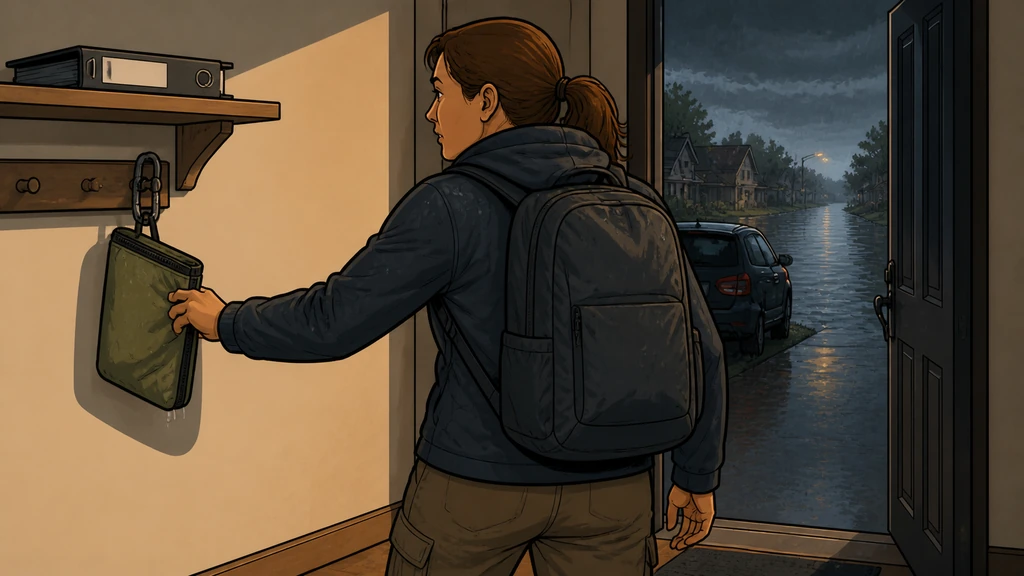
The advice you’ve heard is “keep a binder.” It’s good advice, and we’ve made the case for it. But a binder is a library — comprehensive, heavy, and built to live on a shelf. In a fast evacuation you are not carrying a library. You’re grabbing what fits in one hand, and if you have to choose in the moment, you’ll choose wrong.
So don’t choose in the moment. Build a second thing: a small, waterproof pouch that holds the twenty percent of your records that covers eighty percent of the emergencies — and keep a copy of it everywhere the binder isn’t.
The binder and the pouch are different tools
The binder is your complete reference: every policy, every plan, every map, every account. It’s where you go to look something up on a calm day, and it’s one of the things you grab if you have time.
The pouch is different. It exists for the case where you have sixty seconds and one free hand — a house fire, a gas leak, a “get in the car now” flash flood. Its whole job is to be small enough that grabbing it is automatic and complete enough that you can rebuild your life from it. That means it can’t be the binder. It has to be a deliberate subset.
The binder answers “what do I need to know?” The pouch answers “what do I need to carry?” Confusing the two is why people either pack nothing or try to pack everything.
What goes in the pouch
Keep it to the records that recovery, shelter, and travel actually demand. Copies for most of it — the originals stay in a fire-rated safe or a safe deposit box — with a few exceptions noted below:
- Identification — copies of driver’s licenses, passports, and Social Security cards for every household member. One page per person.
- Insurance — policy numbers and the agent’s direct phone for home, auto, health, and life. Not the whole policy; the number and the human who answers.
- Emergency contacts — family, friends, doctors, attorney, printed on paper, because your phone is the thing you’re most likely to lose or drain.
- Medical — current medication list (name, dose, prescriber) and any critical conditions for each person. This one saves lives at a shelter or an ER.
- Money — some cash in small bills, because “the card readers are down” is a Tuesday, not a doomsday.
- The digital twin — an encrypted USB drive holding the entire binder. This is the trick that lets the pouch stay thin: the paper is triage, the drive is the full archive.
Two documents earn a harder look. A passport is both your ID and your exit if a border ever matters, and a certified birth certificate is the master key for replacing almost everything else. Whether the original or a certified copy rides in the pouch is a judgment call about your risks.
Build it so grabbing it is automatic
A pouch you have to think about is a pouch you’ll forget. Engineer that out:
- Waterproof and one-piece. A sealed zip pouch or a small dry bag. Water and fire are the two things most likely to be happening when you need it. Magpul DAKA pouches are perfect for this.
- Copies in more than one place. Same 3-2-1 logic as everything else — one in the go-bag, one in the car, the master in the binder and on the drive. A pouch that’s in the house that’s on fire helped no one.
- Same place, every time. Clipped to the go-bag, top of the pack, by the door. Muscle memory beats a checklist when the smoke alarm is going.
- Dated. Write the review date on it. An expired ID copy and a dead medication list are worse than useless — they’re wrong.
Our Digital Binder is built for exactly this workflow: it holds the encrypted master, and it prints a clean grab-set so the paper in your pouch always matches the truth on the drive.
Bottom Line
- Two tools, not one. The binder is the library you consult; the pouch is the subset you carry. Build both.
- Curate ruthlessly. IDs, insurance numbers, contacts, medications, cash, and one encrypted drive. The drive carries the depth so the paper can stay thin.
- Copies everywhere, originals secured. Go-bag, car, binder, drive — one copy is always somewhere the current disaster isn’t.
- Make it grab-proof. Waterproof, same spot, dated. If reaching it requires a decision, you’ve already lost the sixty seconds.
Load the master copy into the Digital Binder, then print the grab set — your pouch and your archive stay in sync.