


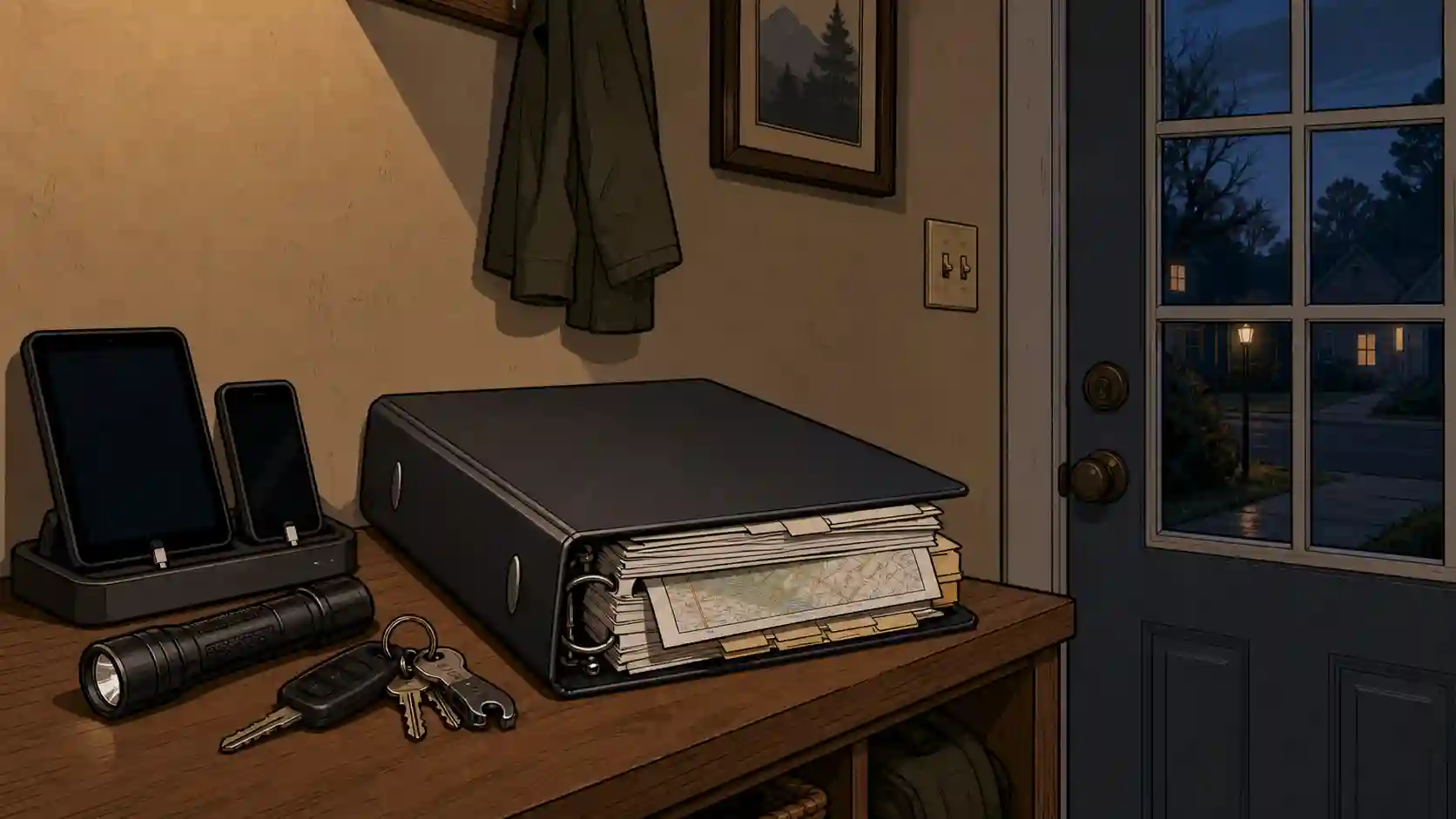
We build this whole site around software, so this may sound strange coming from us: every prepared home should keep a paper binder. Not instead of the digital tools — alongside them. The two fail in opposite ways, and that’s exactly the point.
Digital is brilliant until it isn’t
Your phone holds your insurance policy, your medication list, your contacts, your account numbers. It’s searchable, syncable, and always with you — right up until the battery dies, the cell network drops, or the power’s been out for three days and there’s nothing left to charge it with.
The failure modes of digital are precisely the situations preparedness exists for.
What paper does that screens can’t
A binder has no battery, no password, no signal requirement. In a genuine emergency it has a quiet superpower: it just works.
In a separate article I explained all the important records and documents that should be backed up and how. I recommend you read that article first as it lays the framework and this article really expands upon it.
Beyond personal records - your plans.
Here, we’ll take the paper backup and expand upon it. While I believe that you should include all that information into your binder, it’s far from the only content that should be included. I feel that your preparedness plans are just as important to include.
Hopefully, you’ve created plans for each threat that you are preparing for. If not, we have several free tools that can help you accomplish this. Each of these plans should be printed and included into your binder. If starting from scratch, this article will also help you get started.
Your goal here is to include everything you need, but to do it in such a way that it’s easy to read and understand quickly. The best analogy I have for this is the cookbook. I know it sounds silly at first, but think about it. A cookbook has everything you need to know in a simple and easy-to-read format. The structure makes it easy to find the information you need. These are the same desires that we have for our threat analysis and plans. As a result, build a system that includes all the information you may need while keeping it simple. For these plans, I recommend the following be kept in mind while writing it:
- Short - Keep it short and sweet. Share all of the key information with no extra. No paragraphs or even long sentences.
- Simple - No big words or anything else that will slow reading it. Write it so that a 6th grader can read it and do what it says quickly. This age is picked for a reason – it’s the average reading comprehension level in the United States (which says a lot about the failures of our public education system…). Furthermore, during an emergency people will be stressed, which lowers their comprehension level. You’re also not going to have the time to read a 100-page dissertation about how to address an issue. You need to get to the points quickly and concisely.
Plan Contents
While we do want to keep it short and sweet, there are several things that you’ll want to include. Like a recipe, this should include all the information you would ever need about what it is, the assumptions made, and what to do in the moment. To this end, I recommend you include the following minimum information in your plans:
- Threat Name - Big, bold letters at the top of the page so it’s extremely clear and easy to find
- Brief Description - A short description of the threat scenario. It should be easily understandable by anyone that might pick up this sheet. This won’t be used in the moment, but is extremely useful for everyone in the household to read beforehand so they’re familiar with it.
- Signs - How do you know the threat has happened or is happening currently? For more obscure threats it can be helpful to include this (EMP for instance).
- Preparations - What are you doing to prepare for the threat?
- Reaction - What do you do when it occurs? Get out of the house, etc. for a fire. These are the things you will drill with your family.
- Response - What do you do afterward? Steps to recover and begin the steps back to normalcy. Include key phone numbers, etc. here so you’re not searching.
For Preparations, reaction and response, I recommend you create these for both yourself and also for your neighbors / community. If your neighbor’s house catches on fire, you need to know what to do as well.
If you want to go further, the following are other things that may be worth including depending on how deep you want to go:
- Goals - It’s hard to reach a goal that you don’t set…
- Ratings - I recommend all threats be rated. This helps you prioritize your preparedness activities so you maximize your time and money. We have a Threat Planning tool to help you achieve this and it will feed directly into our planning tools as well.
- Critical Facts and Assumptions — What assumptions were made that affect the analysis? There are always assumptions made or actions based on critical facts. Note them now so that when you’re re-rating you know what assumptions the plans were based upon. This is extremely helpful for someone to pick up where you left off, as well.
- Intelligence Gaps — What could we miss from an intelligence standpoint? What don’t you know? I know it’s a hard thing to know what you don’t know, but it does occur sometimes and should be noted.
- Risks/Complications — What risks or complications could exist that need to be considered? Similar to facts and assumptions, you want to understand things that may complicate your response to a threat.
I try to make each of these plans as comprehensive as possible while at the same time making them simple & easy to read. It’s a hard balance to walk, but I recommend you do the same.
A Family Resource
I’ve alluded to it above, but I want to make the point about what a great resource this binder becomes for your family. This binder should be the effective center of your preparedness activities:
- When you do emergency drills (you do drills, right?), give the book to a different family member each time and let them run it - it’s a great teaching tool as it forces them to become familiar with how to handle any threat.
- Even if you’re away, your family has all the information they need to respond properly to any threat that emerges.
Maintenance
A binder is only as good as its last update. Keep it somewhere known and grab-able, refresh it on a schedule (a yearly review is plenty for most of it), and store the truly sensitive pieces with appropriate care.
Bottom Line
The digital tools here will always be the fast, powerful way to plan. But when the lights go out, calm comes from knowing the important things are also sitting on a shelf, in ink, waiting — no batteries required.