


“I’m insured, so I’m covered.” It’s the sentence that lets people stop thinking about it, and it’s true right up to the moment you file a claim. Then you learn the fine print of how insurance actually works: after a loss, the company doesn’t pay for what you owned. It pays for what you can prove you owned — and the burden of proof is entirely on you.
That’s a fine arrangement when you’ve lost one laptop and still have the box and the receipt. It’s a brutal one after a total loss, when the adjuster asks for an itemized list, with values, of every possession in a house that no longer exists — and the receipts, the manuals, and the photos that would have proved it all burned in the same fire.
Memory is a terrible inventory
Sit down cold and try to list everything in one room — every tool, every kitchen item, every piece of clothing, the small stuff in every drawer. You’ll get a fraction of it, and you’ll price most of that fraction wrong. Now do it grieving, exhausted, and under a claim deadline, for the whole house. The gap between what you owned and what you can list from memory is money you paid premiums on and will never see.
Your policy limit is the most it will pay. What you actually collect is capped by what you can document. Those are two very different numbers, and the second one is the one you control.
This is why a home inventory isn’t paperwork for its own sake — it’s the instrument that turns your coverage limit into an actual payout. Without it, you’re negotiating from memory against a professional who does this every day.
Build the record once, the right way
The good news: a complete inventory is a one-afternoon project with a phone, and it only needs real updating when you buy something significant.
- Walk the whole house on video. Narrate as you go — “living room, this is the TV, sixty-five inch, bought last year.” Open closets, drawers, cabinets, the garage, the shed. Video captures volume and context that a written list never will, and it’s fast.
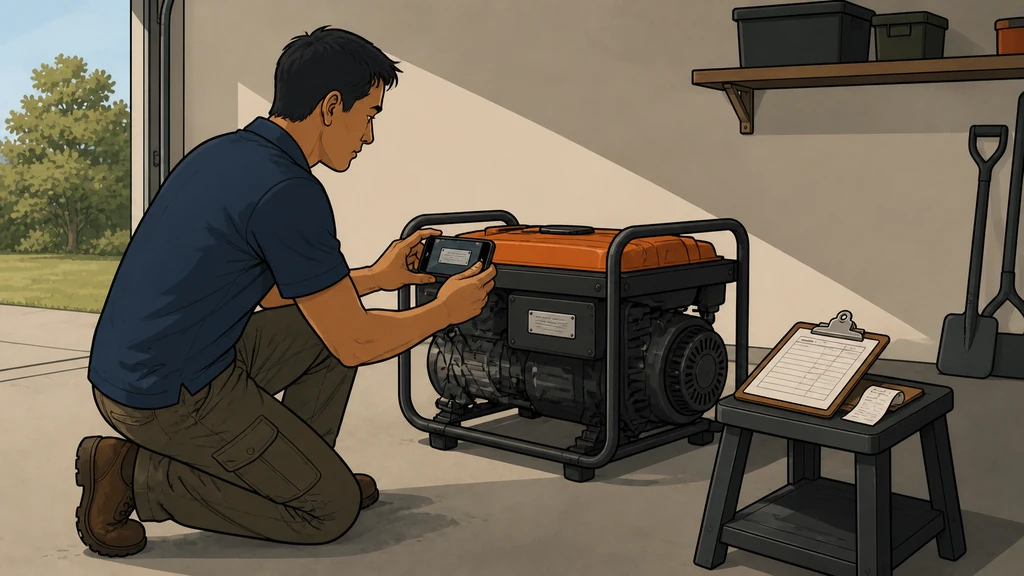
- Photograph the things that matter individually, with serial numbers and model numbers legible. Electronics, tools, appliances, firearms, cameras, anything with a plate. A serial number is the least arguable proof there is and it’s very important should you ever be robbed - the police will want these numbers to try and help catch the thieves.
- Keep receipts for the big items. You don’t need a receipt for every fork. You do want them for the expensive, easily-doubted things — the categories an adjuster scrutinizes.
- Note counts and rough values for the bulk stuff — how many of a thing, roughly what it’s worth. Precision matters most where the dollars are.
Our Supply Inventory Tools are built for the parts that need structure — the typed records where make, model, and serial number matter, like firearms, tools, and equipment. That structured detail is exactly what survives scrutiny on a claim.
The proof has to outlive the house
Here’s the failure that makes all of the above worthless: a beautiful inventory stored on the home computer, or in a drawer, or on a shelf — inside the house it’s meant to document. It burns with everything else and proves nothing.
The 3-2-1 rule is the whole game here: three copies, two kinds of media, one off-site. The video and the photos go to an off-site copy — a relative’s drive, an encrypted vault, cloud storage you can reach from anywhere. The Digital Binder is built for this: encrypted, off-site, reachable after the event that destroyed the originals.
Know your policy’s blind spots
An inventory also surfaces a second problem before it becomes a surprise: standard policies often cap certain categories regardless of what you can prove — jewelry, firearms, cash, collections, and business equipment are common ones. The exact limits are specific to your policy, so this is a conversation with your agent, not a number to take from an article. Building the inventory is how you find the categories where your coverage and your possessions don’t match, while you can still buy a rider to fix it.
Bottom Line
- Coverage is a ceiling; documentation is the payout. The policy sets the most you can get. Proof decides how much of it you actually collect.
- Video first, serials second. A narrated walkthrough captures the volume; photographed serial numbers make the valuable items impossible to argue.
- Off-site or it doesn’t exist. An inventory stored in the house it documents burns with the house. One copy lives somewhere else — always.
- Read your own limits. Building the list exposes the capped categories — jewelry, guns, cash — in time to add a rider instead of eating the gap.
Build the itemized record in Supply Inventory Tools, then store the video and receipts off-site in the Digital Binder — proof that outlives the loss.