


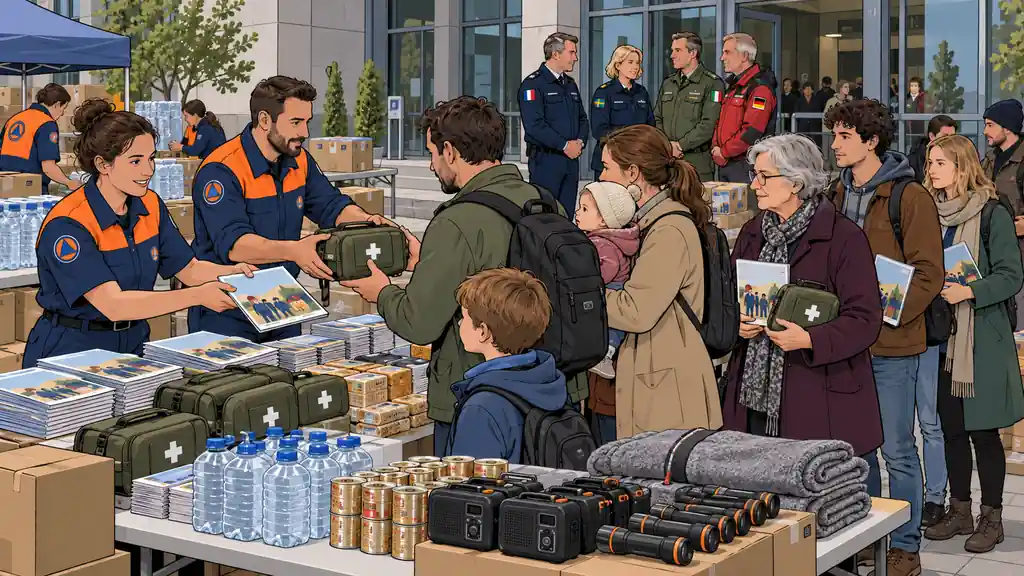
Governments telling citizens to keep a few days of supplies is, by itself, completely ordinary. The United States has run Ready.gov for twenty years, and FEMA’s standing advice has long been to keep at least three days — ideally two weeks — of food and water. Sweden mails every household a booklet literally titled If Crisis or War Comes. Finland has a celebrated “72 hours” civil-preparedness tradition. So if you see one country issue a stockpiling notice, the correct reaction is a shrug. It’s good governance, not an omen.
The reason I’m writing this is not any single notice. It’s the clustering. Over roughly the last 90 days, at least ten countries have told their citizens to prepare — and when you line them up, two things jump out: they’re concentrated in two specific regions, and several of them are reversing decades of “don’t worry” at the same time.
The last 60 days
Here is the cluster, as best I can assemble it for the last 60 days or so:
| Date | Country | Guidance (recent) | Link |
|---|---|---|---|
| September 25, 2026 | Poland | 3 days | Link |
| October 1, 2026 | Belgium | 3 days | Link |
| October 12, 2026 | Netherlands | 3 days | Link |
| October 13, 2026 | EU (all 27 countries) | 3 days | Link |
| October 19, 2026 | Ireland | 3 days | Link |
| October 22, 2026 | United Kingdom | 3 days | Link |
| October 26, 2026 | Japan | 3–7 days | Link |
Any one of these, in isolation, is business as usual. Some of these countries have always told citizens to keep supplies and maintain fallout shelters; for them, a notice is a routine refresh. But the UK, Ireland, the Netherlands, and the entire EU reviving or launching household-preparedness guidance in the same season is not their normal posture. That’s the tell: it’s not that preparedness advice exists; it’s that several governments which spent a generation treating it as fringe are all issuing it at once.
Two regions, one message
Look at where the notices cluster and the picture sharpens. Six of the seven are European, and they ring the obvious concern — a continent that watched a land war return in 2022 and now hears its own ministers counting down to 2030. These nations are far from the first to proclaim this as well. In fact, if you look back to 2024, you can add almost two dozen more nations to the list. It’s hard to ignore that Europe as a whole is telling their citizens to prepare.
The other — Japan and, by extension, the anxieties of the broader Indo-Pacific — ring the second concern: China, Taiwan, and a region quietly bracing for the possibility that a Pacific conflict disrupts the trade, shipping, and supply lines the whole area lives on. Japan asking households for a week of supplies in the same window it’s screening for broader national readiness is not a coincidence of the calendar.
So, normal or something deeper? Both. The mechanism is normal — governments nudging citizens toward self-reliance is healthy and overdue. But the pattern — two strategic regions, each ringing with war talk, telling their publics to stock up within the same 60 days — is not what a quiet world looks like. Governments are slow and allergic to alarming people. When this many of them move together, they’re reacting to the same assessments, not to each other.
What it means for an American
The U.S. isn’t on that list this season, but that’s cold comfort: FEMA has told you the same thing for two decades, and the reasons European and Asian governments are suddenly urgent are reasons that pull the United States in too, through alliances and through a global economy that doesn’t respect borders. The useful move is also the simplest. Every one of those governments is asking for the same humble thing — a few days to a couple of weeks of food, water, and essentials. You can do the top end of that range this month, gradually, without anyone’s instruction. When several countries independently land on “keep supplies,” the argument is settled; only the doing is left.
Bottom Line
- One notice is noise; seven is a pattern. Governments encouraging preparedness is routine. Ten doing it in 60 days, clustered in two war-anxious regions, is not routine.
- Watch who’s reversing. The UK, Ireland, and the Netherlands saying it is the change worth noting.
- The map tells the story. Europe is bracing for Russia; Japan is bracing for a Pacific disruption. Same message, two theaters.
- You already have your instruction. FEMA’s said it for twenty years. Do the two-week version of what ten governments just asked their citizens to do — calmly, now, before you need it.
Turn “keep supplies” into a real household number with the Food & Water Storage tool, and weigh the bigger picture with the World War threat brief.