


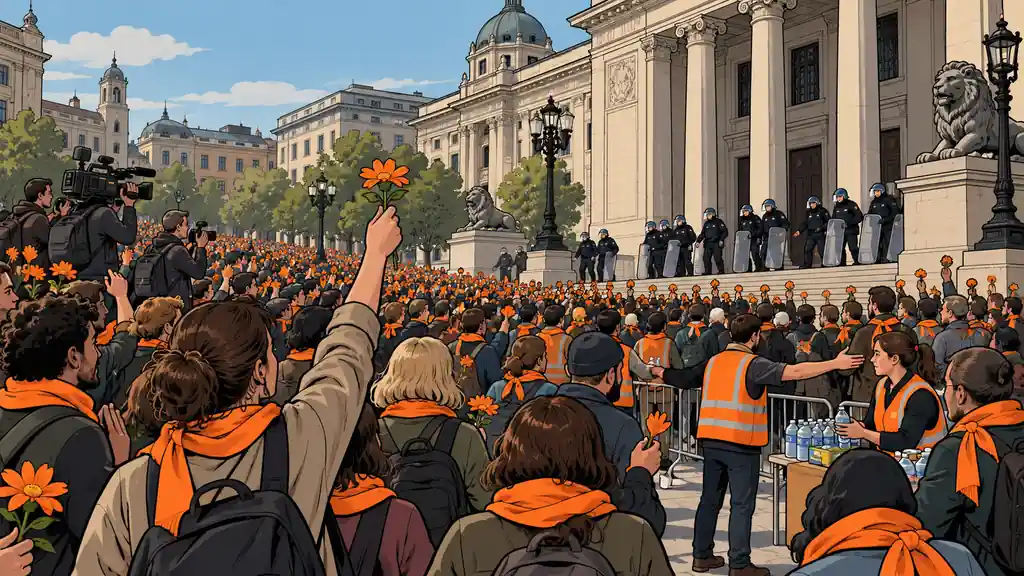
Most revolutions are slow. Political reform is measured in decades. An armed insurgency or a civil war runs, on average, about ten years. A color revolution is the exception that breaks the pattern: it is built to topple a sitting government in a few weeks to a few months, with as little bloodshed as the organizers can manage. That compression isn’t luck. It’s the whole point, and it is the product of a specific, rehearsed playbook.
I cover color revolutions briefly in The Ultimate Preparedness Framework because they sit at a particular rung on the ladder toward civil war — the non-violent coup that, handled well by its planners, never has to become a war at all. This article expands that short treatment into the full picture: what a color revolution actually is, the three pillars it attacks, the role violence plays even when the campaign is “non-violent,” the mathematical tipping point its planners aim for, and four real cases that show the method working — and, in the last one, tipping into exactly the bloodshed it was designed to avoid.
A color revolution is a coup run on a stopwatch. The plan is finished before the first protest; everything after is execution.
What a color revolution is
Strip away the branding and a color revolution is a regime-change method: a coordinated civil-resistance campaign aimed at removing a government quickly, usually without open warfare. The name comes from the habit of adopting a single color or symbol — a rose, the color orange, a tulip — so a stranger can signal membership in the movement with a scarf or a flag, and so the world’s cameras have an easy visual shorthand.
How you describe the method depends on where you stand, and it’s worth stating both views plainly rather than pretending there’s only one. To its participants and much of the Western press, a color revolution is a popular, non-violent uprising against a corrupt or authoritarian government, usually triggered by a stolen election. To the governments on the receiving end — and to critics like the Russian state — it is a foreign-engineered coup, a destabilization campaign dressed up as a grassroots movement and funded through Western NGOs and democracy-promotion money. The honest answer is that the label describes a set of tactics, and those tactics have been used both by genuine popular movements and by well-resourced political operations. What matters for understanding the threat is the method itself, because the method is the same either way.
The playbook: attack three pillars at once
Every government, no matter its form, stands on three pillars. A color revolution is engineered to knock out all three simultaneously — the organizers understand that attacking them one at a time just lets the government shore up the others. The plan is fully formed before any public action begins; what you see on the street is the execution phase, not the planning phase.
| Pillar | How it’s attacked |
|---|---|
| Legitimacy | Convince the public the government was never legitimately elected — or that it has forfeited its mandate through fraud — so its leaders “don’t have the right” to govern and can be resisted. A disputed or stolen election is the ideal catalyst. |
| Authority | Convince people to disregard the government’s laws and orders directly. The leadership is painted as not merely wrong but immoral or evil, so disobedience becomes a duty rather than a crime. |
| Capacity | Starve the government of what it needs to function — money, people, and the physical flow of goods. Think blocked ports and rail, withheld taxes, mass strikes, and deliberately triggered economic pain. |
Notice how these reinforce each other. Once enough people believe the government is illegitimate (pillar one), ignoring its authority feels righteous rather than reckless (pillar two), and the strikes and blockades that cut its capacity (pillar three) look like justice instead of sabotage. Hit all three in the same window and a government can lose the ability to govern faster than it can respond.
”Non-violent” — but the threat of violence is a tool
Color revolutions are marketed as non-violent, and mostly they are. But organizers have learned that the threat of violence does the work of violence while leaving them the moral high ground. A crowd that could turn into a riot is leverage even if it never does. Actual bloodshed tends to backfire — it hands the government a justification to crack down and splits public sympathy — so the sophisticated version keeps the violence latent: implied, massed, and photogenic, but held in reserve.
There’s a second lever worth naming because it recurs across multiple cases: a distinct group within the population — an ethnic minority, immigrants, a religious sect, a region — is either vilified or glorified to swing the legitimacy fight. Cast the government as the oppressor of a sympathetic group, or as the captive of a resented one, and you move the middle of the country without having to win it argument by argument.
The tipping point: the 3.5% rule
The organizers are not trying to convince everyone. They’re trying to reach a tipping point — the moment a resistance campaign hits critical mass and adoption becomes self-sustaining. The most-cited number here comes from political scientists Erica Chenoweth and Maria Stephan, whose book Why Civil Resistance Works studied hundreds of resistance campaigns across the twentieth century. Their finding, now known as the 3.5% rule, is blunt: no government in their dataset withstood a campaign once it achieved the active, sustained participation of 3.5% of the population — and non-violent campaigns succeeded about twice as often as violent ones.
Consider how small that number is. In a country the size of the United States, 3.5% is just under 12 million people actively and repeatedly in the streets. That sounds enormous until you remember it’s roughly one in thirty adults — and that the planners don’t need all 12 million on day one, only a credible path to it. “Active and sustained” is the catch that saves most governments: a one-day march of millions is not the same as 3.5% showing up week after week. But the threshold is a real target, and serious movements organize toward it on purpose.
Four times the playbook worked
The method isn’t theoretical. A cluster of post-Soviet states supplied the template, and each case shows the pillars being knocked out in sequence.
Rose Revolution — Georgia, 2003
Georgia’s November 2003 parliamentary elections were widely seen as rigged in favor of President Eduard Shevardnadze. The opposition, led by Mikheil Saakashvili and backed by the youth movement Kmara (“Enough”), refused to accept the result — the legitimacy pillar. On November 22, protesters carrying roses walked into the parliament building mid-session; Shevardnadze was hustled out, and he resigned the next day rather than order a bloody crackdown. Saakashvili won the presidency in a January 2004 revote. It was fast, nearly bloodless, and consciously modeled on Serbia’s Otpor movement, which had helped topple Slobodan Milošević in 2000 — the first sign this was a transferable method, not a one-off.
Orange Revolution — Ukraine, 2004
A year later, Ukraine ran the same play on a bigger stage. The November 2004 presidential runoff between Viktor Yanukovych and Viktor Yushchenko was marred by blatant fraud; Yushchenko had also been poisoned with dioxin during the campaign, his face left scarred. Hundreds of thousands filled Kyiv’s central square in orange, the opposition’s color, and simply did not leave — authority and capacity both buckling as the capital ground to a halt. Under that pressure the Supreme Court annulled the result and ordered a fresh runoff in December, which Yushchenko won. The youth movement Pora (“It’s Time”) played the Otpor/Kmara role again.
Tulip Revolution — Kyrgyzstan, 2005
Kyrgyzstan’s turn came in March 2005 after disputed parliamentary elections. Protests spread from the south to the capital, Bishkek, and President Askar Akayev fled the country, later resigning. The Tulip Revolution is the useful imperfect case: it was messier and more chaotic than Georgia’s or Ukraine’s, with looting in the capital, and the man who took power — Kurmanbek Bakiyev — was himself overthrown in another uprising in 2010. The lesson is that removing a government is the easy half; what replaces it is not guaranteed to be better, and a country that has learned it can topple a leader by crowd may do it again.
Euromaidan / Revolution of Dignity — Ukraine, 2014
The last case is the one that should sober anyone who thinks “non-violent” is a guarantee. In November 2013, President Viktor Yanukovych abruptly suspended an association agreement with the European Union and tilted toward Moscow. Crowds returned to Kyiv’s Maidan — but this time the government answered protest with force, and the confrontation escalated over the winter. In February 2014 it turned lethal: snipers killed more than a hundred protesters (remembered as the “Heavenly Hundred”), and within days Yanukovych fled to Russia. Russia then framed the whole episode as a Western-backed coup and used it as justification to annex Crimea and ignite the war in the Donbas that would grow into the full-scale invasion of 2022. Euromaidan shows both halves of the truth: the color-revolution method can remove a government in weeks, and it can slide straight off its own non-violent rails into exactly the civil war and foreign conflict it was supposed to avoid.
Why this belongs in your threat picture
None of this means a color revolution is likely in the U.S.A. On this site we rate Civil War or Revolution as a high-impact but genuinely low-likelihood threat — it is one of the most over-weighted scenarios online, and it stays low on the board on purpose. The value of understanding the playbook isn’t panic; it’s literacy. When you can see the three pillars being worked, you can tell the difference between ordinary political noise and a movement that is actually running the method. Concretely, the signal is all three pillars moving at once, on a deadline:
- a coordinated push to brand an election or a government as illegitimate — ideally before any result is in;
- an organized effort to make disobeying the government feel like a moral duty rather than a crime;
- and a plan to choke the state’s capacity — strikes, blockades of ports or rail, withheld revenue — timed to a specific trigger such as a contested vote.
Any one of those, on its own, is just politics. All three, rehearsed and synchronized against a date on the calendar, is the method. Most of what you’ll ever see is the first kind; the point is to recognize the second.
And the preparedness response is the same one that covers any long disruption, which is the quiet good news: you don’t need a special “revolution kit.” Deep reserves of food, water, and cash that ride out any interruption; strong local relationships and a low profile; your communications and documents secured; and more than one plan for whether you stay or go. That’s it. The sober reserves you’d build for a hurricane or a job loss are the same ones that carry you through a disputed election season.
Bottom Line
- A color revolution is a method, not a mood. It’s a rehearsed campaign to remove a government in weeks by hitting its legitimacy, authority, and capacity at the same time — the plan is finished before the first march.
- “Non-violent” means the violence is held in reserve. The threat of a crowd is the leverage; actual bloodshed usually backfires, which is why the smart version keeps it latent — right up until, as in 2014 Ukraine, it doesn’t.
- The target is 3.5%, not a majority. Sustained participation by about one in thirty adults has, historically, been enough. Planners organize toward that number; “sustained” is what usually saves a government.
- Learn the signal so you can ignore the noise. The threat here is heavily over-weighted. Knowing the playbook lets you watch for the real thing calmly — and the preparations that cover it are the same deep, boring reserves that cover everything else.
Rate how much this should actually weigh on your plan with the threat planning tool.