


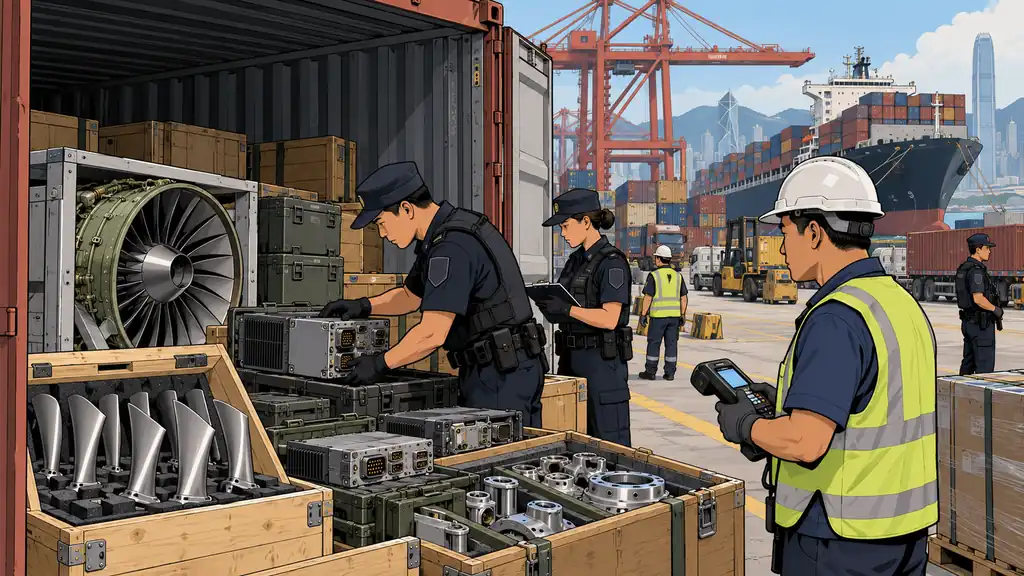
The comfortable assumption about America’s most advanced fighter goes like this: the F-35 is the crown jewel, so it must be guarded like one. Export controls, cleared facilities, trusted allies, a supply chain audited to the bolt. Our best technology is safe because we built a fortress around it.
I don’t think that assumption survives contact with the record. The fortress has a back door, it’s been propped open for years, and the people most likely to walk through it are the ones we’re most worried about. What makes the recent F-35 parts story worth your time isn’t the single shipment that made headlines. It’s what that shipment reveals about a system that was never as closed as we told ourselves.
What actually happened — and what didn’t
I want to be precise here, because the headline and the proven facts are not the same thing.
In the summer of 2026, Politico reported that a shipment of F-35 components — described in follow-on coverage as including a radar-deflecting cockpit canopy and a weapons-bay door — was rerouted to Hong Kong while in transit from Australia toward the United States. The parts were reportedly headed for repair when they were diverted crossing the Pacific. The reporting rests on three anonymous sources. Bloomberg subsequently reported that China has the parts, though it was not clear how the diversion happened.
Now the caveats, because they matter and the honest version is less cinematic than the headline:
- The Pentagon’s F-35 Joint Program Office called it “a shipment issue” and said it is working with U.S. authorities and industry partners to retrieve the components and investigate.
- Australia’s defense minister, Richard Marles, said the parts were not sensitive. Bloomberg described them as “potentially sensitive.” Those two claims cannot both be fully true, and neither has been adjudicated in public.
- As of the reporting, there was no public evidence that Beijing deliberately engineered the diversion or that anyone has accessed the technology. A congressional investigation is not a conviction. Briefings for staff on national security committees began in June, with more expected.
So what’s established is narrow: a classified-program shipment went somewhere it absolutely should not have gone, and Congress and the Pentagon are investigating. What’s alleged or disputed is the rest — the sensitivity of the parts, whether China has them, and whether this was an accident or an operation.
I want to be clear that I’m not telling you Beijing stole a canopy. I’m telling you something more unsettling: it almost doesn’t matter whether they did.
The part that isn’t disputed at all
Here’s why the single shipment is the wrong thing to fixate on. The backdrop is already a matter of public record, signed off by the Government Accountability Office.
In GAO-23-106098, published May 23, 2023, auditors found that more than 1 million F-35 spare parts — worth over $85 million — had been lost by a single prime contractor since May 2018. The Joint Program Office had reviewed less than 2% of those losses. More than 900,000 parts, worth over $66 million, had never even been reported to the program office for review. The reason is almost boring: DOD and its contractors never agreed on whether these parts, sitting in 50-plus domestic and international facilities, were “accountable” under a contract, so nobody was keeping a real-time ledger.
A million parts can go missing from a $1.7 trillion program and the honest answer to “where did they go?” is a shrug. That’s not a leak in the fortress. That’s the fortress having no walls on one side.
When your accounting is that loose, the line between “lost,” “stolen,” and “diverted” stops being a bright line. One rerouted shipment isn’t an anomaly against that background. It’s the background becoming visible.
Twenty-five years of pattern
Set the parts problem next to the espionage record and the shape gets clearer. CSIS maintains a running survey of Chinese espionage in the United States since 2000. The current tally: 224 publicly reported incidents, 69% of them after Xi Jinping took power. Of the cases with an identified objective, 29% targeted military technology. And the authors call their own list “most likely incomplete” — it excludes export-control smuggling cases and more than 1,200 IP lawsuits.
The F-35 specifically shows up in that record more than once. CSIS notes breaches of the Joint Strike Fighter program reported in 2007 and 2012, and the 2014 case of Su Bin, charged with helping access Boeing networks holding data on the C-17, F-22, and F-35. This is not a new interest. It’s a sustained, documented, 25-year campaign against exactly this class of technology.
So: a program that can’t account for a million parts, a quarter-century of espionage aimed at its designs, and a classified shipment that ends up in Hong Kong. You don’t need a conspiracy to connect those. You need a doctrine. And one exists.
Why “unrestricted warfare” predicted this
In 1999, two PLA colonels, Qiao Liang and Wang Xiangsui, published Unrestricted Warfare — a doctrine arguing that a weaker power beats a stronger one by refusing to fight on the stronger one’s terms. You erase the line between war and peace and you prosecute conflict by every available means at once: trade, finance, supply chains, espionage, cyber, and law. The weapon isn’t a missile. It’s the seam in the other side’s system.
Read the F-35 story through that lens and it stops looking like a string of unrelated mishaps. An opaque global supply chain is a seam. A million unaccounted parts is a seam. A repair route through third countries is a seam. Under unrestricted warfare, you don’t need to breach the fortress if the logistics tail is already porous — you just let the system’s own disorder do the work, and you stay below the threshold where anyone feels obligated to call it an attack.
That’s the genuinely uncomfortable implication, and it’s the thesis of this piece: whether or not Beijing diverted this specific box, the conditions that made it possible are themselves the objective. A rival operating on this doctrine wins by making “accident” and “operation” indistinguishable. We keep asking “was this an attack?” The doctrine’s answer is that the question is the vulnerability.
What it means if you’re preparing
If you’re building a plan around a US–China conflict, the lesson here isn’t a date. It’s a reframing: a peer adversary that fights this way is already engaged. There’s no horn that sounds to tell you it started. The supply-chain disruptions, the technology losses, the quiet contests over chips and ports and rare earths — under this doctrine, that is the conflict, running now, in peacetime clothes.
Two practical consequences for how you rate the threat:
First, your timelines should compress, but not toward panic. If the “war” is already underway by other means, the thing you’re actually preparing for is the moment it escalates into the effects you’d feel at home — and that moment arrives with less warning than a declared war would give. You don’t get the mobilization montage.
Second, this doesn’t generate new preparations so much as it raises the Likelihood score on ones you’ve already justified. The downstream effects of a peer conflict are the same ones you plan for elsewhere: supply-chain breakdown, a strained grid, economic turbulence, and fuel and food disruption. A threat this large mostly re-prioritizes existing work. Rate it honestly on Impact × Vulnerability × Likelihood and let the math, not the headline, tell you where it sits.
Bottom Line
- Separate the proven from the alleged. Established: a classified F-35 shipment was rerouted to Hong Kong and is under congressional and Pentagon investigation. Disputed or unproven: that the parts were sensitive, that China has them, and that the diversion was deliberate. Hold both without collapsing them.
- The single shipment is a symptom. The GAO record — 1 million+ parts and $85 million+ unaccounted for since 2018, less than 2% reviewed — is the real story, and it’s not in dispute. A supply chain that loose has no clean line between lost and taken.
- Read it as doctrine, not accident. Against a 25-year espionage pattern (CSIS: 224 incidents, 29% military-focused), an opaque logistics tail is exactly the seam Unrestricted Warfare tells a weaker power to exploit. The ambiguity is the weapon.
- Prepare for effects, and raise Likelihood. You don’t prep for “the F-35 story.” You prep for supply-chain, grid, economic, and fuel/food disruption — and you treat the fact that a peer is already fighting by other means as a reason to move those preparations up your list, not down it.
Track the bigger picture on the war with China threat page.