


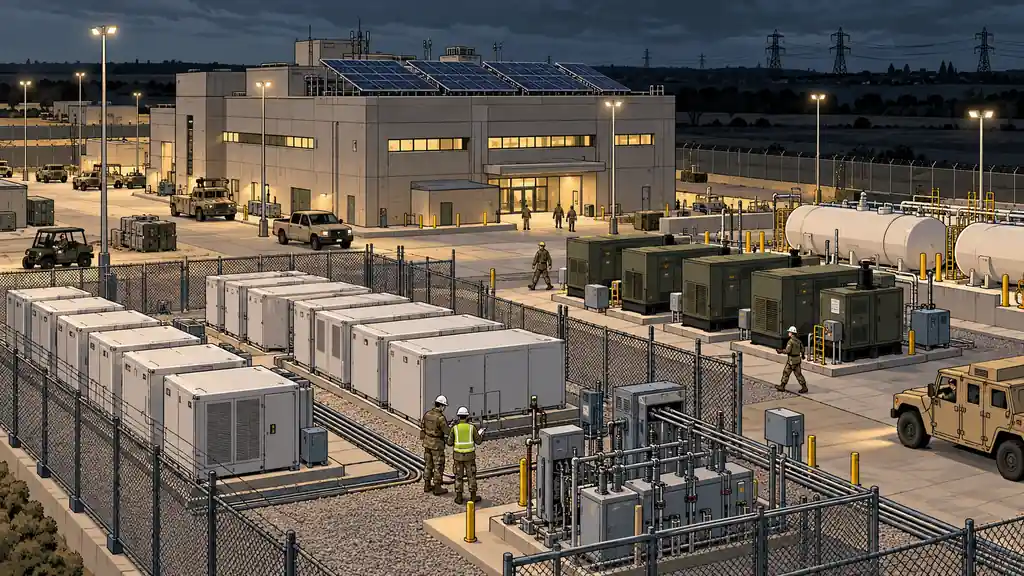
During a speech at Marine Corps Base Quantico on September 30, 2026, Secretary of War Pete Hegseth announced several major initiatives that the military would be undertaking immediately. I’m only going to focus on two of the initiatives in this article as I feel they have direct application to preparedness because they are telling of the future war(s) that the U.S. military is currently preparing to fight.
I’ve covered two of the other topics in this article. You can find the full transcript of the speech here.
Fortress America
FORTRESS America — Federal Operations for Resilience, Troop Resources, Energy, Supply, and Survivability — is, in the Department of War’s own words, the nation’s “insurance policy.” The establishment memo is blunt about the problem it’s meant to fix: for decades the world’s most powerful military quietly let itself depend on foreign mines for rare earths, overseas factories for microchips, foreign supply chains for weapons and propellants, and — the one that should stop every prepper cold — the civilian power grid to keep its bases running.
The program is organized around five pillars:
- Energy independence — every major installation generating its own power so the base stays lit, aircraft keep flying, and command centers stay online even if the civilian grid is taken down by cyberattack or sabotage.
- Supply-chain and defense-industrial base resilience — bringing rare earths, specialty metals, semiconductors and propellants home, to be mined, refined and built in America.
- A strategic defense reserve — deep stockpiles of munitions, fuel, medicine and blood, sized to fight through disruption when global supply lines break.
- Installation hardening and cyber resilience — hardening every base on American soil against cyber intrusion, sabotage and drones.
- Resilience in space and spectrum — securing satellites, spectrum and the ability to see, navigate and communicate, so the force can’t be blinded or silenced.
Read that list again as a preparedness checklist, because that is exactly what it is: power, supply, stored reserves, physical and digital hardening, communications. It’s the same handful of problems you work at your own scale, written at the scale of a continent.
This is not a retreat. It is the foundation from which American strength is projected — a homeland that cannot be starved out, shut down, or cut off.
That line, lifted straight from the memo, is the thesis — and the timeline underneath it is telling. The Under Secretary of War for Acquisition and Sustainment has thirty days to stand up a FORTRESS America Program Office, starting as a “lean core cell” and scaling in months, with the explicit charge of “delivering results in weeks, not years.” When a bureaucracy writes deadlines like that into a memo, it isn’t planning for a threat that’s decades out.
Next Great American Base
The second initiative is narrower and, honestly, stranger. The Next Great American Base rejects the model of patching up decaying Cold War installations and instead builds a brand-new, world-class power-projection platform from the ground up — a highly hardened joint installation inside the homeland, spanning hundreds of thousands of acres, engineered to run completely off the commercial grid with independent power generation, autonomous systems and advanced air defenses.
The memo directs the Assistant Secretary of War for Energy, Installations and Environment to run a nationwide competitive site-selection process — governors and adjutants general are literally being asked to bring their best sales pitch for their states — and to deliver an initial execution plan, evaluation framework and deployment timeline within fourteen days, then weekly updates after that, with the stated objective to “commence construction without delay.”
I’ll be straight about what this is and isn’t. A single new megabase has no direct application to your preparedness this weekend. What it has is signal value. You don’t engineer an installation to survive with its grid, supply lines and communications severed unless you expect someone to try to sever them.
How this fits into the National Resilience Strategy
Here’s where it connects. Both initiatives are, in substance, homeland resilience — grid independence, reshored supply chains, strategic reserves, hardened infrastructure. Those are the exact themes of the National Resilience Strategy the administration rolled out earlier this year, and I don’t think the overlap is a coincidence.
I’ll be careful here: neither memo names the Resilience Strategy. But you don’t need a citation to see that the Pentagon just took the same doctrine the White House has been describing for the whole country and operationalized it on the ground it actually controls: assume the grid can go down, assume supply chains can be cut, and build so you keep functioning anyway. The civilian strategy sets the direction; FORTRESS America is the military executing it.
The preparedness read on this is big as it pertains directly to a potential war on the horizon. Hardening bases against grid and logistics attacks is a direct answer to a tactic China is widely expected to use in any Pacific war — cyberattacks on the power and logistics hubs around U.S. bases to slow the American response to the theater. And there’s a second-order upside here as well. Once installations can island themselves off the grid and keep generating, those independent nodes could help bring the civilian grid back online after a regional blackout, EMP attack, etc.
Now flip it around to your own situation, because the logic is identical:
- For a household: the government is spending enormous sums to make sure its critical nodes don’t go dark when the grid does. You can’t build a base — but you can build your node. Backup power, stored water, food, fuel and medicine, a communications plan, and a home that doesn’t assume everything upstream keeps working. The same five pillars, several orders of magnitude smaller.
- For a business with continuity-of-operations duties: this is a louder signal. If the Department of War has formally concluded that the civilian grid and commercial supply chains are attackable enough to engineer around, your COOP plan should assume the same thing. The government is hardening its nodes. You should be thinking hard about yours.
Does this change China’s timeline?
Connecting the dots between this directive and China means we must ask some other hard questions. Specifically, if hardening bases against grid and logistics attacks would thwart China’s use of those tactics in a future war, does this change their calculus — would they consider moving up their timeline so they attack while these tactics would still be effective?
My thought is that it’s likely. If China would want to use these tactics, and I believe they would as part of their Unrestricted Warfare doctrine, then they would want to strike before we have this resilience in place. Now, the “good” news is that it will take years to build this resilience, which means China still has years until this could force their hand.
Bottom Line
These two initiatives are less a to-do list for today than a window into the war the U.S. expects to fight — and that window is worth your attention.
- The grid is the headline. The military is now formally treating the civilian power grid as something it must be able to operate without. Take that assessment seriously and apply it to your house.
- It’s the same five pillars you already work. Power, supply chains, stored reserves, hardening, communications — FORTRESS America is your prep binder at national scale.
- Signal over syllabus. You can’t build a megabase or a strategic blood reserve, but you can read the direction of travel: plan for grid-down, supply-cut and comms-degraded, and stop assuming upstream systems will hold.
- Businesses: update the COOP plan. If the Pentagon is engineering around the grid and commercial logistics, your continuity-of-operations assumptions are already out of date.
The other half of that speech — autonomous warfare and the future of the force — is here.