


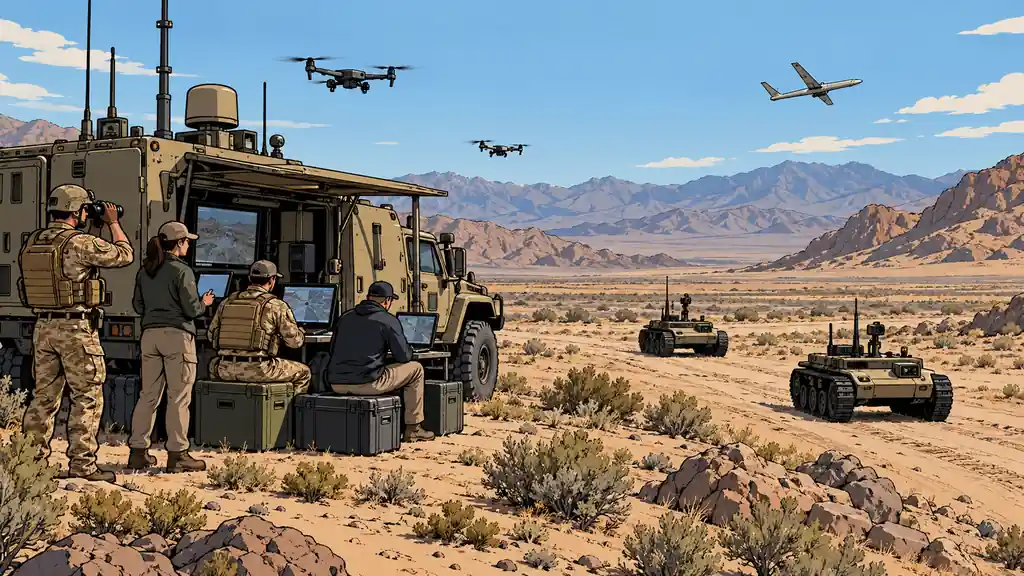
Secretary of War Pete Hegseth announced several major military initiatives during a speech at Marine Corps Base Quantico on September 30, 2026. Within this article, I’m only going to focus on two - Autonomous Warfare Command and Project Meridian. These two initiatives don’t have direct application to preparedness today, but I feel they’re still important as they’re telling about the general direction of warfare in the not-so-distant future. This is something anyone preparing for future wars must understand to prepare properly.
I’ve covered two of the other topics in this article. You can find the full transcript of the speech here.
Autonomous Warfare Command
The headline here is an org chart, not a weapon — and that’s exactly why it’s worth your attention. On September 30 the Secretary directed the Pentagon’s Direct Reporting Portfolio Manager for Unmanned Systems (DRPM-UxS) to run Project Agincourt, the named effort to stand up a new Autonomous Warfare Command (AWC) by a target date of October 1, 2027.
Two words in that memo carry most of the weight: functional and combatant command. Most of our combatant commands are geographic — INDOPACOM owns a map, CENTCOM owns a different one. A functional command owns a mission wherever it happens: SOCOM owns special operations, CYBERCOM owns the network fight, and neither is boxed into a single theater. The AWC is being built on that model — a 4-star functional combatant command whose mission is unmanned and autonomous warfare, with its own directed manpower, budget, and acquisition authority, plus something telling: dedicated career fields for the officers and enlisted who will crew these systems. You don’t build career pipelines for a fad.
A geographic command is tied to a theater. A functional command follows the mission. Standing up autonomy as a functional command is the Pentagon saying, on the record, that drones aren’t a regional problem anymore — they’re a permanent feature of how wars get fought.
Now the honest part, because the distinction matters. The command doesn’t exist yet. It’s a target two years out, and the memo is explicit that it still needs Congress to pass enabling legislation. What’s real today is the directive itself, the named leadership running DRPM-UxS in an unusual CEO-COO pairing, a 30-day deadline for a plan of action and milestones, and the program it builds on: the existing Drone Dominance effort, which the Department says has already pushed thousands of robotic systems into the Middle East under Operation Epic Fury. So: a concrete, funded, staffed effort pointed at a command that is still an aspiration.
Read the memo’s own language and the direction is unmistakable. The stated goal isn’t a particular drone — it’s “a wartime arsenal whose main product is adaptation at the edge,” and a procurement system whose output is “the ability to adapt in combat, on the right side of the cost exchange.” That last phrase should sound familiar if you read my piece on Europe. It’s the same math Poland is spending billions to fix on its border — you cannot win firing million-dollar missiles at thousand-dollar drones. The Pentagon is now reorganizing itself around that arithmetic.
Project Meridian
Where Agincourt reorganizes, Meridian studies. And it’s important to be precise about what it is: Project Meridian is a commissioned study — not a command, not a budget line, not a weapon. The Secretary tasked the Department’s Chief Technology Officer, Emil Michael, with commissioning it through an outside partner organization, to be co-directed by Elon Musk, Palmer Luckey, and Newt Gingrich alongside a bench of academic, policy, and industry experts. Its assignment is to map the trajectory of future warfare — the speech reaches from “subterranean depths to the cislunar frontier” — identify the critical capability gaps, and recommend what to build, in line with the 2026 National Security Science and Technology Strategy. The deliverable is a report, unclassified and publicly released with a classified annex, due 120 days out, on January 28, 2027.
The thesis is the interesting part. Meridian exists to break the oldest trap in defense — that militaries always fight the last war. The bet is that if you can see where warfare is going and field for it faster than your rivals, the payoff isn’t a single gadget; it’s tempo. A force that adapts faster gets to dictate how wars are fought and hold its edge over any single adversary for decades. That’s the ambition, stated plainly.
Stay skeptical where it’s warranted. A 120-day study co-chaired by famous names is an announcement, not a capability, and blue-ribbon commissions have a long record of producing reports that go straight onto a shelf and no further. Whether Meridian means anything depends entirely on what the Department does with it after January. But the signal is in the framing: the Pentagon is standing up a formal foresight effort and saying out loud that AI, autonomy, directed energy, robotics, and biotech are changing the character of warfare — and it’s worth noting where leadership thinks this is heading.
Bottom Line
What does a prepper do with two announcements about Pentagon structure? Mostly, read them as a forecast. Neither puts a task on your list today — the homeland-hardening half of that same speech is where the direct application lives. But the direction they point is worth filing away:
- Autonomy is the trajectory, not a trend. When the Pentagon builds a permanent 4-star command around unmanned systems, it’s telling you drones and autonomy are now a standing feature of conflict — including any conflict whose second-order effects reach your house. Let that shape how you read every future war story.
- The cost-exchange logic is the real lesson. Cheap, mass-produced autonomous weapons beating expensive legacy platforms is the defining dynamic of modern war. It’s the same math I described on Poland’s border. Understand it even if you never touch a drone.
- Adaptation speed is becoming the edge. Meridian’s whole bet is that whoever adapts fastest wins. That’s a sound frame for your own readiness, too — general-purpose preparedness that flexes beats a bespoke kit built for one scenario.
- Watch the dates, not the fanfare. A command targeted for October 1, 2027 that still needs Congress, and a study due January 28, 2027. Those are the bounded markers. Judge both initiatives by whether they hit them — not by the applause in the room.
None of this belongs at the top of a household prep list, and I won’t pretend otherwise. The value is situational awareness: the people who plan America’s wars just told you, on the record, that the next one runs on autonomy and on who can adapt faster. Keep one eye on the direction of travel.
The homeland-hardening half of that speech — Fortress America and the Next Great American Base — is here.