


For about forty years, the official posture of a Western European government toward its own population was relax. The Cold War ended, the peace dividend got spent, and civil defense — the bunkers, the pamphlets, the keep-two-weeks-of-food habit — was quietly filed under paranoia. Telling citizens to stockpile was the sort of thing that got a politician mocked.
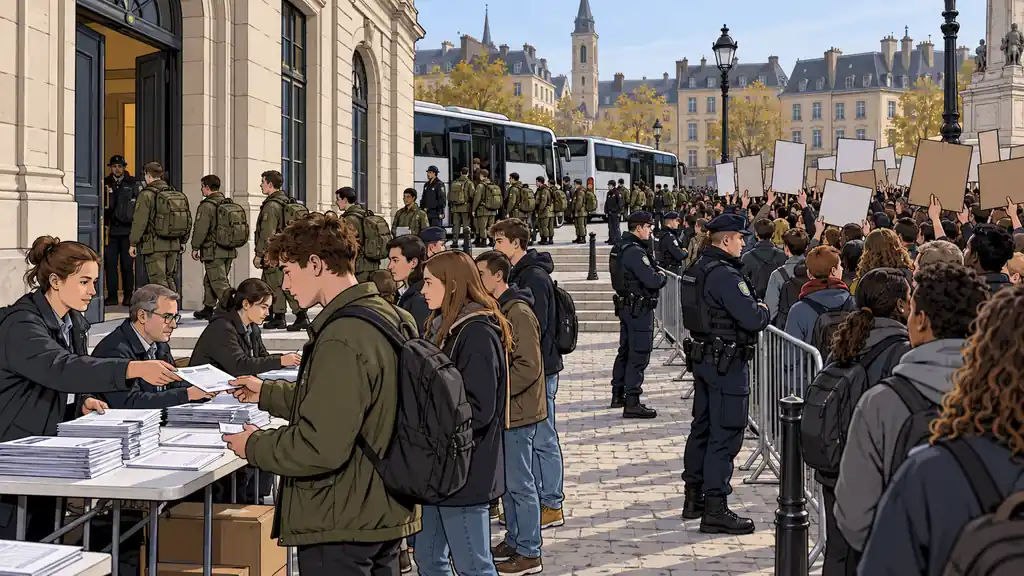
That posture is reversing in public, and it’s worth watching the reversal more than the headlines about it. Britain is now nudging households to keep bottled water and canned food on hand. Germany has started screening every 18-year-old man for military service. And in Germany, tens of thousands of those young men just walked out of school to say no.
The gap between what these governments now think is coming and what their own people will accept is itself a signal. Let me walk through what each government actually did — precisely, because the press coverage has been looser than the facts — and then what a household should take from it.
Britain: a resilience campaign, not a war order
Here’s the part that got garbled. A widely-shared claim held that the UK government told Britons to stockpile food and water because it is preparing for war. That overstates it, and I’d rather give you the real thing, which is interesting enough on its own.
What’s real: the UK has a Government Resilience Action Plan, first published in July 2025, with a 2026 Implementation Report released on 14 July 2026. It commits to a public engagement campaign anchored on the government’s GOV.UK/Prepare website, launching later this year. The Prepare guidance itself asks households to keep basic supplies — a minimum of about three liters of drinking water per person per day (recommending ten liters per person per day once you count cooking and hygiene), non-perishable ready-to-eat tinned food, a tin opener, battery or wind-up torches and a radio, and a first-aid kit. A government official described the coming campaign to the Financial Times as “practical advice… like having some bottled water and tinned food. It will be common sense, not scaremongering.” This is very similar to programs and campaigns that the US government (specifically FEMA) has conducted for years.
The campaign’s stated scope is broad: extreme heat, flooding, drought, cyber-attacks, and the actions of hostile states. Separately — and this is where the “war” framing comes from — a BBC analysis on 17 September 2026 reported that ministers have begun updating the government’s long-dormant contingency planning, the so-called “war book,” amid concern over Russian threats and cyber-attacks on critical infrastructure.
So the honest version is: Britain is building a general civil-resilience campaign, not issuing a wartime stockpiling directive. The war talk is the atmosphere around it, not the text of it. But notice what even the honest version concedes — a government that spent a generation treating home preparedness as fringe is now standing up a national campaign to teach it. That’s not the alarm. That’s the reversal.
Even the pushback is telling. British retailers warned against panic-buying; the British Retail Consortium noted most households already have enough non-perishables in the cupboard and urged people to build supplies gradually rather than clear the shelves in one trip. That’s correct advice, and it’s also the entire preparedness philosophy in one sentence: slowly, before you need it, not all at once when you do.
Germany: a questionnaire today, a draft maybe later
Germany’s move is more concrete, and here too the precise shape matters. Germany has not reinstated the draft. What it has done — under a new military-service law in effect since the start of 2026 — is require every man turning 18 to complete a questionnaire on his fitness, skills, and willingness to serve. Medical screening is mandatory for men born in 2008 or later, phased in, with nationwide exams due from mid-2027. Service itself currently remains voluntary. The catch is the back half of the law: if voluntary recruitment falls short, parliament could move to a demand-based or mandatory model. The framework for conscription is being built now; whether the switch gets flipped is left open.
That “left open” is exactly what the protesters don’t trust. On Friday, 25 September 2026, the School Strike Against Conscription initiative said more than 45,000 students walked out of class in over 100 cities. Their objection isn’t abstract: they report that medical summonses are already going out — including, they say, to men who marked 0 out of 10 for interest in serving. One 18-year-old from Kiel, Golo Kirsch, put the logic plainly:
“We won’t let ourselves be forced into a medical check today, and we won’t go into the barracks tomorrow.”
Read that as a prediction about the ratchet, not just a slogan. They’re assuming the questionnaire leads to the medical exam leads to the draft — and they’re organizing against step one because step three is where they think it goes.
What the gap actually tells you
I want to be careful not to caricature either side. The governments aren’t being reckless; a continent that watched a full-scale land war return to Europe in 2022 has reasons to rebuild civil resilience, and most of what Britain is asking for is sensible regardless of the threat. And the protesters aren’t being foolish; a teenager who doesn’t want to be conscripted into someone else’s war is making a coherent choice about his own life.
But stand back and the two stories rhyme. In both countries, the state is now preparing for a harder future faster than its public is willing to follow. That divergence is the data point. Governments move slowly and hate alarming people; when they start reversing a forty-year “don’t worry,” they’re responding to something their own threat assessments are telling them. The public resistance doesn’t disprove the signal — it mostly measures how far ahead of popular sentiment the official view has gotten.
Here’s the part that should land for you, though: you are not a government, and you don’t need a mandate. The entire fight in Germany is over compulsion — who can be forced to do what. None of that argument touches you. Keeping two weeks of food and water in your house isn’t conscription; it’s a grocery decision you can make this weekend, quietly, with nobody’s permission. The thing European states are now spending political capital to persuade reluctant populations to do, you can simply… do.
Bottom Line
- When the messaging reverses, read the reversal. A government that spent decades calling home preparedness paranoid, and now runs a campaign teaching it, has changed its mind about the odds. That shift is worth more than any single scary headline.
- Separate the signal from the spin. Britain stood up a resilience campaign, not a war order; Germany built a conscription framework, not a reinstated draft — yet. Precision keeps you calm and keeps you credible. Don’t inflate “plans and debate” into “it’s happening.”
- The public pushback measures sentiment, not safety. Forty-five thousand students marching against a medical questionnaire tells you how unpopular the idea is — not that the threat behind it is fake.
- You don’t need a government mandate to keep two weeks of food and water. The one move both stories point at is the one you can make without anyone’s say-so. Do the boring version now, gradually, while the shelves are full.
Start with the basics — the Food & Water Storage tool turns “stockpile” into a real number for your household, and the conflict-with-Russia threat brief lets you rate how much this should actually weigh on your plan.