


On January 18, 2025, during the final days of the Biden White House, a new program was unveiled called the “National Resilience Strategy”. The Trump White House released an updated version in June of 2026, re-branding it as an “America First Resilience Strategy”.
Two administrations, two documents, one word on the cover — and for once Washington has written down, in an official strategy, that no adversary or hazard should be able to hold the country at risk. The question I want to answer is narrower and more useful than “is the strategy good.” It’s this: does any of it touch the one vulnerability that could actually end the country — the electric grid, which an EMP, a solar storm, a cyberattack, or a saboteur can all take down — and if the fix is as cheap as its advocates claim, why hasn’t it happened yet?
The strategy summary
The two strategies are a study in contrast, and the contrast is important.
Biden’s 2025 version is built on four pillars — Governance, Social and Community, Economic, and Infrastructure — and its register is whole-of-society. It leans heavily on equity, climate adaptation, and vulnerable communities, and it treats resilience as something you build broadly across every system at once.
Trump’s 2026 rewrite keeps the name and throws out the method. It’s built on four tenets of transformation — Prioritize, Modernize, Distribute, Simplify — applied across four core domains: national security, the economy, public health and safety, and national infrastructure. The framing is risk-informed (it calls for a National Risk Register - basically the national version of this website), tech-modernization-driven, and explicitly federalist — pushing responsibility down to states, communities, and individuals.
The most important line in the whole document is a rejection. It argues that the existing “all-hazards” or “one-size-fits-all” approach has “reached the limit of its utility,” with the federal government “stuck as the primary liability holder” even for routine incidents. Whatever you think of the politics, that’s a direct shot at how the US has actually behaved for decades — which is to say, it hasn’t. Five or six administrations have treated power grid hardening as a problem for the next guy. That’s not a strategy; that’s kicking the can down the road with better letterhead.
Many weapons, one grid
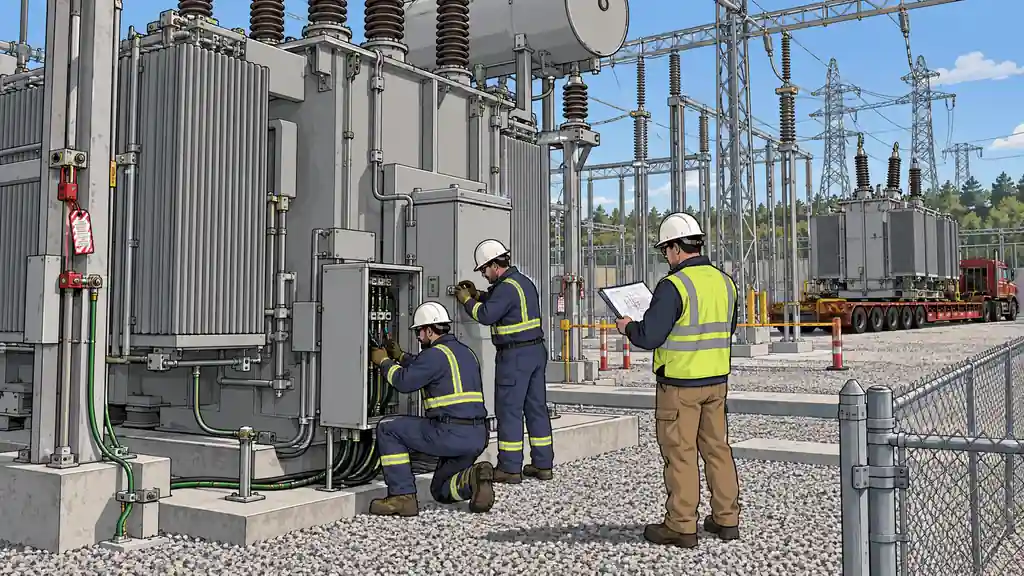
Before the strategy, the vulnerability. The reason to care about any of this is that a short list of very different threats all converge on the same chokepoint — the electric grid, and specifically the few thousand massive high-voltage transformers at its heart. A high-altitude nuclear EMP, a severe solar storm (a CME), a cyberattack on grid control systems, and old-fashioned physical sabotage of a substation are, from a preparedness standpoint, four doors into the same room. Knock out those transformers — which take a year or more to build and replace — and everything downstream fails, no matter which door was used. That convergence is the whole reason a single, affordable fix can buy down several catastrophic threats at once.
Here’s the first caveat: neither strategy document names these threats directly, and neither commits a dollar to hardening transformers. The 2026 version mentions “space weather” exactly once. The granular numbers below come not from the White House but from the Task Force on National and Homeland Security, whose analyst walked through the grid problem in a recent interview.
A word on who they are, because it decides how much weight to give them. Despite styling itself a “Congressional Advisory Board,” the Task Force is a small private nonprofit — founded to carry on the work of the Congressional EMP Commission after that body lost its funding, and long led by the late Dr. Peter Vincent Pry, a former EMP Commission staffer. That lineage makes it genuinely credible on the fundamentals, which line up with mainstream institutions like the National Academies and the grid regulator’s own geomagnetic-disturbance standards. But it is an advocacy organization whose mission is to sound the alarm, and it has a documented reputation for worst-case framing. So I’ll trust it on the direction of the problem and double-check it on the dramatic specifics — and I’ll say plainly which is which.
Because here’s the thing: you don’t actually need the Task Force to establish that the hole in the fence is real. In Lights Out (2015), the veteran newsman Ted Koppel spent a book documenting two things — that a long-duration grid-down event would be catastrophic, and, his real subject, that the United States has no serious plan for the aftermath. He was writing about a cyber attack rather than an EMP, but the grid doesn’t care what knocks it down. When the congressional EMP Commission, a mainstream journalist, and an advocacy task force all circle the same gap, the gap is probably there; the honest work is separating the measured middle from the worst case.
Start with the physics, because the acronyms do real work. A high-altitude nuclear detonation produces two pulses that matter. E1 is the fast one — nanoseconds — and it fries microelectronics and microchips directly, the way a near lightning strike kills a laptop. E3 is the slow one. It’s a geomagnetically induced current, and it works by the same mechanism as a major solar storm: the pulse interacts with the Earth’s magnetosphere, and the long high-voltage transmission lines act like antennas, gathering enormous extra current that runs down the lines into generation and distribution equipment and cooks it. A nuclear E3 and a severe solar flare are, functionally, the same attack on the grid from two different sources.
The Task Force’s point is that E3 is the solvable half. There’s an industrial device — a neutral-ground blocker — that installs on the neutral-ground wire of high-voltage transformers and redirects that induced current harmlessly back into the earth before it can damage the equipment. By their estimate, protecting the roughly 6,000 highest-voltage (EHV) transformers, plus maybe 3,000 more, would cost about $4 billion and take E3 off the table entirely — no more grid threat from a solar storm, and half the threat from an EMP neutralized.
Roughly $4 billion protects on the order of 6,000 to 9,000 transformers and takes the threat of E3 off the table — against both a solar storm and a nuclear burst.
Hold that number against the alternative. The Task Force estimates a full national grid collapse could cost on the order of $4 trillion — a thousand times more — if you can even price it. And the figure that should stop you isn’t dollars but time: grocery stores empty in about three days, and with no power to pump water, run sewage, refrigerate medicine, or move fuel, the human toll compounds fast.
How fast is where the numbers turn genuinely dark — and it’s worth getting the sourcing exactly right, because this figure gets mangled constantly. In testimony before Congress, members of the congressional EMP Commission warned that a worst-case event could kill up to 90% of Americans within the first year, almost all of it from the collapse of the grid rather than the pulse itself. Note the two words that fall off in the retelling: it’s testimony, not a hard finding written into the Commission’s report, and it’s a worst-case, upper-bound estimate, not a point prediction. (I walk through that number and its caveats in “EMP: Real Threat or Mythology?”.) Some people argue it’s too severe — but even a fraction of it is a civilization-scale event, which is the entire reason a $4 billion insurance policy should be an easy call.
The cyber and supply-chain door
That transformer fix closes the EMP-and-solar-storm door — the whole E3 threat, and half of the EMP one. But it does nothing for the other two doors into the same room, and the strategy’s supply-chain language — “trusted providers,” denying “unmitigated foreign control” of national infrastructure — maps onto the next one whether or not it names it: compromised equipment built into the grid itself. Here the documented kernel is alarming enough without anyone’s worst case. In 2019, federal authorities seized a 500,000-pound Chinese-built transformer at the Port of Houston; examined at Sandia National Laboratories, it was reportedly found to contain hardware back doors that could let it be switched off remotely. (I cover that episode — and the 300-to-500 Chinese-made transformers believed to be running in the US grid — in the state cyber-warfare piece.) The Task Force puts the count of back-doored units far higher, claiming roughly 815; treat the seized-transformer case as the solid floor and that figure as the advocacy ceiling, since it’s the Task Force’s own estimate rather than anything I can confirm.
The federal response is itself the proof of this article’s worry about durability. In 2020, Executive Order 13920 declared a national emergency and moved to bar bulk-power equipment from foreign adversaries — and it was promptly suspended and largely unwound by the next administration in 2021, then revived by a successor order in 2026. A policy you can switch off every four years is not the same thing as a hardened transformer.
The Task Force argues the exposure runs deeper than the hardware already installed, and here we’re squarely in its claims rather than the documented record. Its analyst describes grid-scale battery technology — developed with a US national-lab grant, better than lithium, sized like shipping containers — being sold to China, manufactured there, and sold back to us, plausibly with back doors installed; add the inverters and other components flowing in from Chinese manufacturers, most of it uninspected, and the pattern it sees is consistent: we build it, lose it, and buy the compromised version back. That specific battery story I can’t corroborate — but the underlying worry isn’t theirs alone. Then-NSA and Cyber Command chief Admiral Mike Rogers testified to Congress On November 20, 2014 that China was already inside US grid control systems with the ability to disrupt them.
What Russia and China Are Already Doing
This is the part that reframes the whole debate from “should we spend $4 billion” to “why are we the only ones still arguing about it.”
Both Russia and China have reportedly been hardening their grids for about ten years. We don’t know exactly how far along they are — but as the Task Force dryly notes, an authoritarian state doesn’t hold a decade of advisory meetings. The order goes out and it gets done.
The sharper claim is about the fix itself. A Neutral Blocking Device (NBD) — frequently called a Geomagnetically Induced Current (GIC) blocker — is an industrial safety device inserted into the neutral-ground wire of a high-voltage transformer (anywhere from 115 kV to 765 kV) that redirects induced current safely to ground. It’s the same device described above, and the pioneering version was developed by a US company, Emprimus, which the Task Force says has had units proving themselves in the grid for roughly a decade.
According to the Task Force, within the last six months it became clear that China copied the Emprimus patent and is now rolling the device out across its own grid as a national-priority “Manhattan Project”-scale effort — with Russia reportedly doing the same. Read that plainly: the country most likely to consider an EMP or grid attack against the United States is busy immunizing its own grid against the identical attack — using American technology — while we’re still debating whether to protect ourselves with it. That’s not a capability gap; that’s a decision gap.
A nation unprepared
Suppose, though, that the strategy never funds the fix and the grid goes down — storm, burst, or back door, it doesn’t matter which. What’s the plan for the aftermath? That’s the question Koppel set out to answer in Lights Out, and the answer he came back with is the quietly alarming part. He put it to the officials whose job it would be, and found no coherent federal plan for feeding, watering, and sheltering tens of millions of people through a blackout lasting weeks or months — even disagreement, inside FEMA’s own leadership, about basics like whether major cities would have to be evacuated. The agencies are built and funded to handle a hurricane, not a nationwide, open-ended loss of power.
If that sounds like an indictment, it’s also a clarifying gift, because it tells you exactly where the responsibility actually sits. The one group Koppel found that genuinely impressed him wasn’t a federal agency at all — it was the Latter-day Saints, whose culture of household food storage and strategically placed community storehouses amounts to a real, rehearsed, bottom-up continuity plan. That’s the model, and it’s available to anyone: the resilience that will actually carry your household through a long grid-down event is the resilience you build yourself, with your neighbors, before the lights go out.
Bottom Line
The strategy is a real step — the first administration in a long line to write the problem down and reject the kick-the-can posture. But a strategy document is not a hardened transformer, and the specific fix that matters isn’t in it yet.
- A step in the right direction, not the fix. The 2026 strategy names the right instinct — risk-informed, prioritize the catastrophic — but it commits no money to E3 hardening. Treat it as a mandate to watch, not a problem solved.
- E3 is the cheap, solvable half. If the Task Force’s ~$4 billion / ~6,000–9,000-transformer estimate is even close, neutralizing the solar-storm and nuclear-E3 threat to the grid is a rounding error against the cost of losing it.
- The adversary already decided. China and Russia hardening their own grids — reportedly with a copied American device — tells you how seriously they take the threat. We should extend them the courtesy of believing them.
- Your grid plan doesn’t wait on Washington. National policy may or may not harden the grid in your lifetime, and as Koppel documented, there’s no federal plan for the aftermath if it fails — the responders are built for a hurricane, not an open-ended national blackout. A multi-day-to-indefinite grid-down plan is the part you control, and it’s the same preparation whether the trigger is a pulse, a solar storm, a cyberattack, or a back door — which is exactly why it’s worth building. The proven model is bottom-up: household stores plus a prepared community.
A grid-down event looks the same from your kitchen no matter what caused it — so prepare for the outcome, not the trigger. Start on the national grid collapse threat page.