


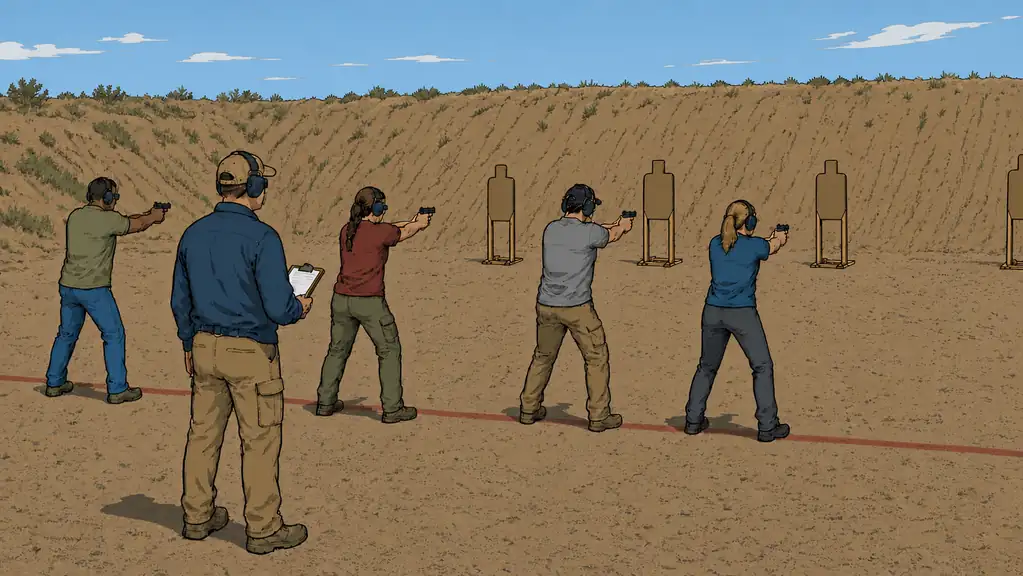
There’s a comforting lie underneath a lot of gear purchases: that owning the thing is the same as being able to use it. It isn’t. Capability is skill × gear, in that order, and multiplication is unforgiving — if the skill is zero, it doesn’t matter how good the gear is, because zero times anything is still zero. A drawer full of hardware you’ve never run under stress isn’t capability. It’s inventory.
This is the least satisfying idea in the category, because you can’t buy your way to the top of it. The best gun, optic, and light in the world, in untrained hands, is outperformed by mediocre gear in hands that have done the reps. Everyone knows this and almost everyone spends against it anyway, because a purchase is instant and a skill is slow.
Skill is perishable — that’s the part people miss
Even people who train treat it like a light switch: learned it once, own it forever. Skills don’t work that way. They decay. The draw stroke, the reload, the malfunction clearance, the decision-making under adrenaline — all of it degrades without maintenance, and the complex, fine-motor pieces degrade fastest. A class you took three years ago is not a capability you have today. It’s a capability you had.
A skill is not a purchase you make once — it’s a maintenance item, like a filter or a fuel supply. Stop maintaining it and it quietly expires.
That reframe matters because it moves training out of the “someday” pile and onto the maintenance cadence where it belongs. The same way you rotate food and test the generator, you schedule the reps. Not because it’s fun, but because the alternative is discovering the decay at the exact moment you needed the skill.
Most of it is free
The excuse is usually time and money — ammo is expensive, ranges are far, classes cost real money. All true, and all beside the point, because the highest-frequency training costs nothing. Dry fire practice — the draw, the presentation, the trigger press, reloads, all with a verified-empty gun — builds the exact reps that decay fastest, and it happens in your living room for free. The four rules of gun safety run every single rep, dry or live; that’s non-negotiable and it’s the discipline that makes free practice safe.
Live fire and professional instruction still matter enormously — you can’t learn recoil management or force-on-force decision-making in a dry-practice session, and a good instructor fixes errors you can’t see in yourself. But the reps between those sessions are what keep the perishable skills alive, and those reps are the cheapest thing in this entire category.
And “skill” is bigger than shooting. The reps that end more emergencies are often medical: stopping a bleed, managing an airway. Awareness, de-escalation, and simply having practiced the plan at your own front door all sit in the same bucket — trainable, perishable, and mostly free.
Buy the skill goal, not the gear goal
The book is pointed about this. It uses the guy whose goal is “10,000 rounds of 5.56” — with no idea why, only that “experts recommended it” — as the textbook example of a goal that fails the test. It’s a number to accumulate, not a capability to reach. A real goal is specific and relevant to a threat: draw and put two rounds on target at seven yards in under a set time, or clear a malfunction without looking. Those are capabilities. The stockpile of ammo is just fuel for building them — useful only if you’re actually burning it to train.
Bottom Line
- Capability is skill × gear. Great gear times no skill is zero. Buy the multiplier first.
- Skill is perishable. Treat training as a maintenance item on a cadence, not a one-time class you “have.”
- The best reps are free. Dry fire practice builds what decays fastest, in your living room, at no cost. Just do it safely.
- Set skill goals, not shopping goals. “10,000 rounds” isn’t a plan. “This drill, this standard” is.
The person who trains with a modest setup beats the person who collects gear and never runs it. That’s not an opinion; it’s arithmetic.
Put practice on a schedule in Reminders, and write skill-based goals — not gear counts — in Category Planning.