


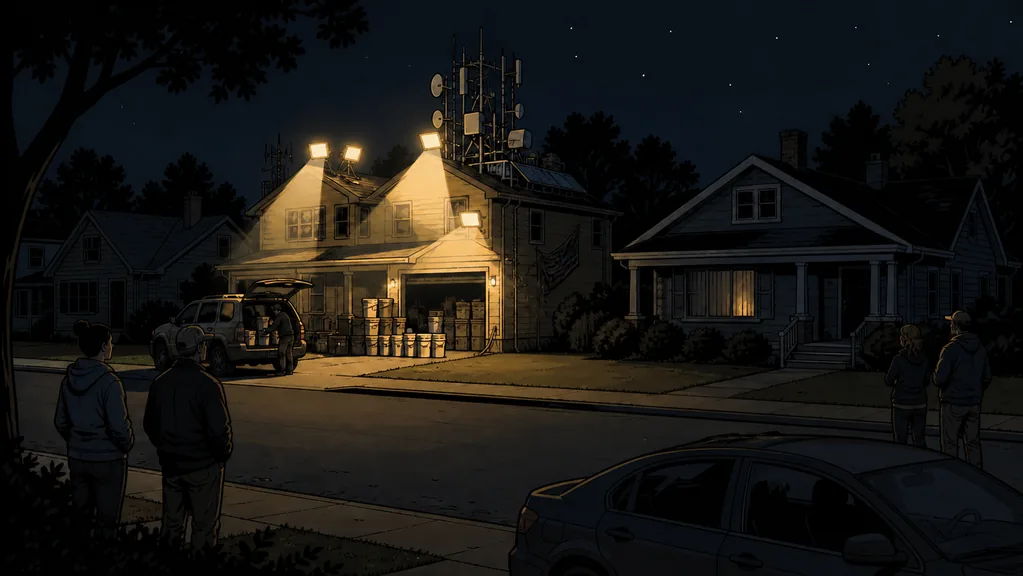
Most of this category is about keeping a stranger out. But the more dangerous exposure usually isn’t a stranger — it’s the people who already know exactly what you have and where you keep it, because at some point you told them. Operational security, OPSEC, is the discipline of controlling that information, and it’s the one layer of your defense you can’t buy, mount, or bolt down.
Here’s the uncomfortable version: in a genuine emergency, you become the plan for everyone who knows you have one. The coworker you told about your food storage. The relative who joked about coming to your place “if things go bad.” The neighbor who watched a pallet of buckets come off the truck. None of them are threats today. All of them are a mental note that gets cashed the day the store shelves are empty and their kids are hungry. Desperate people are dangerous people, and desperation has a long memory.
Every person who knows what you have is a variable in someone else’s survival plan. The goal isn’t secrecy for its own sake — it’s not being the answer to another family’s worst day.
Blend in — the “gray man” isn’t only a person
The idea of the “gray man” — not standing out, not being memorable, not looking like a target — usually gets applied to how you dress or carry in public. But it applies just as much to your house, your habits, and your online footprint. A home that looks like every other home on the block is a worse target than the one with the tactical bumper stickers, the antenna farm, and the “we don’t call 911” sign advertising there’s something inside worth protecting. Loud signaling doesn’t deter; it markets.
The same goes for your digital shadow. The devices in your pocket and on your desk leak location and identity constantly. Photos with location data, a social feed that shows the inside of your pantry, a check-in that says the house is empty for a week — that’s the same mistake as the bumper sticker, just harder to see.
This is the reason I maintain my anonymity on this site - I plan on helping those around me in an emergency, but I can’t help everyone. Limiting who knows about my preparations gives me the opportunity to choose.
The tension: OPSEC vs. community
This is where honest preparedness gets hard, because the opposite is also true: you cannot survive alone. You need a community — neighbors, a mutual-assistance group — to keep watch while you sleep, to share the work, to not be the lone house holding out against a hungry street. Total secrecy and real community are in direct tension.
The resolution isn’t to pick one. It’s to be deliberate about who’s inside the circle and who’s outside it. The people you’ve vetted, who are building alongside you and bringing their own capability, get to know things — that’s what makes them a community and not a crowd. Everyone else gets the gray man. The failure mode isn’t having people who know; it’s having told everyone by accident, through vanity, venting, or a loose social feed, so that the circle has no edge at all.
Bottom Line
- You can’t buy OPSEC. No gear fixes a reputation as the house with supplies. It’s a discipline, not a purchase.
- Loud signaling markets you. Stickers, signs, antennas, and a visible stockpile advertise a target instead of deterring one.
- Mind the digital shadow — location data, an open social feed — it leaks the same information as a sign in the yard.
- Draw the circle on purpose. Community is survival; indiscriminate disclosure is exposure. Decide who’s inside, and give everyone else the gray man.
The strongest door in the world doesn’t help if half the county already knows what’s behind it. Quiet is a layer, and it’s free.
Work through who’s in your circle and how you’ll handle the people who show up in Threat Planning and the community side of Category Planning.