


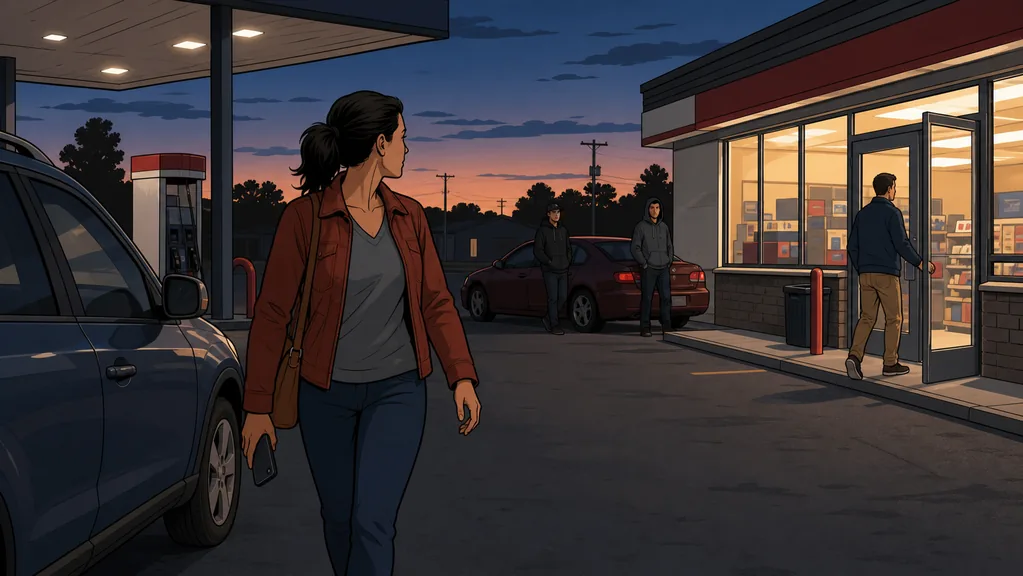
The popular image of self-defense is the moment of the fight — the draw, the strike, the decisive move. So that’s what people train for, if they train at all. But the fight is the failure. It’s what’s left after every earlier chance to avoid it got missed. The people who are genuinely hard to hurt aren’t winning fights; they’re not being in them, and they’re not in them because they saw the thing coming and left.
That skill has a name — situational awareness — and it’s the single highest-yield item in this entire category. It isn’t a mood, it isn’t a gadget, and it isn’t walking around wired and suspicious. It’s a trainable habit of reading the room early. And it costs nothing.
Baseline, then anomaly
Awareness is not vigilance. Vigilance is exhausting and it burns out in twenty minutes. Awareness is quieter: you passively learn what normal looks like for wherever you are — the baseline — and then you notice what breaks it.
Every place has a baseline. The gas station at 9 p.m. has a rhythm: who’s pumping gas, who’s walking where, the ambient noise. You don’t have to catalog it consciously. You just have to be present enough that when something doesn’t fit — the man who’s paying attention to you instead of the pump, the group that goes quiet as you pass, the car that’s now behind you through three turns — a small alarm goes off. Anomalies are the signal. The baseline is what makes them visible.
You can’t spot the wrong thing until you know the right thing. Learn the baseline and the threat announces itself.
This is why the framework starts with knowing your area cold — your Area of Operation and the region around it. Baseline isn’t only a skill you run in the moment; it’s homework you did in advance. On ground you’ve actually studied, the anomaly stands out. On ground you’ve never looked at, everything is noise and nothing is.
The point of noticing early is to leave
Here’s the part people skip: awareness is only worth something if it buys a decision, and the best decision is almost always to not be there. Distance and early exit beat every technique. The confrontation you walked away from three minutes before it started is a total victory that leaves no bruises and requires no gear.
That means awareness has to be paired with a low threshold for acting on it. Most people get the early warning and then talk themselves out of it — they don’t want to be rude, or paranoid, or wrong. That hesitation is the whole game. Trust the anomaly. Cross the street. Leave the store. Get back in the car. You will be wrong most of the time, and being wrong costs you nothing but a little inconvenience. Being right and ignoring it costs everything.
Kill the things that blind you
Awareness has natural enemies, and they’re winning. A phone screen is the single biggest one — head down, earbuds in, you’ve voluntarily removed your two best sensors in exactly the transition moments (parking lots, doorways, the walk to the car) where most bad encounters begin. Fatigue, alcohol, and rushing do the same thing. You don’t need to be paranoid. You need to look up, take one earbud out, and give the parking lot the ten seconds you’re currently giving your notifications.
None of this is tactical cosplay. It’s the same discipline I teach throughout this site: decide with data and in advance, not with emotion in the moment. Awareness gathers the data; a pre-made decision spends it before the stress hits.
Bottom Line
- Avoidance is the win. The fight is the failure — the best outcome is the one you saw coming and left.
- Baseline, then anomaly. Learn what normal looks like so the wrong thing stands out. Study your ground in advance.
- Act on the alarm. The early warning is worthless if you talk yourself out of it. Being wrong is cheap; being right and ignoring it isn’t.
- Put the phone down. In parking lots, doorways, and transitions, your eyes and ears are the gear that matters.
You can spend a fortune on this category and skip the one skill that would have kept you out of the situation entirely. Don’t.
Turn the decisions awareness buys into pre-written responses in Threat Planning, and study the ground you move through in Area Recon.