


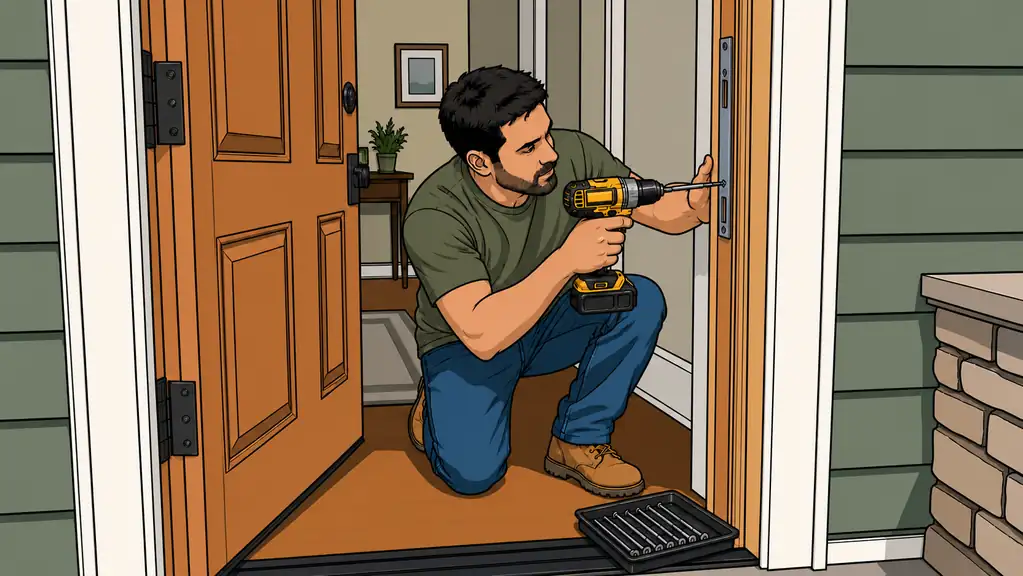
People spend real money on locks and almost none on the thing the lock is bolted to. That’s backwards. When a door gets kicked in, the deadbolt usually holds fine — it’s the strike plate, held by two short screws into a thin door jamb, that tears out of the frame, taking a chunk of soft pine with it. The lock did its job. The wood didn’t.
Hardening entry points is the delay layer of your home’s defense — the seconds between “something’s wrong” and “they’re inside.” Delay is worthless on its own and decisive when paired with detection, because those seconds are exactly what your warning and your response need. And unlike most of this category, it’s a one-time job with hardware-store parts.
The door frame, not the lock
A standard exterior door fails at predictable points, and all of them are fixable in an afternoon:
- The strike plate. Swap the builder-grade plate and its short screws for a reinforced strike plate anchored with long screws that reach past the jamb into the wall framing behind it. This single change moves the failure point from “soft trim” to “structural stud,” and it’s the highest-yield thing on this list.
- The door. If you have a wooden door, once you reinforce the strike plate, the next source of failure becomes the door itself. The area around the lock mechanism is extremely thin. You can purchase plates that wrap around the door to reinforce these areas so they won’t break as easily / quickly.
- The hinges. Same problem on the other side — short screws into the jamb. Replace at least one screw per hinge with a long one into the framing (3 inches is usually adequate). On out-swing doors, use hinges with non-removable pins so the door can’t be lifted off.
- The deadbolt itself. A real deadbolt with a solid throw, not just the handle latch. The latch alone is decoration.
- The door’s core. A hollow-core interior door used as an exterior door defeats everything above it. Solid-core or metal is the baseline.
The lock is only as strong as the wood it’s screwed into. Reinforce the frame and you’ve done more than any brand of lock ever will.
Windows and the second-story assumption
Doors get the attention; windows get the entry. A locked window still breaks, but a broken window makes noise — which turns a silent entry into a detected one, and that’s the point. Ground-floor and hidden windows are the priority. Cheap, effective, in rough order:
- Keep them locked — an unlocked window is an unlocked door with a better view.
- Don’t assume the second floor is safe if a porch roof, fence, or deck rail makes it a step, not a climb.
- Add security film to the glass. This turns 2 seconds into a minute or more to break through a window, so it buys you real time to respond.
And stop leaving the tools out. A ladder against the garage, an unlocked shed full of pry bars, a spare key under the mat everyone’s checked since 1985 — you’re pre-positioning the burglar’s kit for him.
Reinforce your weak side first
You don’t have to do the whole house at once, and you shouldn’t start at the front door. Do it in the order an intruder would. The best approach is to walk your own ground and look at it the way someone casing it would: which entry can’t be seen from the street or a neighbor’s window? That hidden door or basement window — not the well-lit front entrance — is where the effort should start, because that’s where an intruder gets unlimited time to work.
Most break-ins are through a door or a first-floor window, and most are opportunistic — the unlocked, the hidden, the obviously easy. Hardening doesn’t have to make your home a fortress. It has to make it enough of a chore that the opportunist quits and the determined one runs out of the seconds he was counting on.
Bottom Line
- The frame fails, not the lock. A reinforced strike plate with long screws into the framing is the cheapest, biggest upgrade you can make.
- Do the hinges too, and put a real solid-core or metal door in the opening.
- Lock the windows; noise is a feature. Break-in resistance on hidden, ground-floor glass first.
- Reinforce your weak side first — the entry no one can see — and stop leaving ladders and spare keys out for the taking.
Delay is seconds, and seconds are the whole reason the rest of your plan gets to happen. Buy them once, with screws.
Log the hardware you install in the Protection inventory, and find your unseen approach by walking the property in Area Recon.