


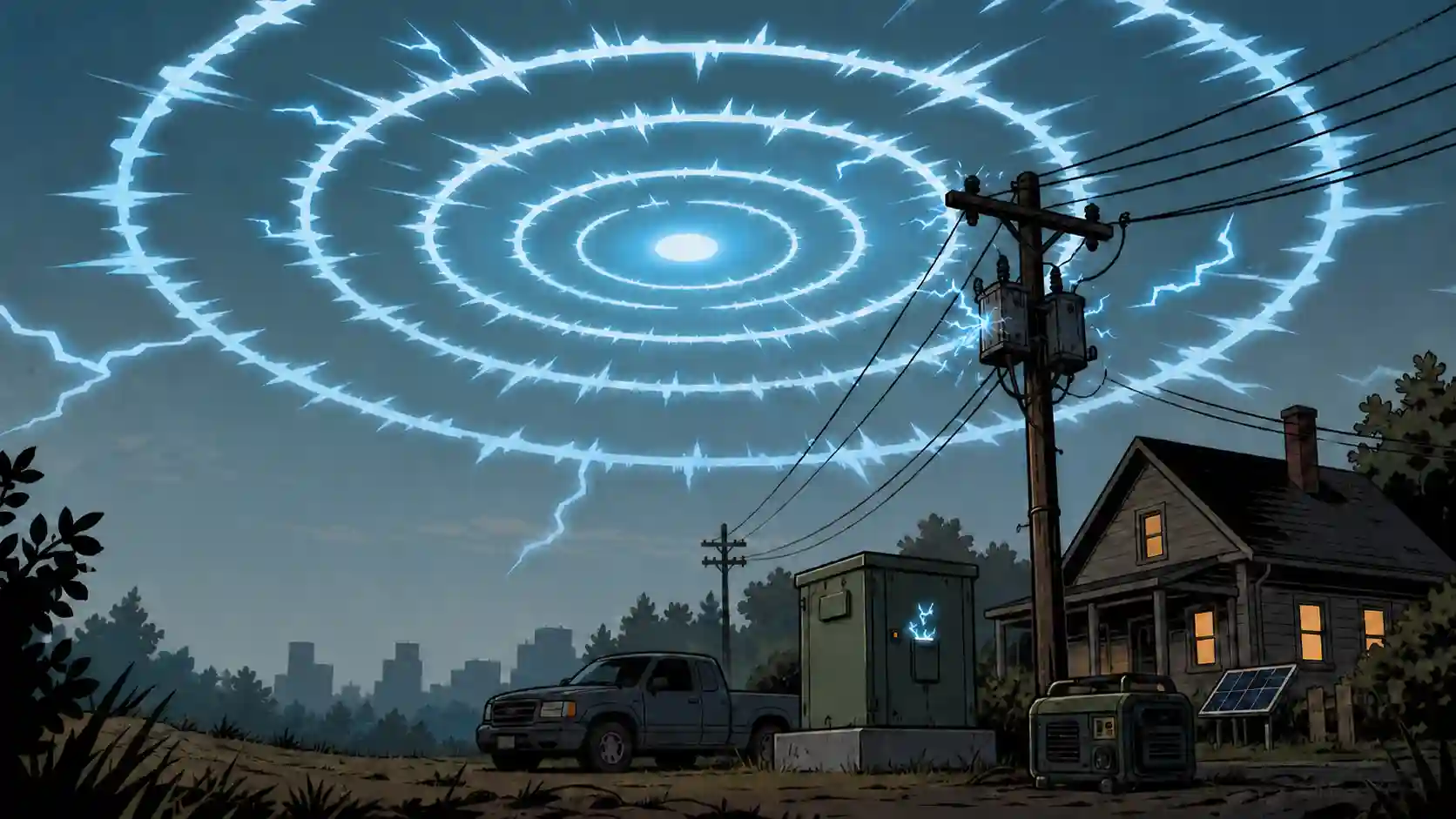
Few topics generate more opinion and fewer facts than EMP. It’s either civilization-ending and imminent, or it’s pure fantasy — depending on who’s selling what. The truth is more useful and less dramatic: it’s a real phenomenon with a wide range of severities and a low-but-nonzero probability, which is exactly the kind of threat you need to handle without panic.
What it actually is
Two different things get lumped together, because their effect on you is similar even though their causes are nothing alike. Before we dig into the details of EMP, we need to clarify this distinction:
- EMP (Electromagnetic Pulse) — A high-altitude nuclear detonation which creates a fast, wide-area pulse of electromagnetic radiation.
- CME (Coronal Mass Ejection) — A severe geomagnetic storm. Basically, the sun doing what it has done before. For a detailed look, see what coronal mass ejections actually are.
This isn’t hypothetical — it has already happened
As a prepper and electrical engineer, I had come across mention of this threat in the early 2000’s. At that point, there really wasn’t a lot of publicly available information as this pre-dated the EMP Commission. For the most part, I ignored the threat as I didn’t see it being very realistic. Then I attended an IEEE Symposium on Electromagnetic Compatibility and Signal/Power Integrity where Stanford professor and former director at DARPA, Dr. Thomas H. Lee, delivered the keynote address. It was titled, “The Carrington Event, H-Bombs, Telstar and the Great Geomagnetic Storm of 1989” and gave the history of both EMP as well as CMEs and emphasized the real-world effects. This event really opened my eyes to what has happened in the past as well as what could happen in the future.
In the 1950’s scientists discovered that the detonation of a nuclear weapon creates a strong electromagnetic field. In typical scientist/engineer fashion, someone said, “I wonder what would happen if we detonated a nuke high up in the sky?” Someone else thought it was a good idea, so they did it. In July of 1962 U.S. scientists detonated a 1.4 megaton thermonuclear device about 250 miles above the Pacific Ocean. This test was called “Starfish Prime”. Well, in this case they definitely got more than they bargained for. The fields generated were much stronger than expected. In fact, they pegged out their instruments and damaged some. However, the interesting part was the side effects caused in Hawaii.
The Hawaiian Islands sat about 900 miles away from the test site. The scientists never dreamed that the islands would be affected, but they were very wrong. The pulse knocked out around 300 streetlights on Oahu, set off burglar alarms across the islands, and damaged the microwave repeater that carried telephone traffic between the islands. Thankfully, the EMP was “small enough” that no major damage occurred. But, the event made the scientists truly realize the potential that existed. After this point U.S. EMP testing and most knowledge about these weapons were highly secretive. Most of the U.S. public never learned about this risk until after the year 2000.
Unfortunately, the U.S. wasn’t the only country to learn about EMP effects. Nearly simultaneously, the USSR made the same discoveries as the USA and did some of the same stupid tests. I’m guessing the Russians monitored Starfish prime because they did their own version almost immediately. In October 1962 the USSR detonated a 300-kiloton device 180 miles above Kazakhstan (a populated area). And like the U.S. tests, they got results much higher than they expected. They monitored a telephone line and measured currents of up to 3,400 amps in the line. It blew every overvoltage protector and fuse in the system and caused damage to the system. More importantly, the test destroyed the Karaganda power plant and damaged over 1,000 km (620 miles) of shallow-buried power cables.
The EMP Commission
As I said, the fact that EMP existed, let alone the results were marked as Secret by the government, so the bulk of the nation had no idea anything about this topic. This changed in 2000 when Congress formed the Congressional EMP Commission (Commission to Assess the Threat to the United States from Electromagnetic Pulse Attack). This commission met and ultimately delivered two reports to Congress. In 2004, they delivered an executive summary and delivered the full report in 2008 with their findings and recommendations.
I’ve seen mention of a “classified” full 2004 report, but it could be a rumor. The 2008 report has been released in its entirety and offers a really good insight into what the results of an attack like this on the United States would mean. You can find both reports along with a host of other EMP-related documents in our EMP Reference Library — the declassified primary sources, from the 1962 test reports through the full Commission record.
The effects - no sugarcoating
I’m going to start by ripping off the band-aid. In testimony before Congress, members of the EMP Commission warned that a worst-case event could kill up to 90% of the U.S. population within the first year, almost all of it from the collapse of the power grid rather than the pulse itself. That’s a number worth taking seriously, and worth putting in context. It comes from that testimony — not a hard finding written into the Commission’s report — and it’s a worst-case, upper-bound estimate, the kind of figure that gets repeated with the “worst-case” quietly dropped off the front. The exact fraction is genuinely uncertain. What isn’t uncertain is the mechanism behind it: knock out the big transformers that take a year or more to replace, and everything downstream of the grid comes apart. The engineering of how it breaks is solid; the body count is the speculative part.
Now that’s out of the way, let’s look at some specifics. An EMP waveform is actually comprised of 3 distinct parts, that are categorized as E1, E2 and E3. Each have a different speed and strength.
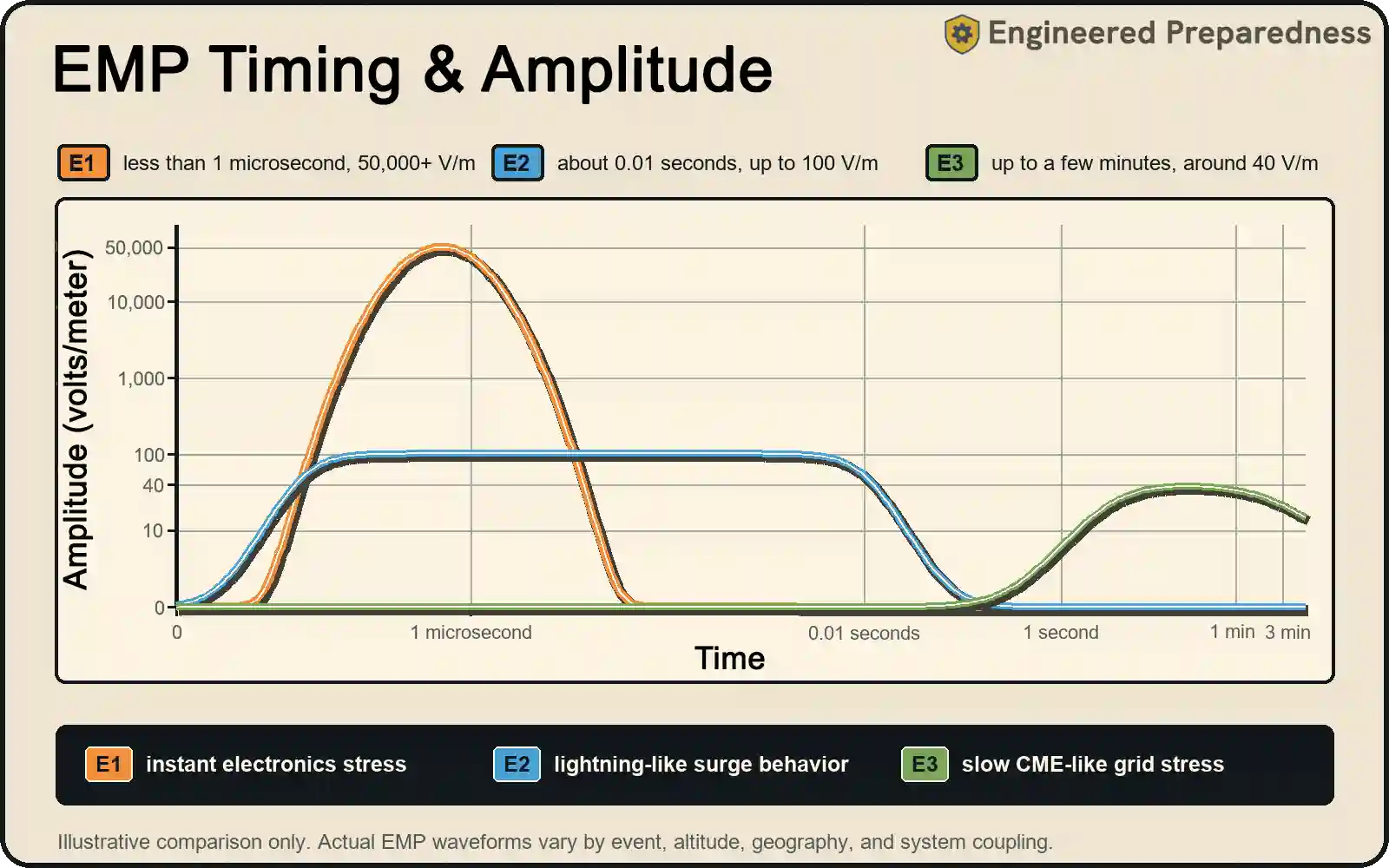
All three do the same basic thing — induce voltage in anything that behaves like an antenna — but they arrive on wildly different timescales, and that timing is what decides what each one destroys:
- E1 is the fast one, and the part unique to a nuclear burst. Gamma rays from the detonation strip electrons off air molecules high in the atmosphere (the Compton effect), and Earth’s magnetic field bends that shower of electrons into a sheet of current that radiates toward the ground. It rises to its peak — on the order of tens of kilovolts per meter, canonically around 50 kV/m — in a few nanoseconds. Nothing built to shrug off lightning reacts that fast, which is exactly why E1 walks straight through ordinary surge protection and kills electronics outright.
- E2 is the middle one, and the least of your worries. It behaves a lot like a lightning strike, and the lightning protection already on most equipment actually does something about it.
- E3 is the slow one, and it’s the twin of a solar storm. It’s a magnetohydrodynamic “heave” that lasts seconds — the same kind of long, slow current a severe CME pushes into the grid. E3 doesn’t care about the phone in your pocket; it cares about long transmission lines and the giant transformers on the ends of them. This is the overlap that makes the EMP and solar-storm stories one story.
Why does any of this matter? Picture a 10 m wire sitting in even a gentle 20 V/m field — it develops roughly 200 volts end to end. Now scale that up to E1’s real peak and to infrastructure measured in miles of wire, and the induced voltages get enormous. It’s an over-simplification, but you get the idea: what gets damaged comes down to how fast the voltage changes (electronics hate fast changes) and how high it climbs before something’s insulation gives out and it arcs over. Faster signals break things at lower voltages — which is why E1 is so destructive and why the grid’s long lines are what E3 comes for. Here are the net effects of all this:
- Large transformers and long-line infrastructure are genuinely vulnerable, and slow to replace — the pulse raises line voltages until transformer insulation fails, and those units can take a year or more to build and they’re only built overseas. This is the real danger, and it’s a grid problem, not a personal-gadget problem.
- If it’s connected to a long wire, it’s dead. Nearly everything connected to the grid would be damaged, which includes anything plugged in at home (radios, cell phones on a charger, etc.).
- Things with antennas are very susceptible. Antennas are essentially long wires. Antennas are also normally attached to sensitive electronics that aren’t capable of handling large voltages. The result is that almost everything with an antenna will be damaged. This means all cell phone towers will be destroyed as will television and radio transmitters.
- Small, disconnected electronics are far more survivable than the breathless version claims. With short wires, there is much less to couple into. As a result, small electronics will be largely unharmed, but you’ll be without the rest of the infrastructure to support it.
- Cars are where things get complicated. This isn’t a situation where some makes and models are better than others. It’s generally believed that the less electronics the more survivable. Outside this, it’s a mixed-bag. I will note that it seems that passenger cars and trucks are more resilient than semi-trucks here. This means your car may still work, but there won’t be trucks bringing fuel to your gas stations or food to grocery stores any longer. This is one of the biggest single issues caused by EMPs. There is data on this in the EMP Commission report, but no vehicles tested were newer than 2002, so we don’t truly know what the effects on newer vehicles (especially electric vehicles) will be.
- People and animals are unharmed. Outside of special cases where people have medical devices with external leads/connections, they’ll be safe from the direct effects. Cyborgs will have problems…
How likely is this?
Unfortunately, this is the one section that has little in the way of concrete answers. Here’s what we do know, good and bad:
- It doesn’t take a giant, sophisticated weapon. The E1 footprint is line-of-sight from the burst, so it’s the detonation altitude, not the raw yield, that decides how much of the country sits underneath it — one warhead a few hundred miles up puts most of the continental U.S. in view. A modest device is enough to do continental-scale damage, and purpose-built “super-EMP” designs deliberately trade blast for gamma output to make the pulse worse. The bar to attempt this is lower than the Hollywood version implies.
- All nuclear powers (Russia, China, North Korea, India, Pakistan, etc.) could deliver an EMP attack on the US. They don’t have to launch it from halfway around the world either. They could launch from a submarine or container ship off our coast for almost zero warning.
- While against various treaties, it’s possible that China or Russia have pre-positioned EMP devices in satellites.
- It was rumored that North Korea had EMP weapons in their two functional satellites, but they both burned up in the atmosphere in 2023. North Korea does have one satellite in orbit currently, the Malligyong-1. Whether it has EMP capabilities is anyone’s guess. If you want to see its orbit, we have it mapped as part of Area Recon.
Preparing for it is boring, in the best way
Here’s the good part: preparing for an EMP looks almost identical to preparing for any long grid-down event. You don’t need an EMP-specific bunker. You need:
- Backup power sized to what matters — not the whole house.
- Non-electric heat, light, and cooking.
- Comms that work without the network.
- Water and food that don’t depend on refrigeration.
Every one of those is worth having for a dozen more-likely reasons — a winter storm, a fuel shortage, a regional grid failure. The EMP just happens to be the extreme version of the same problem.
The caveat
While the results of EMPs resemble any other power outage, there is one key difference: time. While a normal power outage is measured in days, the power outage resulting from a wide-spread EMP will be measured in months to years. This changes the level of self-sufficiency required. It also means that there will be secondary and tertiary effects that wouldn’t come from a normal power outage. Specifically many theorize that the following are possible in the areas affected by EMP:
- Without electricity, food cannot be preserved easily.
- Without electricity, water, sewer and other municipal services cease.
- Without electricity, fuel can’t be refined or pumped.
- Without fuel, large-scale farming is no longer possible.
- Without fuel, trucks and trains won’t be able to deliver food and other goods.
- Without fuel, police, fire and other emergency services won’t be able to function.
- Without emergency services, crime rates will rise dramatically.
The typical story about these effects typically resembles “Mad Max” or “The Purge”. One cannot discount the possibility in cities and other densely populated areas. Unfortunately, there is no historical precedent for an EMP attack. As a result, guesses are all we have to go on.
Bottom Line
EMP is real, it’s rare, and it’s survivable as a category of preparation rather than a special project.
- Don’t dismiss it and don’t panic. The history is real; so is the low probability.
- Prepare for the consequence, not the cause. Extended grid-down covers EMP, CME, and a long list of likelier events at once.
- Rate it honestly against your other threats — low likelihood, high impact — and let the threat-rating math decide where it lands in your priorities. Then move on.
If you want to go a step further, there are preparations that you can do that are specific to this threat (and CMEs to a lesser extent). Due to the specificity, I broke them into their own article.