


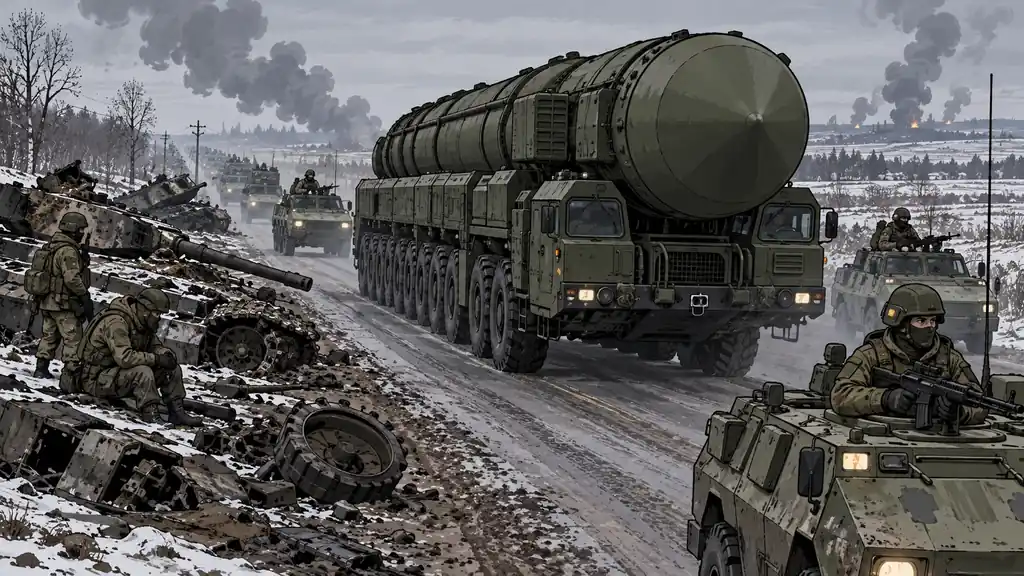
As a child of the Cold War, I can remember when war with Russia felt like an eventuality — something we half-expected to wake up to. After the Soviet Union fell in 1991, most of the country stopped thinking about Russia as a threat at all, and for thirty years that was a reasonable place to leave it. The war in Ukraine dragged it back onto the table. Not, I’d argue, in the way most people picture it.
Before I go further, I want to be clear about where I stand: I’m not on Russia’s side or Ukraine’s. I find plenty to detest in both. What I’m after here is as unbiased a read of the risk as I can give, because that’s what actually helps you prepare. And the honest read is that the version of this threat worth your attention isn’t a war Russia could win. It’s the one it can’t — and what a nation does when it’s backed into that corner.
The picture most people have is the wrong one
Two mental images dominate, and both point you the wrong direction.
The first is that post-Cold-War Russia is a spent force — a gas station with an army, not worth worrying about. The second is the opposite: that the danger is a grinding land war in Ukraine, far away, that might someday pull in NATO on the ground. The problem is that this picture doesn’t represent the current reality of the situation.
On February 7, 2022 just two weeks prior to the war with Ukraine beginning, Vladimir Putin attended a joint press conference in Moscow with French President Emmanuel Macron. At this press conference, Putin said, “We understand that the collective potential of NATO and Russia are incomparable. We understand that Russia is one of the world’s leading nuclear powers, but in terms of conventional forces, NATO is superior. We understand that. But we also understand that if Russia fights the NATO collective, it will be a conflict where there are no victors. ” Then he doubled-down on his warning, saying, “You won’t even have time to blink when you execute Article 5.”
Here, Putin publicly acknowledged that Russia cannot win a conventional ground war against the United States and NATO. As a result, they wouldn’t try to. Planning around a conventional Russia-versus-NATO slugfest is preparing for the one version the Russians have told you they won’t fight. That leaves the version that’s genuinely dangerous, and it’s the one that follows from taking Russia at its word about what it can’t do.
Ukraine may be a proving ground, not the point
Here’s a read of the war that, to me, has gotten more plausible as time has gone on — and I’ll flag clearly that this is my analysis, not established fact. If you look at the early days, something odd happened: Russia pushed to within about 20 miles of Kyiv in three days, then pulled its lines back hundreds of miles to defensible positions. That’s not how you behave if the goal is to take the whole country as fast as possible.
One explanation that fits the behavior is that Ukraine is being used — by Russia and its partners (China, Iran, North Korea) — for a set of purposes that don’t require conquering Ukraine at all:
- Bleed the Ukrainian military down until it’s no longer a threat.
- Get first-hand experience against the best Western hardware — Abrams, Leopard, and Challenger tanks, F-16s, Patriot batteries, ATACMS and Storm Shadow missiles.
- Give Russian and allied troops real combat experience the West has accumulated over decades of operations and they hadn’t.
- Build and stress-test their military-industrial base.
- Prove out new missile and drone technology in real combat.
I’d rate several of those as looking, from the outside, like they’ve largely worked. NATO’s own leadership has said Russia is out-producing the entire alliance on ammunition — NATO chief Mark Rutte told the New York Times that Russia produces “three times as much ammunition in three months as the whole of NATO is doing in a year,” which is a factor of roughly twelve. And Russia has showcased missiles like the “Oreshnik” intermediate-range system and the SARMAT ICBM that, by its account, the U.S. currently has no reliable defense against.
A cornered nuclear power is the real threat vector
Now put it together. If Russia concludes that a war with the West is coming regardless — and it believes it can’t win that war conventionally — the incentives get very dark. This isn’t idle speculation on my part; the posture has already shifted. In November 2024, Russia changed its official nuclear doctrine to allow the use of nuclear weapons in response to a critical threat to its sovereignty or that of Belarus, with language broad enough to fold in NATO’s arming of Ukraine. Both sides have taken to describing the stakes as existential — and there have been public proposals in the West to break Russia into dozens of smaller states after a defeat. When a nuclear power comes to believe it’s facing not just a loss but its own dismemberment, the logic that keeps nuclear weapons in their silos starts to erode.
On December 2, 2025, Russian President Vladimir Putin make his point very clear when he said, “If Europe suddenly wants to start a war with us and starts it, then it would end so swiftly for Europe that Russia would have no one left to negotiate with.”
My own read — again, my analysis — is that if Russia ever decided the war was unavoidable, it would strike first, and not with the ICBMs everyone watches. It would come from submarines parked quietly off the coasts, launching at effectively point-blank range with almost no warning time. That’s a decapitation strategy, not a battlefield one, and it’s exactly the kind of asymmetric move a country reaches for when it can’t win the conventional fight.
Hold both numbers at once
On our scale this rates a likelihood of about 3 and an impact of about 6. Both are true at the same time, and you have to hold them together. It’s genuinely unlikely — deterrence is real, the economies are entangled, and everyone involved knows how it ends. But if it landed, the consequences would run from serious to civilization-scale. That combination — low odds, heavy tail — is exactly the profile that tempts people into one of two mistakes: dismissing it entirely, or hoarding for Armageddon. Neither is the right move.
The honest prep pivot: two very different problems
This threat actually splits into two problems that need completely different answers.
The likely, lesser version — the one that reaches your house — is economic. Long before any missile flies, a serious Russia confrontation shows up as energy, food, and finance shocks. Russia is a major oil and gas exporter; Russia and Ukraine together are enormous exporters of wheat and fertilizer. Sanctions, blockades, and pipeline disruptions ripple straight into fuel prices, grocery prices, and jumpy markets — you saw a preview of exactly this in 2022. That’s the part with real odds, and the good news is it’s the same preparation every other supply-and-price shock demands: a deeper pantry, a fuel and heat reserve, and a cash cushion. You build it once and it pays off against inflation, a bad storm season, a job loss, and this.
The tail — a nuclear exchange — is a different discipline entirely, and you don’t prep it with a Russia-specific kit. Fallout shelter, shielding, and the realities of survival are their own subject, and most people badly overestimate how hopeless it is. If you want that side, start with why most people survive a nuclear war — it’s not the everyone-dies scenario the movies sold you and I have the math to back it up.
Work the number: buffer beats the shock
Say a confrontation spikes diesel and heating fuel and jolts grocery prices for a few months. If you run your household on the last tank and the last few days of food — the way most people do — that’s a few months of paying panic prices out of a squeezed budget, right when the market’s also punishing your savings.
Now flip it. A season’s worth of heating fuel bought ahead, a pantry measured in weeks and months instead of days, and a cash cushion that keeps a price spike from forcing a bad decision — and the same few months are a non-event you watch from a comfortable house. That’s the whole game, and it’s identical to the lesson from a Pacific supply-chain war: your buffer just has to outlast the shock. Do that math for fuel, food, and the bills, and the likely version of this threat stops being scary.
The common mistakes
- Buying “war gear.” There’s no Russia-specific stockpile worth having. Depth that serves a dozen likelier shocks is the answer.
- Picking one number and ignoring the other. “It’ll never happen” and “we’re all doomed” are both wrong. Low odds, heavy tail — hold both.
- Skipping the boring channel. The energy-and-food ripple is undramatic and it’s the part that actually has real odds. Don’t let the mushroom cloud distract you from the pantry.
Bottom Line
- The dangerous version isn’t a war Russia could win — it’s openly admitted it can’t beat NATO conventionally, so it wouldn’t fight that war.
- The real vector is a cornered nuclear power — a changed nuclear doctrine, existential framing on both sides, and the asymmetric first-strike logic that follows.
- Unlikely, but heavy if it lands — hold the low likelihood and the serious impact at the same time.
- What reaches your house first is economic — energy, food, and finance shocks, answered by the same buffer every disruption needs.
- The nuclear tail is a separate discipline, not a Russia kit — and it’s far more survivable than most people think.
Russia isn’t dangerous because of the war it could win. It’s dangerous because of the one it knows it can’t — and the buffer that carries you through a fuel-and-food shock is the same buffer you’d have built anyway.
Size the deeper food, water, and fuel reserves this kind of shock rewards with the Food & Water Storage tool — it measures your household in weeks and months, not guesses.