


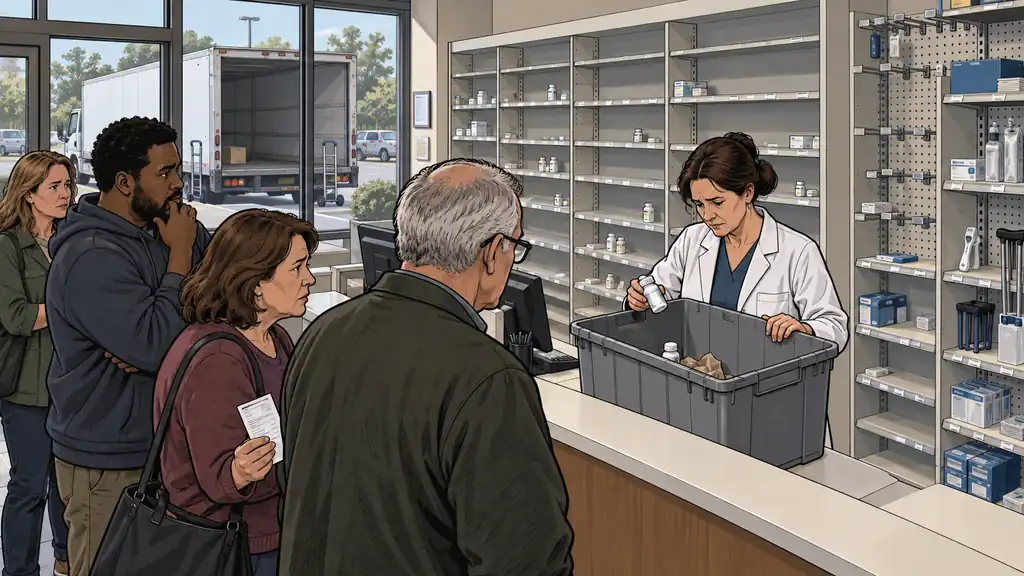
It’s natural to picture a war with China as ships and islands and things happening a long way off. That picture is missing the part that would actually reach you. A war in the Pacific wouldn’t come to your town as bombs. It would come as empty shelves and higher prices, and it would get there through the supply chain — the same supply chain that puts a phone charger, a bottle of blood-pressure pills, and a set of brake pads within a day’s reach right now.
That system runs on just-in-time delivery. Parts and goods are made overseas and shipped to arrive right when they’re needed, with almost no spare stock sitting anywhere. In calm times that’s efficient. In a shock it’s brittle. There’s no reservoir to draw down, so when the flow stops, the shelves go empty in weeks, not months.
This threat rates a likelihood of 2 out of 9 and an impact of 7 out of 9. Hold both numbers at once. It’s genuinely unlikely — the two economies are so tangled together that a war would gut both sides, and that’s a big part of why it hasn’t happened. But if it did, the damage would travel far past any battlefield, because so much of what your household runs on is made in or shipped through that one region. So you don’t prepare by war-gaming the Pacific. You prepare by putting back the slack the system took out.
How a war on the other side of the world empties your shelves
A few plain facts explain the whole thing.
The factories are concentrated in one place. A large share of the world’s electronics, parts, and components is made in East Asia, and a few categories are dangerously bunched up. Taiwan makes more than 60% of the world’s made-to-order chips and over 90% of the most advanced ones (US International Trade Administration). China refines an estimated 85 to 90% of the world’s rare earth materials. China accounts for nearly 40% of the world’s active pharmaceutical ingredient production (Citeline). Concentration means no easy substitute — if the main source is cut, there isn’t a second one waiting.
Nobody keeps a cushion. Stores and factories hold days to weeks of stock, not months. The efficiency everyone optimized for is exactly the thing that has no give in it. Cut resupply and the emptiness shows up almost immediately.
Most of it moves by sea, through a narrow door. Roughly 80% of world trade by volume moves on ships (UNCTAD), and about a third of global shipping — well over $3 trillion in goods a year — passes through the South China Sea alone. A conflict there raises risk, reroutes ships, spikes insurance, and closes ports. That slows and prices up everything, no matter whose factory is still running.
One missing part stops a whole product. Modern goods are built from parts sourced all over the world. A single missing chip can halt a finished product made entirely somewhere else. The shortage doesn’t stay put — it multiplies down the line.
Put it together: a war doesn’t have to touch American soil to empty American shelves. It just has to interrupt the flow, and the system’s lack of a cushion does the rest.
We’ve seen the mechanism — just not at war scale
We don’t have a US-China war to point to, and making one up would be worthless. But we’ve watched supply-chain shocks travel, and they travel the same way every time. The pandemic did the whole demonstration: empty shelves, a chip shortage that idled car plants and shoved prices up, medical supplies running thin, and shipping costs spiking as the just-in-time system seized. The 2021 auto-chip shortage alone cost the industry an estimated $210 billion in lost revenue and roughly 7.7 million vehicles never built (AlixPartners). Trade fights show the same shape — China’s 2010 halt of rare-earth exports to Japan sent those prices soaring, and studies of the 2018 US-China tariffs found the cost landed mostly on American importers and shoppers.
None of that was a war. But it maps the wire exactly: concentrated, cushion-free supply is fragile, and when it breaks the bill lands on you fast. A great-power war would be that same mechanism, bigger and longer.
The common mistake: buying “war gear”
Here’s where people go wrong. They treat this like a special event that needs a special kit — some scenario-specific stockpile they’d only ever use if this one rare thing happened. That’s backwards. The right move is the boring one: build a deeper household that rides out any interruption in the flow. That’s not a war kit; that’s a bigger pantry and a standing buffer on the things you can’t quickly replace. The exact same depth covers a pandemic, an inflation spike, a job loss, and a bad storm season. You build it once and it pays off a dozen likelier ways.
Work the number: buffer beats the gap
Say you take a daily prescription and you refill it the way most people do — when you’re down to the last few pills. Call that a 5-day cushion. Now imports slow for three months. That’s a 90-day gap against a 5-day cushion, which means about 85 days with nothing. That’s not an inconvenience; that’s a medical emergency you scheduled for yourself.
Now flip it. Keep a 90-day buffer — same pills, just more of them on the shelf, rotated — and the same three-month gap is a non-event. You never notice. That’s the whole game in one number: your buffer has to be longer than the gap. Do that math for every critical consumable — meds, filters, batteries, the parts you can’t improvise — and you have a real plan instead of a worry.
What preparedness looks like
The goal is buffer — putting the slack back in at the household level that the wider system stripped out. Measure it in weeks and months of self-sufficiency for the things you can’t quickly replace.
1. Deep reserves of the import-dependent stuff you can’t substitute. Certain medications (build the biggest buffer that’s safe and legal to store), replacement parts and filters, batteries, and specialized supplies. These get hit hardest and you can’t improvise them, so they get the deepest shelf.
2. Deep basics. Food and water and everyday household consumables — the same foundation that serves every disruption, sized generously here because this kind of shock could run long.
3. Break the just-in-time habit. Stop living on the last roll, the last dose, the last filter. Set a standing minimum you never go below, and reorder well before empty. And where you can, buy things that last and can be fixed — that lowers how often you need a replacement to show up at all.
4. A financial cushion. Keep some cash on hand and a little slack so a price shock and a jumpy market don’t force a panicked decision. Don’t go into an uncertain stretch over-leveraged and fragile.
5. Keep it in proportion. This is a hedge, not a reason to reorganize your life. Everything above is justified by likelier trouble too — which is exactly why it’s the right answer. Don’t buy anything that only pays off if this specific rare war happens.
Bottom Line
- The shock is economic, not military — a Pacific war first reaches you through a just-in-time supply chain built for efficiency, with no cushion in it.
- Unlikely, but heavy if it lands — deterrence and tangled economies keep the odds low; concentration and fragility keep the potential impact serious.
- Buffer the stuff you can’t replace first — meds, parts, filters, batteries — where a shortage is a hazard, not an annoyance.
- Your buffer has to outlast the gap — do the days-on-hand math for every critical item and stock past it.
- Stay proportional — cash and depth justified by likelier shocks, not a war-specific kit you’d never otherwise touch.
The battlefield would be an ocean away. The shortage would be at your pharmacy and your hardware store — and the household with a real buffer barely notices the gap.
Size the deeper reserves this kind of shock demands with the Food & Water Storage tool, which measures your household stockpile in weeks and months rather than guesses.