


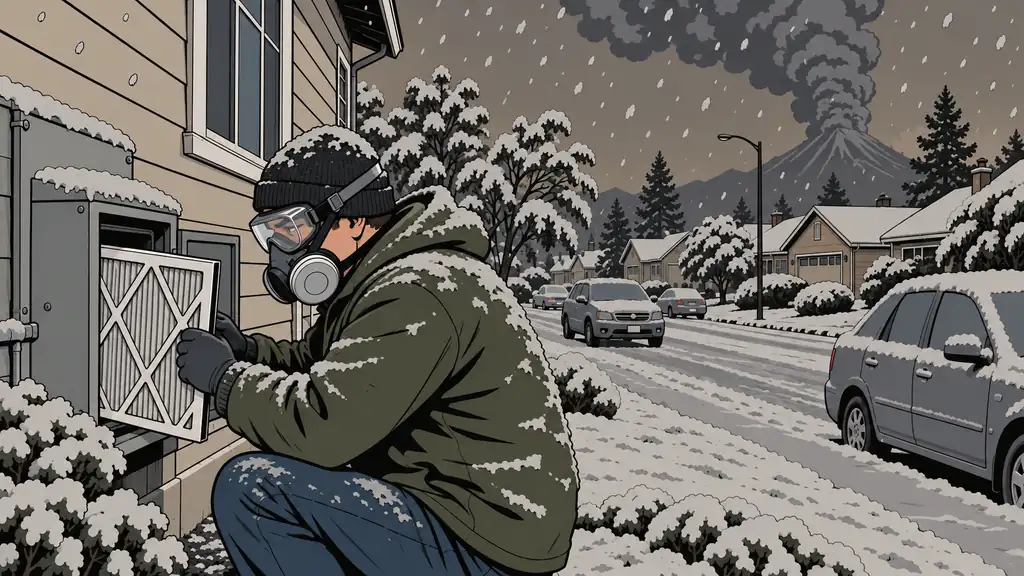
Volcanic ashfall is a threat that rewards being honest about the odds. For most of the country it’s a very low likelihood — 2 out of 9 — because it only reaches a handful of volcanic regions and the ground downwind of them. If that’s not you, read this for the shape of it and move on to threats that actually will reach you. But if you are downwind of an active volcano, the 6-out-of-9 impact undersells how thoroughly ash takes daily life apart, because it goes after several things you depend on at the same time and then sits there for weeks. Here’s the one idea that organizes everything else: for anyone in range, almost every fix is a filtering or sealing job — for your lungs, your water, and your machines.
Note, this threat will focus on the indirect result of a volcanic eruption — ash. The lava, lahars, etc. of an eruption are a much more focused threat that affects a very different subset of the population and has much different impact. As a result, it’s split out into a separate threat. You can find the volcanic eruption threat here.
What ash actually is
Volcanic ash isn’t the soft gray fluff the word suggests, and it isn’t burned-up anything. It’s rock and volcanic glass, blown apart by the eruption into fine, gritty particles — a lot of it small enough to breathe deep into your lungs. Three physical facts drive every hazard that follows:
- It’s abrasive. Hard, sharp glass and mineral grit grinds and clogs anything it passes through — engine cylinders, air filters, pump seals, the HVAC in your house. That’s why machines die.
- It’s fine enough to breathe, and it doesn’t break down. The finest particles go deep into your lungs, and unlike ordinary organic dust your body can’t clear it the same way. That’s the health hazard.
- It’s heavy, and it doesn’t leave on its own. Ash is dense — and once it soaks up water, much heavier. It doesn’t dissolve or rot away. Somebody has to physically shovel and haul it. That’s why roofs fail and cleanup drags on.
Ash also often comes coated in soluble compounds — sometimes acidic, sometimes carrying fluoride — that wash into water and onto the grass animals eat. This isn’t theoretical. After Iceland’s 1970 Hekla eruption, fluoride riding on the ash killed an estimated 3% of adult sheep and 8–9% of lambs in places dusted with as little as 1 millimeter of ash (USGS and the International Volcanic Health Hazard Network).
How far it travels
An explosive eruption throws ash high into the sky, and the wind carries it. So the area that gets hit isn’t a circle around the mountain — it’s a long plume stretching downwind, routinely for hundreds of miles, farther for the big ones. Mount St. Helens in 1980 dropped measurable ash across some 11 states. The layer gets thinner with distance, but even a thin coat is enough to foul water, clog a filter, and make the air rough to breathe. Ash and jet engines are a catastrophic mix, which is why airspace closes across an even wider area than the ash itself covers.
What the record shows
You don’t need invented numbers; the well-documented eruptions show the whole pattern. Mount St. Helens (1980) killed 57 people and dusted 11 states. Iceland’s Eyjafjallajökull (2010) grounded European air travel for days, canceling roughly 100,000 flights and stranding about 10 million travelers — most of them at airports that never saw a speck of ash. At the Philippines’ Mount Pinatubo (1991), most of the roughly 300 deaths during the eruption came from roofs collapsing under rain-soaked ash. The lessons repeat every time: the footprint is wind-driven and wide, lungs and water are the first things to protect, engines and infrastructure take a beating, and the disruption long outlasts the eruption.
The odds, honestly
The 2/9 cuts both ways, and you should respect both. For most people this is remote — don’t let it crowd out the everyday threats that actually will reach you. But “low” isn’t “zero,” and if you live downwind of an active system, the odds for you are real and the hit is heavy enough to earn a modest, targeted plan. Your address decides which group you’re in. Figure that out first, then prepare to match.
What it does, and what it takes down with it
The direct hits land on several systems at once:
- Your lungs — fine ash is a real health risk, worst for anyone with asthma, COPD, or a heart condition, and for kids and the elderly.
- Your water — open sources get fouled, treatment plants get stressed, and the surface chemistry can make water unsafe.
- Your machines — engines, generators, HVAC, and pumps clog and wear out fast. This one’s nasty, because the ash can kill the very generator you were counting on during the blackout that comes with it.
- Your roof — ash piles up, and wet ash is far heavier than dry.
Then it cascades. Grounded flights, dangerous roads, and stalled trucks empty the store shelves and stop the fuel resupply — so you have to carry yourself for the duration. And because the ash has to be hauled away by hand and truck, normal life doesn’t restart when the fall stops. It restarts when the region is cleared, which takes much longer.
Worked example: the roof, in pounds
“Four inches of ash” sounds like a sweeping job. Run the weight and it isn’t. The USGS puts wet ash at roughly 1,000–2,000 kg/m³. Four inches is about 100 millimeters, or 0.1 meter deep. Multiply it out and every square foot of your roof is carrying somewhere around 30 to 40 pounds of wet ash — and the USGS says a depth in that range can overload a weak roof. A dry fall you shrugged off can cross the line the moment it rains, because rain can nearly double the load without another flake falling. That’s why the move is to clear it before the rain, not after.
And size your supplies the way you’d size for any long outage. Four people at two gallons of water a day is 8 gallons a day — 56 a week, about 224 for a month — before you replenish a drop. Ash makes replenishing hard, so store toward the long end.
The common mistakes
- Treating ash like dust. It’s powdered glass. You filter against it and shovel it out; you don’t sweep it and wait it out.
- A cloth or surgical mask. Those don’t seal and don’t stop the fine fraction. You need N95 or P100.
- Leaning on the generator. The ash that started your blackout is also eating your generator’s air filter. Any plan that needs powered gear to survive the ash is built on the thing the ash breaks.
- Filtering ashy water through your good filter. It’ll clog in minutes. Pre-settle and coarse-pre-filter first — better yet, drink your stored water and leave the ashy source for later.
- Ignoring the roof until it rains. By then the load’s already up.
What preparedness looks like
Think of it as protecting four systems, measured in weeks you can run on your own.
1. Your lungs — first priority. N95 or P100 respirators for everyone; P100 for heavier or longer exposure. Sealed goggles, because ash is hard on eyes. And seal the house: close and weatherstrip doors and windows, and know how to switch the HVAC to recirculate or shut it off so it isn’t pulling ash inside — with spare filters on the shelf.
2. Your water. Store it ahead, in sealed, covered containers ash can’t reach. Plan to treat more, but know an ordinary filter clogs fast on ashy water — pre-settling and coarse pre-filtering help. Assume the municipal supply is degraded.
3. Your machines. Drive as little as possible — every mile in ash is wear you don’t get back. Stock spare air filters for vehicles and generators, and shield the intakes. And accept the generator is vulnerable, which is exactly why your water and air plans can’t depend on it.
4. Your roof. Watch the load and be ready to clear it before it deepens — and especially before forecast rain — turns it into a collapse risk. Do it safely: good footing, a respirator on, and don’t overload yourself. This is a real injury hazard, not a chore.
Plus the ordinary outage layer: a couple weeks of food and water, light, a battery or crank radio, and a plan for a multi-week interruption.
Bottom Line
- Know your group first. For most, this is a very-low-odds threat; downwind of an active volcano, it’s a real regional hazard worth a targeted plan.
- Ash is abrasive glass that doesn’t go away — you filter against it and haul it out, you don’t wait it out.
- Filtering is the whole game: N95/P100 for lungs, sealed and covered storage for water, spare filters and minimal driving for engines.
- It hits several systems at once — including the generator you’d lean on — so don’t build a plan that needs powered gear to survive the ash.
- Watch the roof and plan in weeks, because wet ash collapses roofs and the cleanup long outlasts the eruption.
Volcanic ash rarely kills you. It quietly wrecks the air, water, and machines every other plan takes for granted — so where it falls, prep is just filtering, sealing, and hauling, done for weeks.
Confirm whether volcanic hazard is a real factor for your location with the county Threat Report, and size the weeks of water and no-cook food a regional supply cutoff demands with the Food & Water Storage tool.