


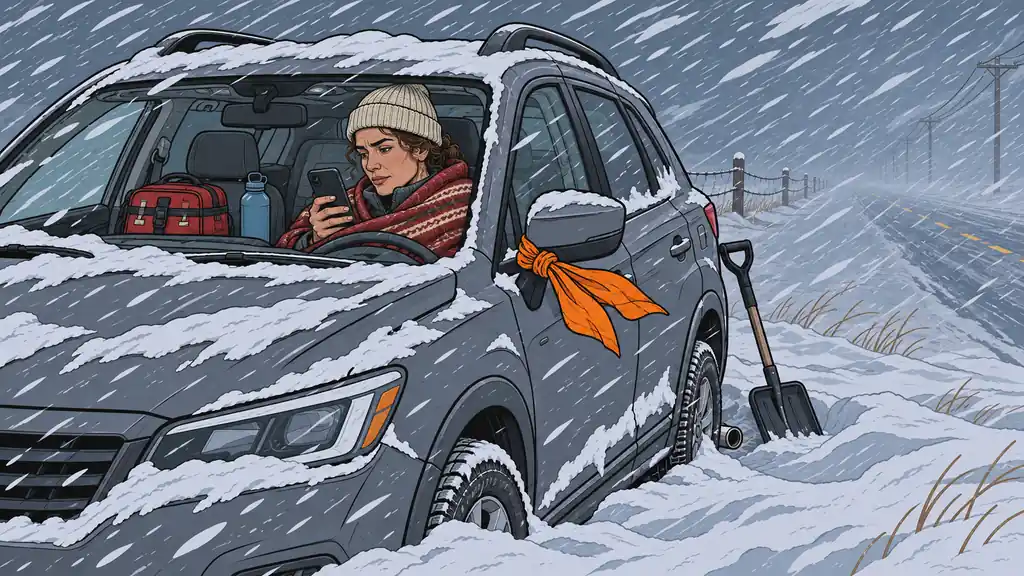
The blizzard advice everyone knows is “don’t drive during a warning,” and it’s correct. But it quietly assumes you’ll always have the warning, always heed it, and never get caught. Real life is messier. The storm arrives faster than forecast, the commute home turns white, a road closes behind you, or the trip genuinely couldn’t wait. So the honest question isn’t only how to avoid being on the road — it’s what you do when the road already has you. Because the grim pattern in blizzard fatalities is that a large share happen to people in vehicles, and a large share of those happen not in the crash or the cold of the car, but after the driver made one specific decision: to get out and walk for help.
This article is about that scenario and that decision. The car is one of the best emergency shelters you own — it’s windproof, it’s visible, and it’s a known location. The mistake is abandoning it.
Why leaving the car kills
Picture the setup. You’re stuck — snowbank, closed road, ditch — visibility near zero, wind howling, and the thought that arrives is the reasonable-sounding one: I’ll just walk to that house / that exit / that gas station. Here’s why that instinct is the dangerous one:
- Distance and time lie in a whiteout. The landmark that looks close is farther than it appears, and the wind and drifts make every step cost more than a step normally does. People set out for a light they can see and don’t reach it.
- You lose your shelter and your visibility at once. The car blocks wind and holds some warmth. On foot you have neither, and a person walking in a whiteout is nearly invisible to the rescuers and plows who would have found a car.
- Exertion plus cold is a bad trade. Wading through deep snow works up a sweat, that sweat freezes, and wet-and-cold is how exposure sets in fast. You can exhaust yourself into far worse shape than sitting still would have left you.
- The car is a target searchers can find. A stuck vehicle on or near a road is exactly what plows, patrols, and other drivers encounter and report. A person who left it is a much smaller, mobile, hidden problem.
The rule is blunt and it saves lives: stay with the vehicle unless safety is genuinely, visibly within reach — a building you can clearly see and certainly reach, not a light you’re guessing at. Otherwise the car is your shelter, and your job is to survive in it and be found.
In a whiteout, the car is the shelter and the beacon. The person who walks away from it gives up both and becomes a needle in the snow.
Surviving inside the car
Staying put isn’t passive. There’s a short discipline that keeps the car survivable and findable:
- Run the engine sparingly for heat, and clear the exhaust pipe first. This is the killer detail: snow drifting around the car can block the tailpipe and push carbon monoxide back into the cabin, poisoning people who did everything else right. Before running the engine, get out and clear snow from around the tailpipe, and run it only in short intervals — roughly ten minutes an hour is the common guidance — with a downwind window cracked slightly for fresh air. Don’t idle continuously and don’t sleep with it running.
- Insulate yourself, not the cabin. Your blankets, extra layers, hats, and anything that traps air go on you. The same one-warm-space logic that governs a house applies to a car: warm the person, not the volume.
- Stay visible. Turn on the dome light while the engine runs, tie something bright to the antenna or mirror, and keep the car free enough of snow that it reads as a vehicle and not a drift. You want to be the easy thing to spot.
- Move a little so you don’t stiffen. Small, regular movement keeps circulation up without working up a sweat. The balance is warmth without wetness.
- Call for help and share your location. A charged phone that can tell someone where you are is worth more than almost anything else in the car — which is exactly why the kit below leads with a way to keep it charged.
When the stranding runs long
Most strandings end in hours, but plan for the one that doesn’t — a road closed overnight, a pileup that takes a day to clear, a rural stretch nobody reaches until the plows do. The survival logic doesn’t change; it just has to hold longer, and a few habits make the difference between an uncomfortable night and a dangerous one:
- Ration the fuel from the start, not once it’s low. Short engine bursts for heat, tank kept above half before you ever set out, and you stretch a partial tank across many hours instead of burning it warm in the first two.
- Ration your energy the same way. Eat and drink a little at a time; stay just warm enough rather than trying to get toasty, which wastes fuel and calories you may need tomorrow.
- Keep a rhythm you can sustain — a cycle of a little movement, a little rest, a check of the phone and the tailpipe — so a long wait doesn’t turn into either panic or the fatal drift into sleep with the engine running.
A stranding you’re mentally prepared to spend the night in is a survivable one. The danger is treating a long event with a short event’s urgency and burning your margins early.
The kit that turns a stranding into a story
The difference between a survivable stranding and a deadly one is mostly what’s already in the trunk, staged before winter. None of it is exotic; all of it is worthless if it’s at home in the garage. A winter vehicle kit worth the name covers warmth, visibility, energy, and dig-out:
- Warmth: a real blanket or two (wool or a proper emergency blanket), spare hats and gloves, and extra dry layers. This is the core — it’s what keeps you alive with the engine off.
- Energy and comfort: water and calorie-dense snacks that don’t mind freezing, so you’re not burning your own reserves faster than you must.
- Power and signal: a way to keep your phone charged (a battery pack, a car charger), and something bright — a flashlight or flares — to be seen.
- Dig-out and traction: a small shovel, and sand, cat litter, or traction mats to get unstuck; a scraper and brush to keep the car visible and the tailpipe clear.
- The boring multipliers: keeping the fuel tank above half all winter (fuel is heat and options), and a full charge on your phone before you set out.
Stage it in the car in fall and forget it. The people who survive strandings almost always turn out to have been the ones who’d done this months earlier, on a day when it felt like overkill.
Who ends up here — and the decisions upstream
The stranded-in-the-car scenario disproportionately catches a few groups: people who trusted a forecast that shifted, people who “had to” make a trip they could have delayed, and people passing through unfamiliar terrain who couldn’t read how fast conditions were turning. The upstream fixes are unglamorous and decisive:
- Respect the warning, and build slack. The single most effective move is still not being out there. When a warning is up, the trip that “can’t wait” almost always can, and the cost of waiting is boredom, not exposure.
- Tell someone your route and your timing. If you’re overdue, a person who knows where you were headed is the reason a search starts hours sooner. A stranding you’re expected back from is a very different event than one nobody knows about.
- Keep the tank full and the kit in the car all season. These two habits, set once, cover most of the gap between the plan and the day the plan gets tested.
The through-line of blizzard safety is that the danger lives on the road, and this is the article-length version of why. Avoid the road when you can; when you can’t, make the car a shelter you’ve stocked, and never trade it for a walk into a whiteout.
Bottom Line
- Most blizzard deaths are on the road, and leaving the car is the decision that turns a stranding fatal — stay with the vehicle unless safety is clearly, certainly within reach.
- The car is shelter and beacon: it blocks wind, holds warmth, and is what searchers can actually find. On foot you lose all three and become invisible.
- Run the engine only in short bursts with the tailpipe cleared — drifting snow can back carbon monoxide into the cabin and kill people who otherwise did everything right.
- A staged winter kit is the whole game — warmth, water, phone power, visibility, and dig-out tools, in the car before the season, useless if left at home.
- The real fixes are upstream: respect the warning, keep the tank above half, and tell someone your route so a search starts early.
Plan winter travel decisions, routes, and check-ins so a caught-out trip is a stranding you’re expected back from — build it with the Threat Planning Tool.