


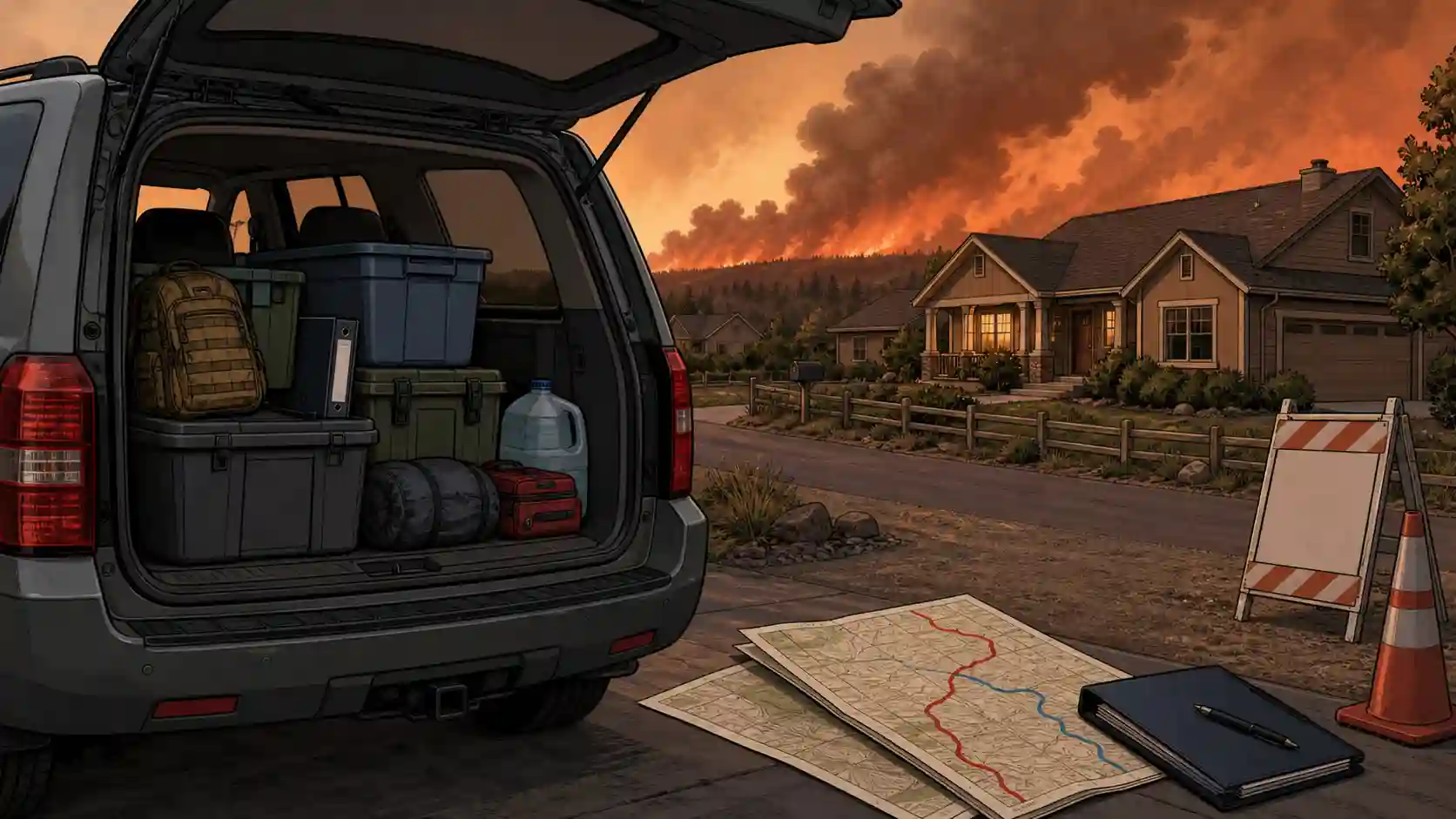
The bug-in versus bug-out argument is one of the oldest in preparedness, and almost everyone frames it as a matter of preference — homesteader or refugee, hunker down or head for the hills. I’ve made my own case that bugging in is usually the stronger position when your location supports it. But that whole debate quietly assumes something that isn’t always true: that you get a vote.
For a specific handful of threats, you don’t.
The threats that decide for you
Even if you have a well-stocked home, a good location, and every intention of staying put, some events simply revoke the option. A few examples:
- A chemical spill or radioactive fallout drifts over your area and makes the air itself the threat.
- Your house is destroyed — a tornado, a wildfire, a structure fire — and there’s nothing left to bug in to.
- Your area is overrun, whether by a wildfire evacuation zone, civil violence, or whatever end-of-the-world scenario you want to name.
In every one of these, the ground you planned to hold is the thing that’s now dangerous. Staying isn’t stubbornness at that point; it’s a fatal mistake. For these threats, your plan has to be bug-out — there is no bug-in version of “your house is on fire.”
Which is why the plan isn’t optional
Two things follow, and both are worth stating plainly.
First: for those threats, you need a real bug-out plan — not a fantasy. “We’ll just go stay with Mom down the street” is not a plan, because whatever forced you out of your house may well be at Mom’s house too. The fallout doesn’t stop at her property line; the wildfire evacuation zone probably includes her. A real bug-out plan means the same things it always meant: somewhere secure and sustainable to go, supplies already positioned there, and a reliable way to get there — with a backup route, because the primary one may be exactly where everyone else is stranded.
Second: even for threats where you can bug in, bug-out is your backup. You don’t get to skip it just because you plan to stay. The whole point of the forced-evacuation category is that the decision can be taken out of your hands with no notice. A backup you never use costs you nothing. A backup you needed and didn’t have costs you everything.
Bug-in is a plan. Bug-out is also a plan. For most threats you’ll lean on the first — but you are never excused from having the second.
And if bug-out is your primary plan
If you live somewhere that can’t support bugging in — dense urban core, no way to be self-sufficient where you are — then bug-out is your first move, not your fallback. Fair enough. But apply the same logic one more step: the hazards that can make a home unlivable can make a bug-out location unlivable too. The fallout, the fire, the overrun area don’t care that you labeled the second place “safe.” You may end up needing to bug out of your bug-out location, which means the redundancy you build for home — a second destination, a second route — you now have to build for the retreat as well.
Bottom Line
Bug-in versus bug-out isn’t one decision you make once as a personality. It’s a decision you make per threat, in advance, on a calm day — a column on the threat worksheet, not a philosophy.
- Sort your threats into “can bug in” and “must bug out.” The must-bug-out ones — hazmat, fallout, fire, overrun — decide for you.
- Build a real bug-out plan for those, and as the backup for everything else: a destination, pre-positioned supplies, and a route with an alternate.
- If bug-out is primary, give your retreat the same redundancy as your home. You can be forced to leave it, too.
Record the call for each threat where it belongs — on the plan itself. Threat Planning keeps the bug-in/bug-out decision, and the route, attached to the specific threat it answers.