


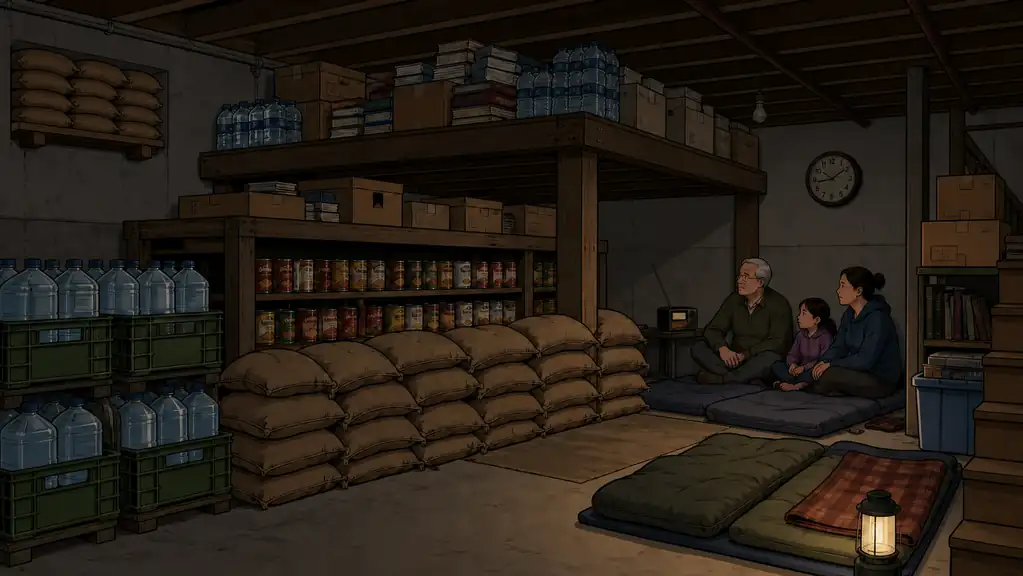
Most people file nuclear fallout under “everybody dies, nothing to do.” It’s an understandable reaction to the worst weapon ever built, and it’s wrong. If you’re standing at ground zero, no, there’s no preparing your way out of that. But fallout isn’t the blast — it’s radioactive dust that drifts downwind for hundreds of miles, and for the people under that plume, fallout is one of the few nuclear effects you can actually prepare for.
The whole problem reduces to a single number: your dose. And dose follows physics, not fate.
Dose is rate times time
The radiation you absorb is just the exposure rate multiplied by how long you’re in it. Sit in a 10 R/hr field for 5 hours and you’ve taken 50 rad — simple multiplication. That’s the entire game, and it’s good news, because it means you have two separate levers to pull: cut the rate (get mass between you and the dust), and cut the time (wait it out, because the rate falls fast on its own).
You don’t beat radiation. You out-wait it behind enough mass — dose is just rate times time, and both are numbers you can shrink.
For scale on what a dose means: below about 50 rad, no acute symptoms. Around 300 rad without medical care runs 30–50% fatal; 600 rad is very likely fatal. Those effects roughly halve if the same dose is spread over weeks instead of hours. See the full dose-effect table rather than trusting a number in your head.
Mass is the lever you build
The rate lever is mass — the more material between you and the fallout, the less gets through. It’s measured as a protection factor (PF): a PF of 200 means you take 1/200th of the outside dose. Per FEMA’s numbers:
- Three feet underground — PF ~5,000. The gold standard, and why a basement corner piled with mass beats every room above it.
- 12 inches of concrete — PF 30 to 1,000.
- An ordinary basement — PF 10 to 20.
- A wood-frame house — PF 2 to 3. Almost nothing.
- A car — PF 1.7 to 2. You are not sheltering in a vehicle.
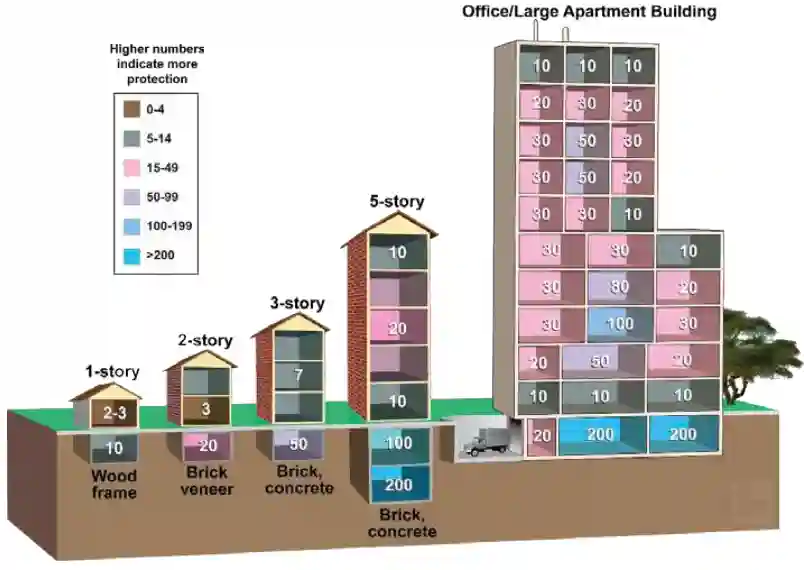
The takeaway isn’t “buy a bunker.” It’s that a basement, with the densest mass you can stack overhead and around you — earth, concrete, water, books, canned food — moves you from a PF of 2 to a PF of 20 or better. That’s the difference between a lethal dose and a survivable one, built from things you already own.
Time is the lever that works for free
We tend to think of nuclear fallout as some sort of permanent problem, and it’s not. The cities of Hiroshima and Nagasaki began rebuilding almost immediately after the bombs were dropped. I’ve personally stood at the bomb drop site in Nagasaki - it’s hard to imagine the city was ever destroyed that way.
Fallout is intensely radioactive at first and then decays exponentially. The rate drops to roughly 1 R/hr about two days after contamination, then tapers toward nothing over months. The practical rule: stay sheltered until the fallout has decayed — more than 48 hours at an absolute minimum, and 7 days is the number to plan around.
That’s why sheltering is a supply problem as much as a shielding one. You need to stay put for days without going outside for water, so store water rather than plan to collect it — surface water will hold fallout particles, and stripping them out requires activated charcoal, distillation, or reverse osmosis, none of which you’ll be running grid-down.
What potassium iodide does — and doesn’t
Potassium iodide (KI) is worth having, and it is not the shield people think it is. It saturates your thyroid so it can’t absorb radioactive iodine — that’s all it does. It does nothing for the rest of the dose to the rest of your body. Adult dosing is 130 mg/day per WHO guidance, scaled down for children. Have it; don’t let it make you feel invincible.
Bottom Line
- Dose = rate × time. Everything you do is aimed at shrinking one or both.
- Mass buys down the rate. A basement corner packed with dense material takes you from PF 2 to PF 20+ — the survivable range — with no construction.
- Time buys itself. The rate collapses within days. Shelter 48 hours minimum, plan for 7 — which makes stored water non-negotiable.
- KI protects one gland, not your life. Own it, dose it correctly, and don’t overrate it.
Before you plan the shelter, find out if your county is even a fallout problem — model the blast and downwind reach with the Nuclear Detonation simulator or results of a nuclear power plant breach with the Nuclear Fallout simulator.