


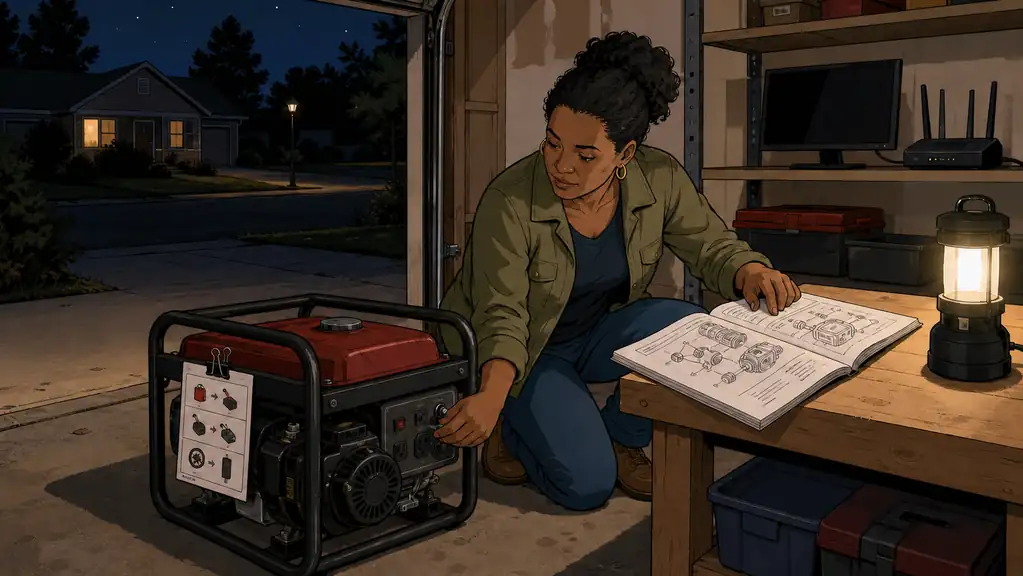
Almost every repair you’ll ever do, you look up first. The torque spec, the fuse location, the carburetor rebuild sequence, the part number for the gasket — you don’t carry that in your head, you carry a phone that fetches it in ten seconds. That works beautifully right up until the exact moment it doesn’t. The scenarios where you most need to fix something yourself are the same scenarios that take the internet down with them. Your repair library and your repair emergency share a single point of failure, and it’s the router blinking in the corner.
That’s the trap: the knowledge feels like you own it because it’s always been there. But you’re renting access to a server somewhere, and the rent comes due precisely when the grid, the tower, or the ISP is out. A manual you can only reach online is a manual you don’t actually have.
The three things worth having on paper (or offline)
You don’t need to print the internet. You need the specific documents that stand between you and a repair you can’t otherwise complete:
- Manuals for anything with an engine or a circuit. Generator, chainsaw, pump, vehicle, well controller. The service manual — not just the owner’s pamphlet — has the torque specs, the fault-finding trees, and the exploded diagrams you’ll be squinting at.
- Part numbers and specs, written down. Filter numbers, belt sizes, spark-plug gaps, O-ring dimensions, fluid types and capacities. This is the stuff you’d normally look up mid-job, and it’s the cheapest thing to lose. Log it next to the tool in your inventory.
- The general repair library. Small-engine and carburetor work, basic electrical, plumbing, roofing — the skills that apply across your whole kit. Save the good how-to videos and guides offline while they load, not while you’re staring at a spinner.
Write your own manual for the things that matter
Factory manuals assume a calm, competent reader with all day. An emergency gives you neither. So make the guide the manufacturer didn’t. For a generator, create and laminate a step-by-step starting guide with pictures and keep it with the generator. Not in a binder across the house. Attached to the unit, in the order you actually do it: fuel valve, choke, switch, pull, warm, choke off, load on. When it’s 2 a.m. and cold and the power’s been out for six hours, that laminated card is worth more than the whole owner’s manual.
A perfect manual on a dead phone is worthless. A crude laminated card zip-tied to the machine is priceless. Optimize for the bad day, not the good one.
Do the same for anything you’d have to think through under stress: the well pump, the water shutoff sequence, the transfer switch, the wood stove’s cold-start. If a family member might have to do it without you, that card is the difference between “handled” and “frozen.”
Keep it where the failure can’t reach it
An offline library only counts if it survives the event you built it for:
- On paper for the critical few. Starting guides, shutoff sequences, emergency contacts. Paper needs no battery and no signal.
- Offline-digital for the bulk. Manuals, diagrams, saved videos — stored locally on a device or drive, not bookmarked to a site that might be down or gone.
- Backed up and findable. One copy is no copy. And a manual you can’t locate in the dark is the same as not having it — label it, index it, keep it with the gear.
The point isn’t to distrust the internet. It’s to notice that your repair capability is currently wired to a system you don’t own and can’t fix, and to cut that dependency for the handful of repairs your safety actually rests on.
Bottom Line
- Your repair knowledge is rented, not owned. It lives online, and the internet fails in the same events that make you the mechanic. Pull it local.
- Save manuals, diagrams, and part numbers offline for every engine and circuit you depend on — before you need them, while they still load.
- Write your own laminated guides for the high-stress jobs, in plain language with pictures, and keep them on the machine.
- Store for the bad day. Paper for the critical few, offline-digital for the rest, backed up and labeled so you can find it in the dark.
The Digital Binder is built to hold exactly this — manuals, diagrams, part numbers, and your own guides — in one encrypted place you control, so your repair library doesn’t depend on a signal.