


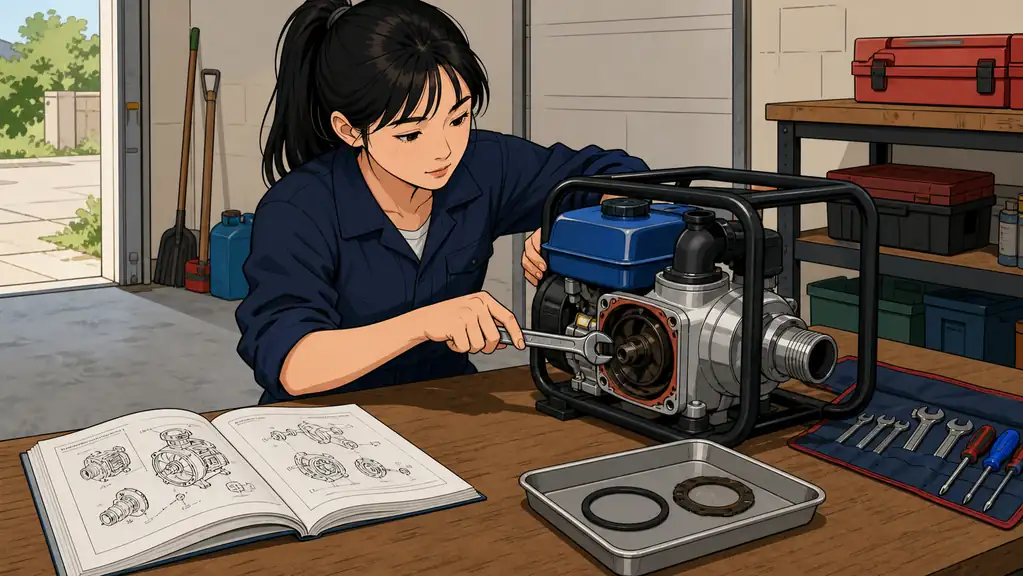
The prepper reflex is to buy the tool. A repair problem shows up, you find the tool that solves it, you own the tool, done. It feels like progress because a box got heavier or a shelf got more full. But a tool on a shelf isn’t a repair capability — it’s one leg of a three-legged stool, and a stool with one leg doesn’t stand a little worse than a normal one. It doesn’t stand at all.
Every actual repair needs three things at once: the tool, the skill to use it, and the parts to do it with. Own all three and you can fix the thing. Own two and you can’t. There’s no partial credit — a flat tire with a jack and a plug kit but no clue how to find the leak is exactly as fixed as a flat tire with the clue and no plug kit. Both are zero.
Why it’s a product, not a sum
Think of your capability as multiplication, not addition. Tool × Skill × Parts. Anything times zero is zero, and most people are carrying a zero somewhere and don’t know which one.
Repair capability multiplies, it doesn’t add. A missing skill doesn’t make you 30% ready — it makes you zero, dressed up as a full toolbox.
- No skill. The chainsaw in the garage you’ve started twice. The multimeter you can’t read. The most common zero, because the tool is the part you can buy and the skill is the part you can’t.
- No parts. You know exactly how to patch the roof, but there’s no flashing, no sealant, no plywood on hand and the store is closed. Competence with an empty pantry.
- No tools. The worst kind of surprise, because you’ll get all the way to the moment of the fix — confident, capable — before you discover you’re missing the 10mm socket.
The skill leg is the one that hides
Tools and parts at least sit on a shelf where you can count them. Skill doesn’t — and it decays silently. There’s no puddle on the floor to warn you that you’ve lost the ability to quickly sharpen a chain or bleed a brake line. You find out on the day you need it, which is the worst possible day to find out anything.
That’s why “I’ll figure it out when I have to” is the most expensive sentence in preparedness. Under stress your comprehension drops, your hands shake, and the internet that would’ve walked you through it is exactly the thing that’s down. The skill either lives in your brain before the emergency or it doesn’t show up during one.
The fix is unglamorous: use the tool while nothing is wrong. Sharpen the chain on a calm Saturday. Change the generator’s oil yourself once so your hands know the bolts. Patch a scrap of roofing in the yard. Each rep converts a tool you own into a repair you can actually do — it moves a leg of the stool from imaginary to real.
Audit your triangle, one capability at a time
Don’t audit your toolbox. Audit your capabilities — the specific fixes your plans depend on — and check all three legs of each:
- Name the repair. “Patch the roof.” “Fix a flat.” “Rebuild the generator carburetor.” “Board up a window.”
- Tool: do I own it, and does it work?
- Parts: do I have the consumables and spares that repair eats, on hand, not on a wishlist?
- Skill: have I actually done it, with my hands, at least once?
Any leg you can’t check honestly is where that capability is zero. That’s not a criticism — it’s a to-do list, and it’s a far better one than “buy more tools,” because it tells you exactly which cheap missing piece is currently canceling out everything else you already paid for.
Bottom Line
- Capability is Tool × Skill × Parts. A zero anywhere zeroes the whole thing. Find your zeros.
- The skill leg is usually the missing one. It’s the part you can’t buy and the part that decays without warning. Practice is the only fix.
- Audit fixes, not toolboxes. Walk each repair your plan assumes and check all three legs.
- Do it once while it’s easy. A repair you’ve done with your hands is real. One you’ve only read about is a hope with a receipt.
Track your parts using the repair inventory tool. The Reminders is where the skill leg gets built — scheduled reps that turn a tool you own into a repair you can actually perform.