


Entropy is a concept from the second law of thermodynamics. It describes the tendency of things in a system to drift toward uniformity — and it says that order is only maintained through outside influence. It’s physics, not philosophy, and it has a blunt implication for anyone who has spent money on preparedness:
Things always break down, wear out, or decay over time. Only through outside influence is this prevented.
Read that as a prepper and it says something uncomfortable. Every item you own is degrading right now. The stove, the generator, the roof, the fence, the truck, the water filter. Not might degrade — is degrading. The only thing standing between your preparations and a pile of broken equipment is maintenance and the ability to fix things.
Which makes Repair the strangest category in preparedness. It’s the only one whose threat is certain, and it’s the one that always gets the smallest budget.
The category is smaller than you think and bigger than you think
Here are some examples of the scope of Repair:
- Ability to patch or fix your roof.
- Ability to repair or board up a window.
- Ability to build animal enclosures.
Three lines. It looks trivial next to the other categories. But look at what’s implied — that’s a roof over your family, a weather-tight building envelope, and the infrastructure keeping your food supply alive and contained. Those aren’t small stakes. They’re shelter, warmth, and food, and they’re all held together by whether you own some sealant and shingles and know how to use them.
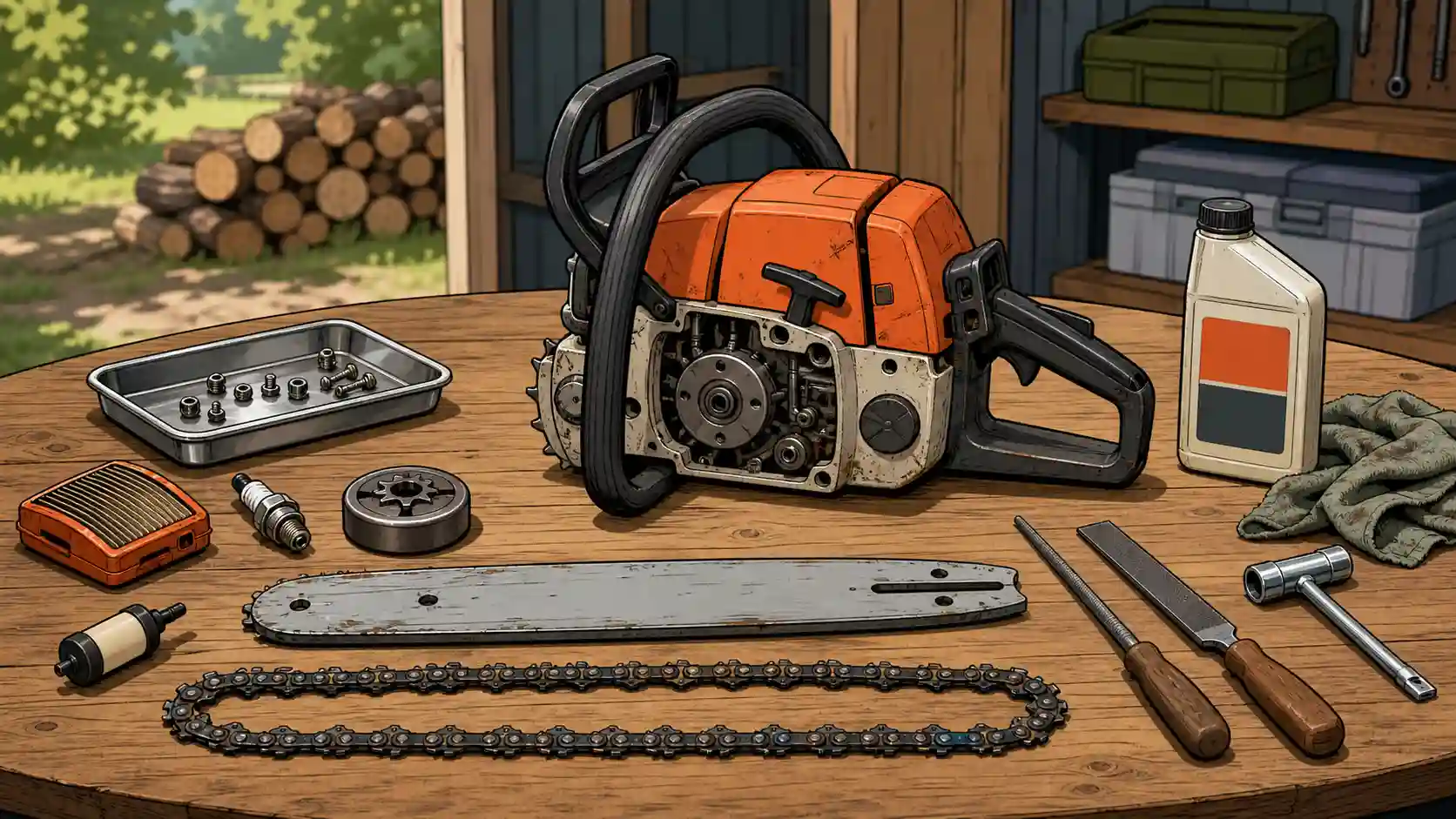
Then extend it honestly. Whatever your other preparations are, those break too. If wood is your heat plan, the chainsaw is part of your heat plan — along with the bar oil, the spare chains, the files, the wedges, and the maul. If a well and pump are your water plan, then pump parts are your water plan. Every other category has a repair dependency hiding inside it, and Repair is where those get written down as spare parts needs.
Simplicity is a repair strategy
There’s a reason to prefer the simplest tool that does the job, and it isn’t nostalgia.
Simpler tools are less likely to fail — and when they do fail, you may be able to fix them. The more complexity you depend on for survival, the more surface area Murphy has to work with. A hand tool with three parts has three ways to break and you can address all of them. The device with a sealed circuit board has hundreds of ways to break and no way to fix it, and it fails on a schedule set by someone else.
This isn’t an argument for doing everything the hard way. It’s an argument for asking a question before you buy: when this fails, can I fix it, or does it become garbage? Both answers are acceptable. Only one of them should be a surprise.
Small failures don’t stay small
Here’s why the boring category matters more than its Impact score suggests.
A flat tire on a normal day is an inconvenience. You’re late, you’re annoyed, it’s over. Now change one thing: you’re evacuating. Tsunami, wildfire, chemical release — something with a clock on it. That same flat tire, on that day, can kill your family. Not because it got worse, but because the situation around it did.
Nothing about the failure changed. Everything about the consequence did.
That’s compounding, and it’s why it’s important to rate the small personal threats — flat tire, out of gas, roof leak, flooded basement — with the same honesty you’d give a hurricane. Their Impact looks low in isolation. But emergencies don’t arrive in isolation, and a trivial problem stacked on top of a serious one stops being trivial.
The fix is usually absurdly cheap. Check that the spare has air. Verify the jack works. Carry a plug kit and a compressor — with which you might not even need to change the tire, and you’re moving again faster. Minutes of effort, and a threat leaves the list.
This is the logic behind carrying a flashlight every day. One certainty about today is that it will eventually get dark. Since that’s going to happen, why wouldn’t you prepare for it?
Two things break, not one
There’s a second point that’s easy to skim past:
- Things will break — only maintenance prevents it.
- Things will be forgotten — only practice prevents it.
The second one is the real ambush. Skills decay exactly like equipment does, and they decay silently. There’s no puddle under the driveway to tell you that you’ve forgotten how to sharpen a chain or patch a roof. You find out on the day you need it, which is the worst possible day for a discovery.
So Repair isn’t a bin of tools. It’s a bin of tools plus the periodic act of using them. Practice is the outside influence that keeps the skill from drifting toward uniformity along with everything else.
Bottom Line
Repair is the one category where the threat is guaranteed. Fund it accordingly.
- Inventory the spare parts your other plans quietly assume. Chains, filters, belts, fasteners, fluids, sealant, plywood. Every category has some.
- Prefer tools you can fix. Ask the question before you buy, not after.
- Clear the small stuff. Spare tire, jack, plug kit, a flashlight on you. Hours of work, entire threats removed.
- Maintain and practice on a schedule. Both equipment and skills decay. Only outside influence stops it — and you’re the outside influence.
Nobody gets excited about a box of spare parts. But it’s the category that decides whether everything else you bought is still working in year two.
The Repair & Tools inventory tracks tools, fluids, and spare parts with the expiration dates that matter, and Reminders is where maintenance and practice become a cadence instead of a good intention.