


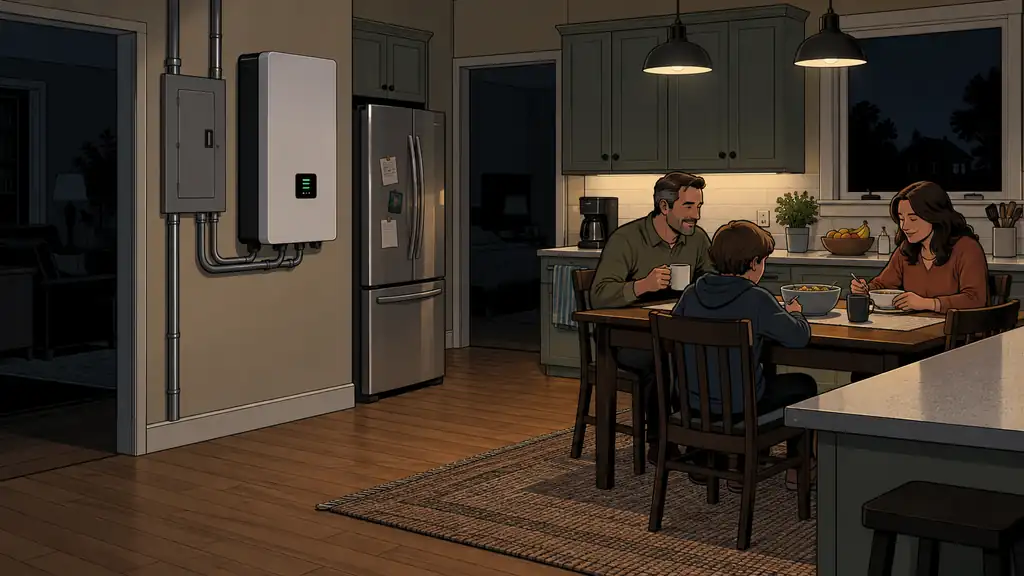
Most people picture a blackout as their street going dark for a few hours. That picture is why they’re unprepared for the real thing. The one fact that changes everything about a regional grid failure is this: when the whole region is down, there’s nowhere to drive to. Lose power on your block and you drive ten minutes to a working store, a hot meal, a charged phone. Lose it across the region for days and that door is shut — the gas stations can’t pump, the stores can’t ring up a sale, the water utility may lose pressure, and every house around you is on its own supplies at the exact same moment. That’s the scenario you’re actually preparing for. It means you don’t plan to escape a grid-down. You build one into your house and plan to ride it out.
A multi-day grid failure is a loss of power across many counties for days rather than hours — from severe weather, ice loading the lines, a heat wave spiking demand past capacity, cascading equipment trips, or a physical or cyber attack. It rates impact 7 of 9 — climbing the longer it runs — and likelihood 4 of 9, a below-midpoint number that reflects a real and rising chance as grids age and weather sharpens.
Why the odds are trending up
Two things are converging. First, a lot of the transmission and distribution hardware is decades old and running closer to its limits, with long waits to replace the big pieces. Second, the weather that stresses it — deep freezes, long heat waves, high-wind and ice storms — keeps arriving harder and more often. Add demand that keeps growing and you get a system with thinner margins and bigger shocks.
The large power transformers make the fragility concrete. These are the hard-to-replace hearts of the grid, and the U.S. Department of Energy has cited replacement lead times commonly around three years — as long as five — to build and deliver one, with recent orders stretching past two years as the new normal. That’s not a prediction of collapse. It’s a plain expectation that multi-day, multi-county outages will keep happening, and that your area’s turn will come.
How the grid fails — and why it’s slow to fix
Understanding how it breaks tells you why the outage is regional and why “days” is the honest number. The grid balances generation and load every second. When a big disturbance hits — a plant drops offline, a line comes down, demand spikes past capacity — protective systems shed load or trip equipment to keep from destroying it. In a severe event those trips cascade, dropping huge areas at once. Getting it back isn’t a switch: operators have to bring it up in stages — a black-start, restarting the system piece by piece — and if the physical hardware is damaged (ice-laden lines, snapped poles, a flooded substation, a blown transformer), crews have to physically go fix it. Over roads that may be blocked. In the weather that caused the outage.
Just how slow that repair runs is easy to underestimate. Reporting in The New York Times Magazine points to the 2013 sniper attack on Pacific Gas & Electric’s Metcalf substation near San Jose: even with the rest of the grid up and every advantage on the utility’s side, it took 27 days to bring that one substation back. If a single damaged substation is a month of work under good conditions, a storm that mauls dozens across a region — in bad weather, with crews stretched thin — is weeks, not the overnight fix most people picture.
What breaks, and in what order
Electricity is the one utility everything else hangs off, so when it goes, it takes the rest with it — in a fairly predictable order:
- Heat and cold — the part that actually kills. No power means no furnace blower, no heat pump, no AC. In a winter storm the house can drop below a survivable temperature and the pipes can freeze and burst; in a heat wave the indoor temperature turns deadly for the elderly and the sick. This is the first thing to solve, ahead of food or light. That’s not the inconvenient part of an outage; that’s the dangerous part.
- Water. Well pumps are electric. City systems often need power to pressurize and treat. No power can mean no water from the tap and — just as bad — no way to flush a toilet, which becomes a sanitation problem within a day or two.
- The cold chain. USDA guidance gives a full, unopened freezer about 48 hours and an unopened refrigerator only about 4 hours. Everything in them is on that clock — and so is refrigerated medication like insulin.
- Communications. Cell towers have battery backup good for hours to about a day without refueling; wired internet and cordless phones die immediately. Your ability to get information and call for help erodes steadily.
- Money and fuel. Card readers and ATMs go dark, and — the one that strands people — gas pumps don’t work without power. The vehicle you were counting on to evacuate or resupply can’t be refueled once its tank runs low.
Each of these is survivable on its own. Stacked together, over four or five days, across a region where you can’t outsource a single one of them, they’re a serious emergency. That’s why the impact climbs with time.
Sizing it: a week, in real numbers
The goal is to keep your household warm or cool enough, watered, fed, and connected for a week or more with no grid and no assumption that resupply is coming. Put numbers on it so it’s a plan, not a vibe.
Water. Plan a gallon per person per day as the floor, and realistically closer to two once you count sanitation. A family of four for a week at two gallons is 8 a day, 56 for the week — before you replenish a drop. That’s not a case of bottles; that’s a couple of proper containers and a way to refill them.
The cold chain, on the clock. Your fridge buys you about 4 hours, your full freezer about 48. So the plan is: eat the fridge food first, keep the freezer shut, and have coolers and a way to get ice ready for anything that has to stay cold longer — especially medication. Know your meds’ real tolerance before you need it.
Heat, solved first. A safe, non-electric (or independently powered) way to hold the house — or one sealed-off room — to a survivable temperature. In summer it’s shade, airflow, hydration, and a cooling plan for the vulnerable. The one rule you don’t break: never run a generator, grill, or any unvented fuel-burner inside a living space or attached garage. Carbon monoxide is invisible and odorless and it’s the leading killer in outages. Pair any combustion with battery CO alarms.
Power, right-sized. You don’t need to run the whole house. Prioritize charging phones and a radio (battery banks, a car charger, a small solar panel), power for any medical device you depend on, and — if you run a generator — one sized to cycle the essentials (fridge, a heater’s blower) intermittently, placed safely outdoors with fuel stored and rotated.
Cash, fuel, and comms, staged ahead. Keep enough cash for a week of essentials, keep the vehicle tank at least half full as a standing habit because you can’t refuel once the pumps are dead, and keep a battery or hand-crank radio plus a plan to reach out-of-area contacts. Measure your readiness in days you can hold each need, not dollars of gear.
Bottom Line
- Scale shuts the door — in a regional outage you can’t drive to power, fuel, or supplies, so the backup has to be at home.
- It’s increasingly likely — aging hardware plus sharpening weather make multi-day, multi-county outages a rational expectation, not a doomsday guess.
- Heat and cold come first — in winter and summer, that’s the part that actually threatens lives.
- Carbon monoxide is the hidden killer — never run generators or fuel heaters indoors, and use battery CO alarms.
- Stage water, no-power food, cash, fuel, comms, and a cold-chain plan — sized for a week or more, because resupply may not come.
The grid is one wire your heat, water, food, medicine, and phone all hang from — cut it region-wide for a week, and the only backup that helps is the one already in your house.
Size a week of water and no-power food with Food & Water Storage, plan safe backup heat and fuel quantities with the Heating Fuel Calculator, and right-size a generator or solar setup with the Generator and Solar calculators.