


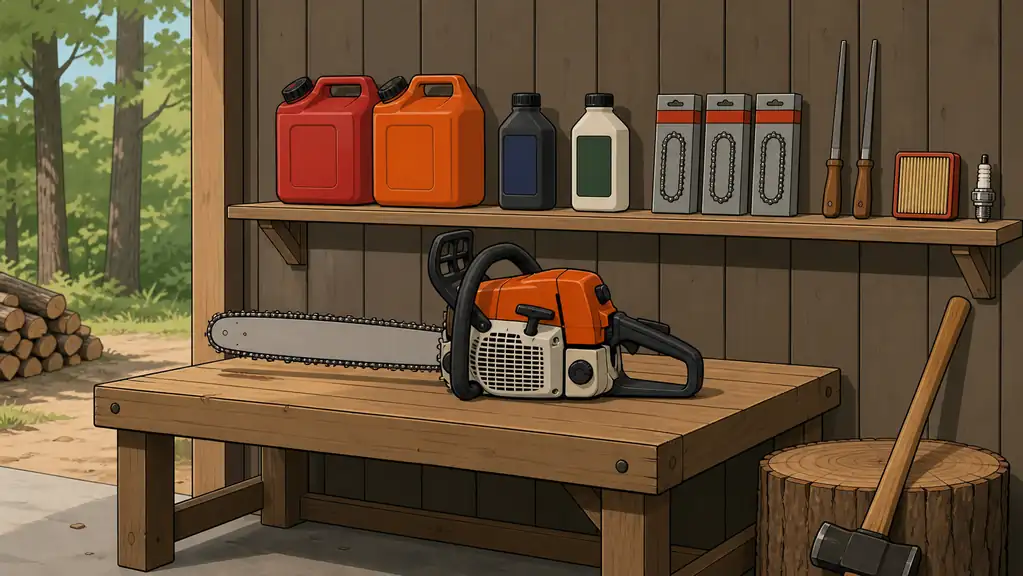
Most people buy the tool and check the box. Chainsaw: owned. Generator: owned. Repair category: handled. It’s a fine place to start and a terrible place to stop — because the tool is the cheapest, most permanent thing in the whole system. What actually decides whether it works on day 40 is the pile of stuff it consumes, and that pile is invisible on a shelf.
A chainsaw doesn’t run on being owned. It runs on fuel, two-stroke oil, bar-and-chain oil, sharp chains, and files to sharpen them. Run it hard and it eats every one of those on a clock. The saw is a one-time purchase. Everything else is a subscription — and in a grid-down winter, nobody’s taking your payment.
The tool is the noun; the consumables are the verb
Here’s the reframe that changes how you buy: a tool describes a capability, but a consumable describes how long that capability lasts. Owning a chainsaw means you can cut wood. Owning twelve gallons of mixed fuel, six spare chains, a gallon of bar oil, and a box of files means you can cut wood for a while. Only the second sentence is a plan.
Most plans stop with the “what” - deciding that wood is your backup heat for instance. You haven’t bought a heat plan — you’ve bought the front end of one. The plan is the saw plus the axes, the hand saws, the splitting wedges, the maul, and the fuel and oil and chains that keep the saw fed. Miss any of it and the whole plan stalls the first time a chain goes dull or the fuel can runs dry.
A tool tells you what you can do. Consumables tell you for how long. Only one of those is a preparation.
Count the wear items your other plans quietly assume
Every category on your list has consumables hiding inside it, and they never make it onto the shopping list because they’re not exciting:
- Wood heat — mixed fuel, bar oil, 2-stroke oil, spare chains, files, wedges.
- Generator / any small engine — gasoline, fuel stabilizer, engine oil, oil filters, air filters, spark plugs, carburetor rebuild parts.
- Water — filter cartridges, well-pump parts, gaskets, O-rings.
- Building envelope — plywood, tarps, screws, nails, sealant, roofing patch.
- Everything — fasteners, tape, adhesive, batteries, fuel of every kind.
Notice the pattern: the tools are durable and the consumables are perishable, and the perishable half is the part that decides whether you’re still operating next month. A generator with no oil filters and no stabilized fuel isn’t a power plan. It’s a heavy reminder of one.
Consumables have their own two enemies
Buying the consumables isn’t the end of it, because they don’t wait patiently. Two things quietly eat your stockpile before you ever use it:
- Time. Gasoline goes stale and gums a carburetor. Rubber gaskets and O-rings dry and crack. Adhesives and sealants cure in the tube. Batteries self-discharge. A consumable you bought three years ago and never rotated may already be dead.
- Rate. You have to know how fast you burn it. “Some fuel” is not a quantity. Gallons per day of running × days is. If you don’t know your burn rate, you don’t know whether you have a week of capability or a season of it — and the difference is the whole game.
This is why the honest way to stock consumables is the same math the rest of the framework runs on: quantity per use × uses × margin. Guess low and you’ve bought a tool that quits early. Guess with numbers and you’ve bought the actual plan.
Bottom Line
- Buy the consumables in the same breath as the tool. A saw with no oil and no spare chains is a third of a purchase. Finish it.
- Inventory the wear items your other plans assume — fuel, filters, gaskets, blades, fasteners. Every category hides some.
- Stock by burn rate, not by vibes. Quantity per use × uses × margin. “Some” is not a number.
- Rotate the perishables. Fuel, rubber, adhesives, and batteries die on the shelf. Put resupply and rotation on a cadence, not a hope.
The Repair inventory is built to track the boring half — fluids, filters, blades, fasteners — with the quantities and dates that decide whether your tools still work in year two.