


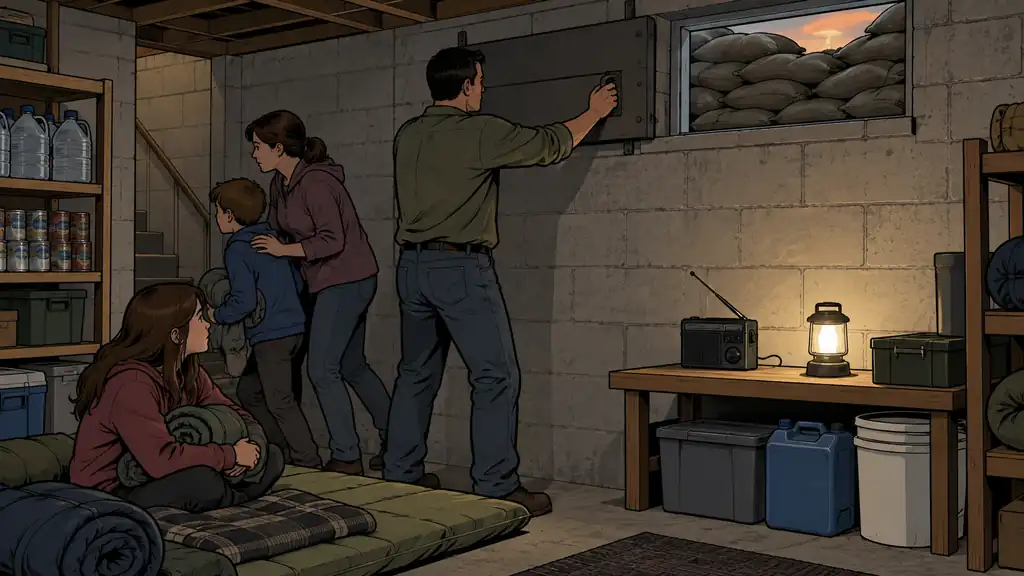
No threat carries a wider gap between how it feels and how likely it is than nuclear war. It’s the maximum-impact scenario — genuinely civilization-altering — and one of the least likely things on the list. On a 1-to-9 scale it’s a 9 for impact and a 2 for likelihood: the top of one scale, near the bottom of the other.
That combination breeds two bad reactions. One is paralysis — it’s hopeless, so why bother. The other is denial — it’s unthinkable, so ignore it. Both are wrong, and for the same reason: a detonation isn’t magic. It’s a set of physical effects that behave in known ways, and for the large majority of people — everyone outside the immediate blast — survival isn’t just possible, it’s likely if you know a handful of basics. The fear is the enemy here. The physics is manageable.
So you don’t build your prep life around this. You do learn the fundamentals, because when the impact is this high, even low odds are worth an afternoon of understanding.
Three hazards, not one
Here’s the reframe that does the work: a nuclear detonation isn’t one thing that happens to everyone the same way. It’s three separate hazards, each with its own answer, each reaching a different distance. Knowing which one you’d actually face is the whole game.
Blast. The pressure wave that flattens buildings near the detonation. It’s severe and lethal — and it’s limited. It does not cover a region. The answer is distance. If you’re outside it, this simply isn’t your problem; if you’re inside it, little short of not being there helps.
Heat and flash. A blinding flash of heat radiates out, causing burns and starting fires farther than the blast reaches. It moves at the speed of light, so the flash beats the pressure wave to you by a few seconds. The answer is instant cover: at the flash, get down behind something solid and off the window line before the wave arrives. The old “duck and cover” reflex gets mocked, but it’s physically sound at the right distances — it’s about putting mass between you and the flash and getting off the path of flying glass.
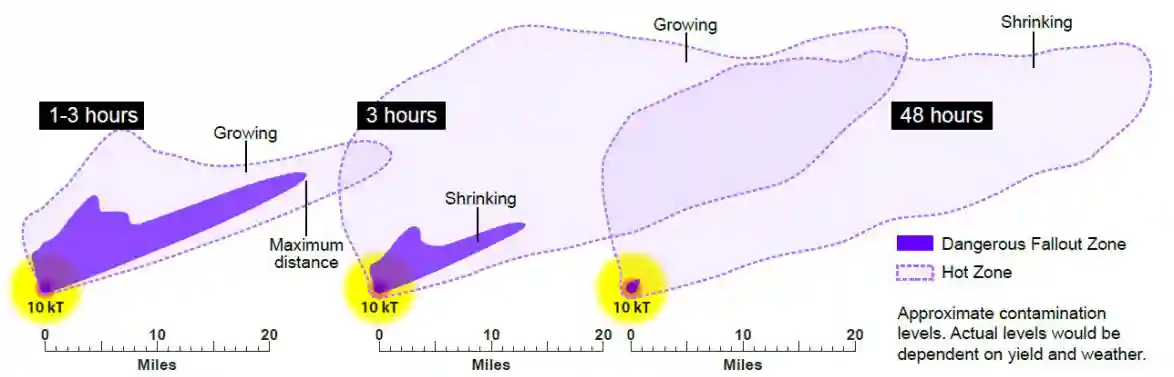
Fallout. This is the one that reaches the most people over the widest area — and, critically, the one you can most defeat. A surface detonation lofts irradiated debris that falls downwind, sometimes for many miles. It’s dangerous, but it has one saving property: it fades fast. The answer is shielding plus time — get mass between you and it, and stay put while it decays.
That’s the split. Blast is distance. Heat is instant cover. Fallout — the widest and most survivable — is mass and time. Most of what keeps people alive is the last one.
A grounded history
Nuclear weapons have been used in war exactly twice — Hiroshima on August 6, 1945 and Nagasaki on August 9, 1945 — and not once in the roughly eight decades since. The dead by the end of 1945 run to roughly 70,000–140,000 at Hiroshima and 40,000–70,000 at Nagasaki, from blast, burns, and radiation together; the exact numbers are unknowable because the cities’ records were destroyed with them. The Cold War brought the world near the brink more than once — the Cuban Missile Crisis of October 1962 the closest — and each time it stepped back.
Two things come out of that record. It’s a threat that’s been acutely dangerous for generations and has still never gone to a full exchange — which argues against inevitability. And the study of those two detonations and of weapons testing gave us a solid, public understanding of what these effects do and what protects people. That knowledge is what turns dread into a plan.
Why fallout is the survivable one — the two facts
Everything about fallout survival comes down to two physical facts. Get these and the plan writes itself.
Fallout fades fast. The rule of thumb civil-defense planners use — the “7:10 rule” — is that for every sevenfold jump in time, the dose rate drops about tenfold. So if you call the dose rate at 1 hour “full strength,” then at 7 hours it’s about 1/10 of that, at 49 hours (7 × 7) about 1/100, and by roughly two weeks about 1/1000. The stuff that’s lethal to stand in during the first hour is a small fraction of that a couple of days later. That’s why time is a countermeasure: you’re not waiting it out to feel safe, you’re waiting because the physics is literally draining the danger. It’s also why going outside early — when the field is at its worst — is the mistake that kills, and staying put is what saves.
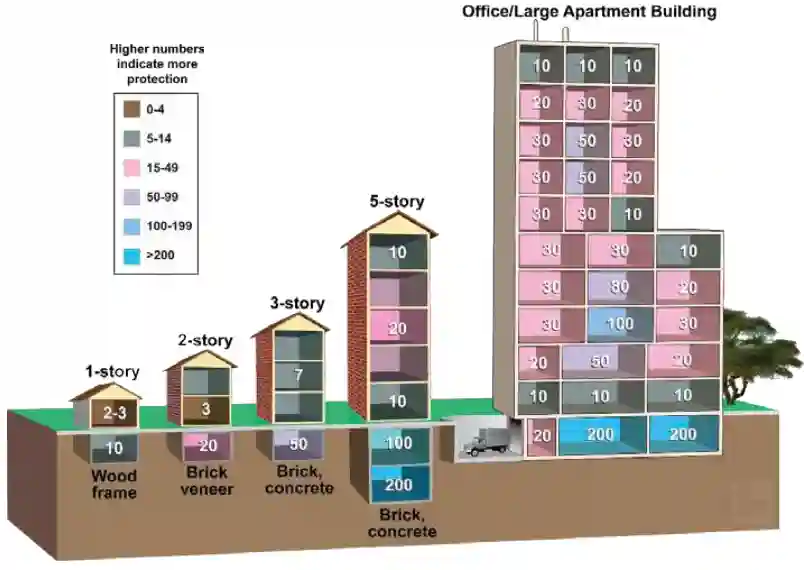
Mass blocks it, and it stacks. Radiation is cut down by dense material, and every layer halves it again. Each material has a “halving thickness” — the amount that cuts the dose in half: roughly 2.2 inches of concrete, 3.6 inches of packed earth, 0.7 inch of steel, or about 7 inches of water. Two halving thicknesses cut you to a quarter, ten cut you to about 1/1000. That’s why roughly 3 feet of packed earth gets you a protection factor near 1,000 — the outside dose divided by a thousand. A basement, with earth on the sides and a house on top, can get you a long way there. And you can improve it: stack dense stuff overhead and against the exposed walls and the number keeps climbing.
Put the two facts together and the fallout strategy is exact: get behind as much mass as you can, and stay there through the steep early part of the decay.
The common mistakes
- Believing it’s hopeless. The single most harmful error — it trades a survivable, knowable situation for fatalism, and fatalism gets people killed who’d have lived.
- Forgetting overhead. People shield the walls and leave the ceiling thin. In most homes, overhead is the weak axis — it’s where you need mass most.
- Coming out too early. The first hours are the worst hours. Cracking the shelter early, when the field is strongest, is the classic fatal move.
- Stocking KI as nuclear-war prep. Potassium iodide is a reactor-accident tool. For general fallout it does almost nothing, and misused it can hurt you (more below).
- Treating a 2/9 threat like a daily one. Pouring money and worry into this while skipping the far likelier stuff — the car wreck, the layoff, the storm — is its own kind of failure.
What preparedness looks like
You’re buying knowledge first, then a fallout-shelter capability — and the second overlaps almost entirely with general prepping.
1. Master the three basics: distance, shielding, time. Distance from both the detonation and the fallout. Shielding by mass, stacked. Time to let the decay do its work. That’s the whole survival logic in three words.
2. Find your most-shielded space now. Walk your home today. A basement is usually best — earth on the sides, structure overhead. Failing that, the center of the lowest floor, away from windows and outside walls, with as much material as you can get above and around you. You’re not building a bunker. You’re locating the best space you already have and knowing how to improve it fast — dense goods and water containers stacked overhead and against the walls.
3. Stock two weeks or more of shelter supplies. The plan is to live in that space while the radiation drops. Two weeks covers the sharpest part of the decay curve. For a family of four, that’s water at two gallons a person a day — eight gallons a day, ~112 gallons for two weeks — plus no-cook food, medications, sanitation, warmth, light, and the one item people forget: information. A battery or hand-crank radio is how you learn when it’s actually safe to come out. This is the standard deep-prep kit, pointed at a two-week shelter-in-place.
4. Handle KI correctly — meaning, usually, not at all. Potassium iodide floods the thyroid so it can’t take up radioactive iodine. Per the FDA, taken within 1–2 hours of exposure it blocks more than 90% of radioiodine uptake, but it protects for only about 24 hours, only the thyroid, only against radioiodine — and it’s really a reactor-accident measure. It does nothing against the broad fallout field, and misused it carries real risk. Keep it only if you live near a reactor and understand its narrow use. For most people it’s a distraction from the mass and the time, which are what actually keep you alive.
Bottom Line
- 9 impact, 2 likelihood. Understand it thoroughly, worry about it lightly, and keep the proportion honest — the attention belongs on likelier threats.
- Three hazards, not one — blast (limited, answered by distance), heat (answered by instant cover), and fallout (widest reach, answered by mass and time).
- Fallout is the survivable one. It fades fast (7:10 rule) and mass blocks it (each halving thickness cuts it again) — that’s not hope, it’s physics.
- Find your most-shielded space and stock two weeks — including a radio for information. It overlaps entirely with general prepping, so none of it is wasted.
- KI is a reactor measure, not nuclear-war prep — keep it only if you’re reactor-adjacent and informed; misuse harms.
Trade the fear for three facts — distance, shielding, time. Fallout fades fast and mass blocks it, and that’s the difference between a hopeless catastrophe and one most people already know how to survive.
Model a nuclear blast using the Nuclear Detonation Simulator and estimate your fallout shielding protection using the Fallout Shielding tool